
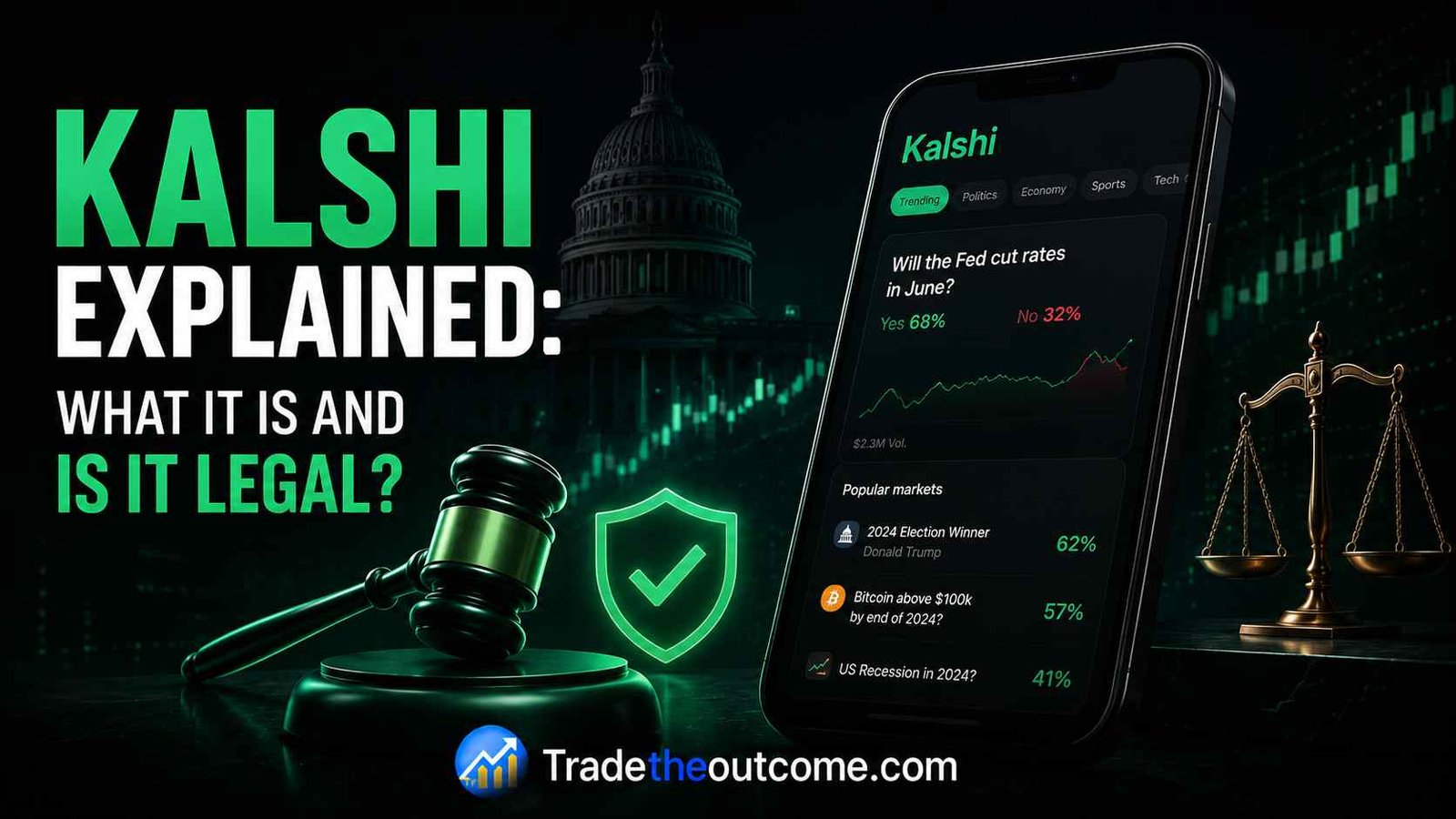
Kalshi is a federally regulated prediction market exchange where US residents trade yes/no contracts on real-world event outcomes. Each contract pays $1.00 if correct and $0 if not, with prices reflecting market-implied probability. The Commodity Futures Trading Commission granted Kalshi a Designated Contract Market license in November 2020, making it the first federally regulated US event-contract exchange.
As of mid-2026, Kalshi has grown from a niche regulatory experiment into one of the most closely watched financial platforms in the United States. The company raised more than $1 billion in a May 2026 Series F led by Coatue Management, valuing it at $22 billion, double its worth from just five months prior, as TechCrunch reported. That growth reflects both the mainstream appetite for prediction markets and an active legal battle with state regulators across more than a dozen US states over the status of its sports contracts.
The central friction is this: Kalshi holds the strongest federal regulatory standing of any US prediction market, yet state attorneys general in Nevada, Arizona, Ohio, and elsewhere have filed lawsuits and, in Arizona’s case, criminal charges, arguing its sports contracts are unregulated gambling that belongs under state gaming law. Federal law and state law are squarely at odds, and appellate courts are currently resolving the conflict.
Key Takeaways
Here is what you need to know about Kalshi before trading.
- Kalshi is the only CFTC-licensed Designated Contract Market for event contracts in the US, giving it stronger federal legal standing than any competing prediction market platform.
- Every contract is a binary yes/no position that pays $1.00 if you are right and zero if you are wrong, with contract prices reflecting the market’s implied probability for that outcome.
- Sports contracts are restricted or blocked in approximately eight states as of July 2026, including Nevada (court-ordered ban), Arizona, Ohio, Massachusetts, and Michigan, due to state-level enforcement actions. Political, economic, and cultural markets are broadly available in all 50 states.
- The minimum trading age is 18, three years lower than most US sportsbooks, because Kalshi operates as a CFTC-regulated derivatives exchange rather than a state-licensed gambling operator.
- Kalshi is privately held at a roughly $22 billion valuation. No public shares exist, and an IPO has been discussed informally for 2027 to 2028 but has not been confirmed.
What is Kalshi?
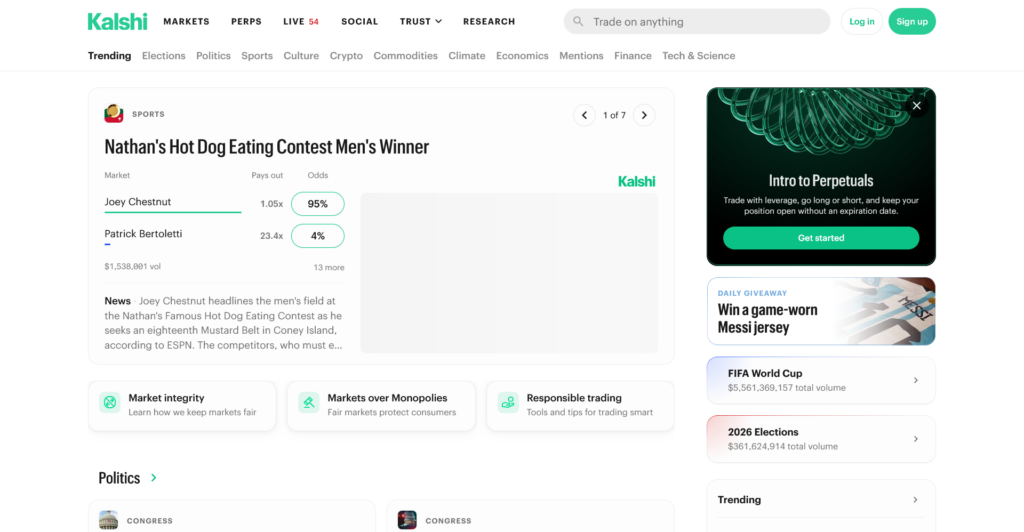
Kalshi, formerly KalshiEX LLC, is a prediction market exchange based in New York that operates under the same federal regulatory framework as traditional futures exchanges. Users do not place bets against a house; they trade contracts against other users on a live order book, with prices set entirely by market supply and demand.
The platform launched publicly in July 2021 after the CFTC issued its Designated Contract Market order in November 2020 under Section 5 of the Commodity Exchange Act, the same statute that governs established exchanges like the CME Group.
The Kalshi app, available on iOS, Android, and desktop at kalshi.com, surfaces markets across sports, politics, economics, entertainment, crypto, climate, and more. Each market is framed as a question with a defined resolution rule: an objectively verifiable source, such as a CPI release, a court ruling, or a final game score, determines whether a contract settles yes or no. Unlike sportsbooks, Kalshi cannot set or manipulate the odds; prices emerge from the aggregate trades of all users on the order book in real time.
How does Kalshi work?
Trading on Kalshi starts with selecting a market and choosing a side. If you buy a YES contract priced at $0.65, you are paying 65 cents for a position that pays $1.00 if the event happens, locking in a 35-cent profit per contract if you are right.
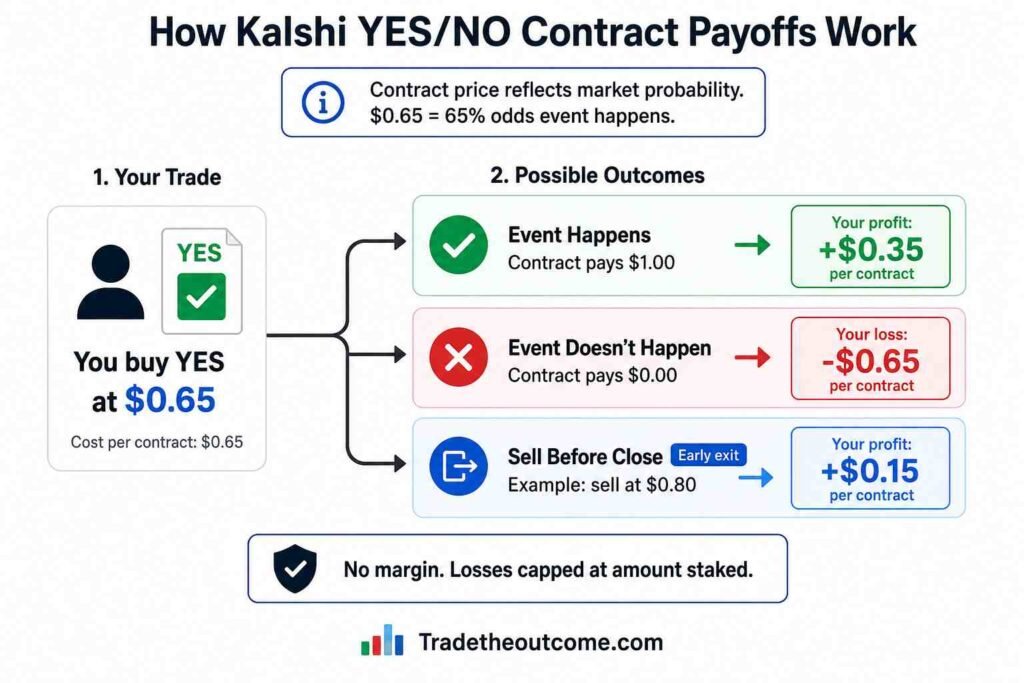
If the event does not happen, the contract settles at zero, and you lose the 65 cents you paid. The contract price at any moment reflects the collective market estimate of the probability of that outcome, so a contract at $0.65 means the market currently assigns a 65% probability to it.
Prices update continuously as new information enters the market and traders take or exit positions. You can sell your contracts before the market closes to lock in a gain or cut a loss rather than waiting for final settlement.
When you open a trade ticket, Kalshi shows the fee for that specific order before you confirm by clicking the “i” icon next to the “You’re buying” field, so there is no surprise on cost. The range of available contract structures, from single-game outcomes to multi-month economic indicators, is covered in our guide to every Kalshi contract type.
Who owns Kalshi?
Tarek Mansour and Luana Lopes Lara co-founded Kalshi in 2018. Mansour, who serves as CEO, previously worked at Goldman Sachs, Palantir Technologies, and Citadel Securities. Lopes Lara, the company’s Chief Operating Officer, came from Bridgewater Associates and Citadel before co-founding the company. Both are MIT graduates.
The founding premise was that Wall Street had long been trading on opinions about future events through derivatives, yet there was no regulated venue for ordinary people to express those same views directly.
Through five funding rounds between June 2025 and May 2026, Kalshi raised a cumulative $2.685 billion, according to DeFiLlama data. The most recent was a Series F in May 2026, led by Coatue Management with participation from Sequoia Capital, Andreessen Horowitz, Paradigm, Morgan Stanley, and ARK Invest, which valued Kalshi at $22 billion, as TechCrunch reported.
That valuation was double the $11 billion Kalshi was worth just five months earlier after its December 2025 Series E, and reflects annualized revenue that the company stated exceeded $1.5 billion at the time of the raise.
Is Kalshi legit? Is it gambling?
Kalshi’s legitimacy as a regulated financial platform is well-established at the federal level. Its CFTC Designated Contract Market status requires user funds to be segregated from the company’s operating capital, mandates transparent settlement rules set in advance, and subjects the exchange to ongoing market surveillance under CFTC oversight.
A 2024 federal district court ruling confirmed that Kalshi’s event contracts, including election markets, do not constitute unlawful gaming under federal law. For a full breakdown of the platform’s safety record, fund protection, and user rights in specific situations such as account disputes and frozen balances, the guide on whether Kalshi is legit covers each dimension in detail.
The gambling question is legally unsettled at the state level, specifically for sports contracts. Kalshi’s core argument is that its contracts are financial derivatives because users trade against each other on a regulated order book rather than placing wagers against a bookmaker with fixed odds.
Several state attorneys general disagree, arguing that betting on a sporting event is gambling regardless of the regulatory wrapper around it. Courts have split on the question: the Third Circuit Court of Appeals sided with Kalshi in April 2026, while Ohio and Nevada district courts have ruled in favor of state regulators. That split is likely headed toward the Supreme Court.
How does Kalshi make money?
Kalshi earns revenue through transaction fees charged on every executed trade, as explained in Kalshi’s official help center. The fee formula is 7% x price x (1 – price), rounded up to the nearest cent. Because the formula multiplies the price by its complement, fees peak at contracts priced near $0.50 (roughly 1.75 cents per contract) and fall sharply toward zero at extreme prices like $0.05 or $0.95.
Maker orders (limit orders that sit on the book waiting to be matched) pay approximately a quarter of the taker rate, making patience a meaningful cost lever for active traders. ACH deposits and withdrawals carry no fees; debit card transactions add a 2% processing charge. For a direct cost comparison with Polymarket, including which platform costs less across different trade scenarios, see our Kalshi vs Polymarket fee breakdown.
Trading fees are Kalshi’s primary but not its only revenue source. The platform has signed data licensing deals with CNN and CNBC to integrate live prediction market odds into broadcasts, holds a partnership with the NHL, and processes trades for Robinhood users through an integration that reportedly routes more than 50% of Kalshi’s total trading volume through the exchange.
Kalshi does not take any financial position in market outcomes; its revenue is entirely transactional, which structurally aligns the exchange’s incentives with providing a fair marketplace rather than with any particular outcome.
Is Kalshi legal? State-by-state breakdown
Kalshi is federally legal in the United States. The CFTC’s November 2020 Designated Contract Market order places Kalshi’s contracts within federal derivatives regulation rather than state gambling law.
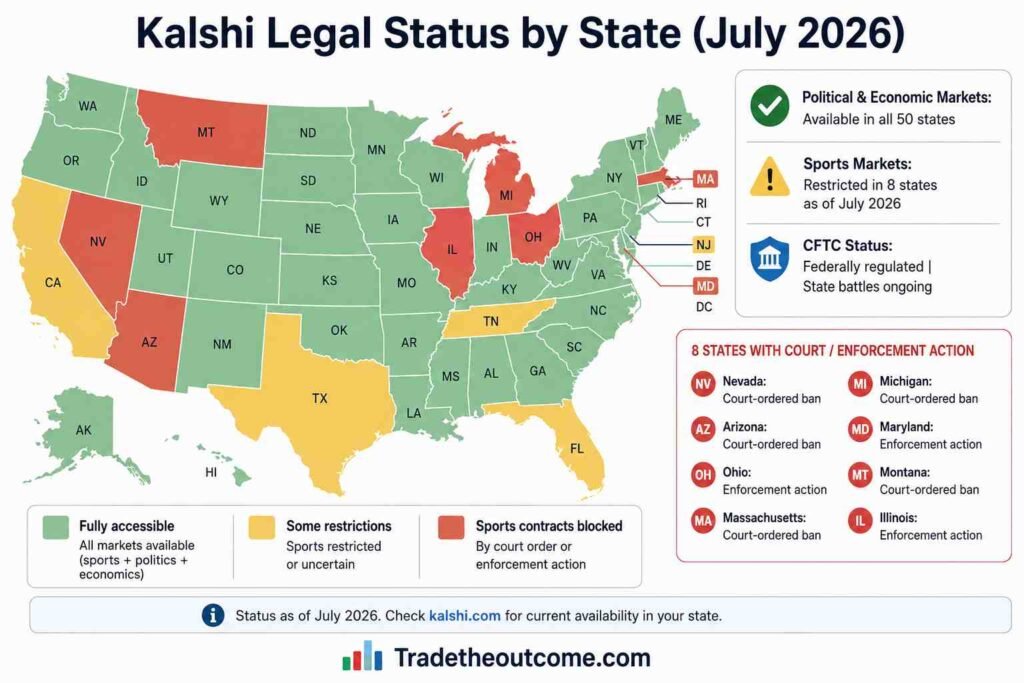
Kalshi argues, and the CFTC actively affirms, that the Commodity Exchange Act preempts state gaming statutes for contracts listed on a licensed DCM. The platform is accessible to US residents across all states as a starting principle; the practical question is which market categories are available in a given state.
Sports event contracts are the specific category state regulators have targeted. Political, economic, weather, cultural, and crypto markets have drawn no meaningful state enforcement actions, and users across all 50 states can generally access those categories without restriction. Sports contracts are where the legal conflict is concentrated, producing a rapidly shifting map of state-level access.
The table below reflects publicly reported enforcement status as of July 2026 and is not legal advice; check kalshi.com directly for current availability in your state, as court rulings can change access within weeks.
| State | Status (July 2026) | Sports Contracts | Notes |
|---|---|---|---|
| Nevada | Restricted | Blocked (court order) | Preliminary injunction in effect; Ninth Circuit hearing pending |
| Arizona | Restricted | Blocked (enforcement) | 20 criminal misdemeanor charges filed March 2026; CFTC obtained restraining order blocking state action |
| Ohio | Restricted | Blocked (court ruling) | Federal court ruled Kalshi products are gambling under state law; Kalshi appealing |
| Massachusetts | Restricted | Blocked (court order) | January 2026 court order blocking sports contracts; CFTC filed suit against state |
| Michigan | Restricted | Restricted | Active enforcement action ongoing |
| Maryland | Restricted | Restricted | Active enforcement action ongoing |
| Montana | Restricted | Restricted | Sports contracts blocked under state rules |
| Illinois | Restricted | Restricted | CFTC filed suit against state asserting federal preemption |
| New Jersey | Accessible | Available | Third Circuit Court of Appeals ruled in Kalshi’s favor, April 2026 |
| Tennessee | Accessible | Available | Federal court sided with Kalshi; positive injunctive ruling |
| California | Accessible | Available | No state enforcement action; gaming tribes have lobbied for restrictions but no ruling issued. See our California guide |
| Texas | Accessible | Available | No enforcement action; traditional gambling prohibited but Kalshi operates under federal law. See our Texas guide |
| Alabama, Florida, Georgia, Colorado, and most other states | Accessible | Available | No enforcement action filed as of July 2026 |
The CFTC has responded to state enforcement efforts by filing its own lawsuits against Arizona, Connecticut, Illinois, Massachusetts, and other states, asserting its exclusive jurisdiction over prediction market contracts.
The most consequential pending decision is the Ninth Circuit Court of Appeals’ review of Nevada’s case; if the Ninth Circuit rules against Kalshi, it creates a direct circuit split with the Third Circuit’s April 2026 ruling in Kalshi’s favor, likely forcing Supreme Court review.
For a practical walkthrough of using the platform today, including current state access details, see our guide to how to use Kalshi in the US.
Age requirements and eligibility to use Kalshi
Kalshi requires all users to be at least 18 years old and to be US residents. The 18-year minimum is set by the CFTC’s framework for derivatives exchanges, which aligns with the federal financial age of majority rather than the 21-year threshold used by most state-licensed sportsbooks.
Identity verification under Know Your Customer rules is mandatory before trading: Kalshi requires a government-issued photo ID (driver’s license, passport, or state ID) and personal information including a partial Social Security number.
The age distinction is practically significant for users between 18 and 20. Most traditional sportsbooks, casinos, and daily fantasy platforms require users to be 21 under state gambling law. Kalshi’s 18-year minimum allows that age group to trade legally on sports outcomes in states where Kalshi is accessible.
As Axios reported in May 2026, this has drawn legislative attention, with some lawmakers and sports leagues calling for the minimum to be raised to 21 to match sportsbooks, a change Kalshi’s CEO Tarek Mansour has publicly opposed because financial trading regulation should not mirror gambling law.
How old do you have to be to use Kalshi?
You must be at least 18 years old. Kalshi enforces this through mandatory KYC verification at signup, and there is no exception for parental consent or custodial accounts. In states where the age of majority is 21 for certain purposes, Kalshi requires users to meet the higher threshold.
Kalshi added facial recognition verification in 2026 as part of updated consumer protection measures, making it significantly harder to use another person’s account credentials to bypass the age check.
How many markets are there on Kalshi?
Kalshi does not publish a real-time count of active contracts, but as of 2026 the platform spans 14 broad categories: Sports, Politics, Economics, Entertainment, Crypto, Climate, Companies, Financials, Technology, Science, Weather, Transportation, Mentions, and Social.
Each category contains dozens of individual markets with expiration dates ranging from minutes (short-form crypto price contracts) to over a year into the future. The catalog has expanded significantly since the 2021 launch, driven by the addition of sports contracts in 2024 and a broader market expansion throughout 2025.
Funding your Kalshi account
Kalshi supports ACH bank transfers (free, one to three business days to clear), wire transfers (bank fees vary), debit cards (2% processing fee), Apple Pay, PayPal, Venmo, Cash App Pay, and crypto through a third-party payment processor.
ACH is the practical default for most traders: no fee on deposit, no fee on withdrawal, and the only method where both directions are completely free. For the mechanics of Apple Pay specifically, including whether deposits and withdrawals carry the same 2% fee or differ, see the full breakdown of Kalshi Apple Pay deposits and withdrawals.
Bank declines are more common on Kalshi than on traditional brokerage accounts because many banks flag prediction market transactions as high-risk under their internal fraud detection rules. This is not a Kalshi policy; it is each bank’s fraud filter treating an unfamiliar merchant category.
If your Bank of America debit card or ACH transfer to Kalshi is being blocked, the specific step-by-step process for allowing Kalshi through Bank of America’s fraud filters covers exactly which settings to change. Users with other banks running into declined transactions will find troubleshooting steps in the guide on Kalshi card declined errors and fixes.
New accounts typically face a withdrawal hold of three to 30 days, depending on funding method and account history, which is standard practice for a CFTC-regulated derivatives exchange and not a sign that funds are at risk. If you are concerned about when winnings and deposits actually reach your bank, the guide on how long Kalshi takes to pay out covers realistic timelines under different account and funding conditions.
Is Kalshi publicly traded?
No. Kalshi is privately held, and no public shares exist. The most recent known valuation is approximately $22 billion following the May 2026 Series F. That number represents roughly a tenfold increase from the $2 billion valuation the company held in June 2025 when it closed its $185 million Series C, reflecting the explosive growth in prediction market volume over those 12 months. Kalshi has not filed an S-1 registration statement, named underwriters, or disclosed a target price range.
As of mid-2026, Kalshi has begun informal discussions with investment banks about a potential initial public offering, according to reporting from Cryptopolitan citing people familiar with the company’s finances.
The earliest a public listing is expected is late 2027 or early 2028. Investors seeking exposure to the prediction market sector today can look at publicly traded adjacent companies including CME Group, Robinhood, DraftKings, and Flutter Entertainment, none of which are pure-play prediction market businesses, but each of which has meaningful exposure to event-based trading volume.
What this means before your first trade
Kalshi offers something genuinely new in US markets: federally regulated access to opinion-based financial contracts that were previously available only to institutions, offshore platforms, or sophisticated derivatives traders.
The regulatory foundation is solid, liquidity has grown substantially with institutional participation now representing the majority of volume, and the fee structure is competitive with most alternatives. The meaningful risk for individual users is not platform legitimacy but state-level access volatility: sports contracts can be restricted in your state with court-ordered speed, and the legal map is changing month to month.
The practical move before funding an account is to confirm which market categories are available in your state, start with ACH to avoid the 2% debit card fee, and understand that the withdrawal hold on new accounts is a regulatory feature of CFTC-regulated exchanges, not a red flag. For a look at how Kalshi compares to Polymarket on trading volume and order book liquidity before you decide which platform to use, our Polymarket vs Kalshi liquidity and volume deep dive puts both platforms side by side across the metrics that matter most to active traders.
Frequently Asked Questions
These are the most common questions readers have about Kalshi’s legal status, safety, and how it differs from traditional sports betting.
Is Kalshi considered gambling?
Federally, no. The CFTC classifies Kalshi’s contracts as regulated derivatives, and a 2024 federal court ruling confirmed they do not constitute unlawful gaming under federal law. Several state regulators, particularly in Nevada, Ohio, and Arizona, have argued the opposite for sports-specific contracts, and courts are currently split on the question. The classification has real tax implications: gambling winnings and derivatives gains are treated differently by the IRS, which has not yet issued formal guidance on prediction market earnings.
Is Kalshi safe to use?
Kalshi’s CFTC regulation requires it to segregate user funds from the company’s operating capital, so your balance is not at risk if Kalshi faces financial difficulty. Trading itself carries inherent risk: contracts settle at $1 or $0, and you can lose your entire stake if your prediction is wrong. Kalshi does not offer margin trading, so losses are capped at the amount you deposit and stake, not a loss multiplied by margin. For a closer look at specific scenarios where funds could be held or frozen, and what your rights are in each case, the dedicated guide on whether Kalshi can freeze your funds covers the conditions in detail.
Can I use Kalshi in a state where sports betting is illegal?
In most cases, yes. Kalshi operates under CFTC federal jurisdiction rather than state gambling law, which is why it is available in California, Texas, and Florida, where traditional sports betting is not legal. Sports contracts are specifically restricted only in states with active court orders or enforcement actions: as of July 2026, those states include Nevada, Arizona, Ohio, Massachusetts, Michigan, Maryland, Montana, and Illinois. Political, economic, and cultural markets are broadly accessible across all 50 states regardless of local gambling laws.
Does Kalshi issue tax forms for earnings?
As of 2026, Kalshi does not issue 1099-B forms for event contract trades, and the IRS has not issued formal guidance classifying prediction market earnings as ordinary income or Section 1256 contract gains. Most tax professionals currently recommend treating gains as ordinary income until the IRS provides clarity. Users should keep their own trade records and consult a tax professional, as the classification difference between gambling income and derivatives gains affects how losses and deductions are handled.
