
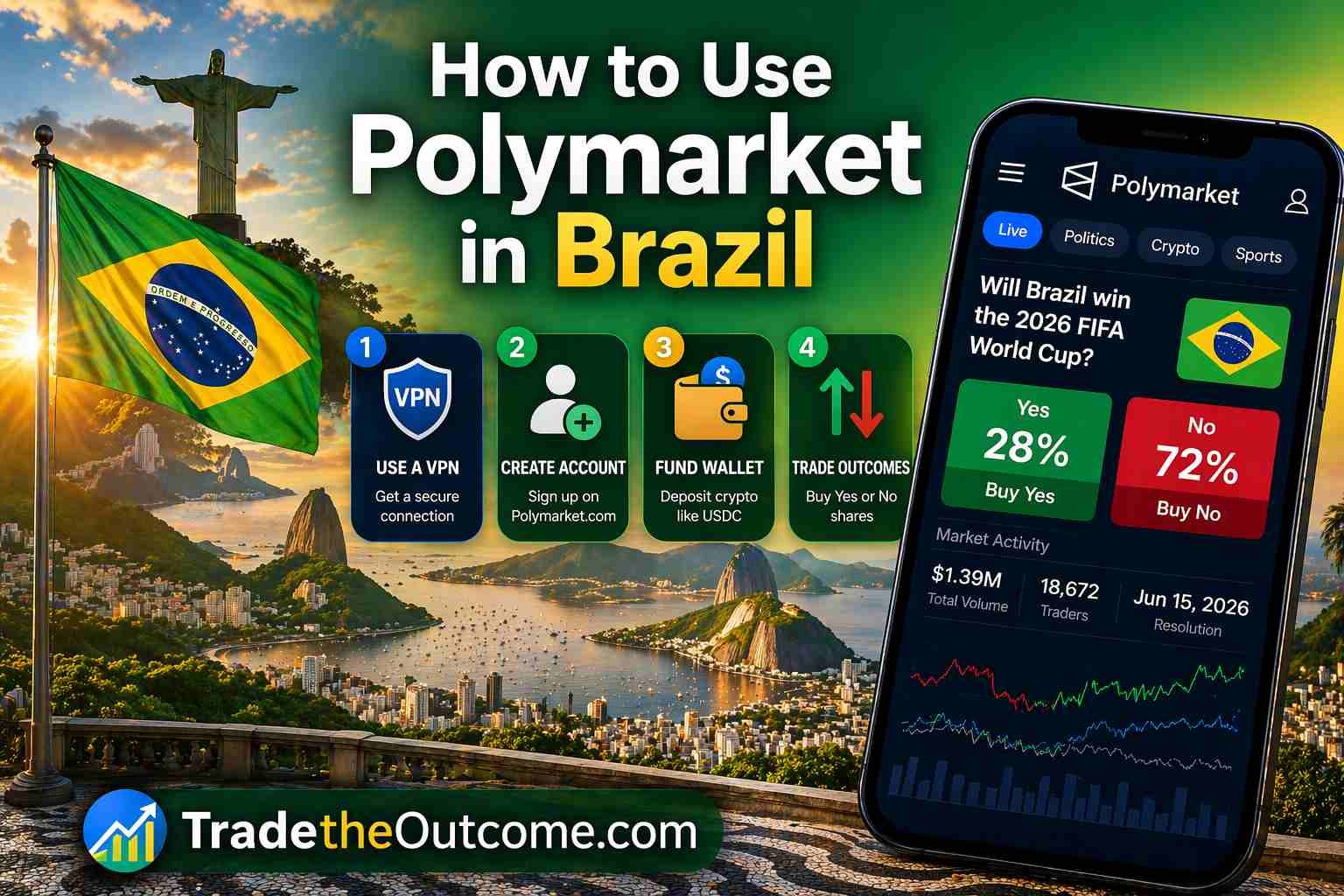
Polymarket is technically accessible in Brazil without a VPN, but the platform operates in an increasingly contested regulatory space.
In March 2026, Brazil’s Secretariat for Prizes and Betting (SPA) officially confirmed that no company is currently authorised to operate prediction markets in Brazil, and the licensed betting sector has formally requested that Polymarket and Kalshi be blocked.
The regulatory situation is moving quickly, and Brazilian users should understand the full picture before depositing funds.
This guide covers everything you need to get started on Polymarket as a Brazilian resident alongside a clear breakdown of the current legal and regulatory environment. If you are new to prediction markets entirely, read our overview of what Polymarket is before following the steps below.
- Polymarket is not currently geo-blocked in Brazil as of April 2026, Brazilian IP addresses can access the platform directly.
- The SPA officially stated in March 2026 that no prediction market platform is authorised to operate in Brazil.
- Brazil’s licensed betting industry has formally requested the SPA block Polymarket and Kalshi.
- Brazil’s CVM authorised B3 to launch regulated prediction markets for professional investors in February 2026, a separate but related development.
- USDC transactions are now classified as foreign exchange operations under the Banco Central do Brasil’s new crypto framework.
- You need a crypto wallet funded with USDC on the Polygon network to trade on Polymarket
Brazil’s Regulatory Landscape for Prediction Markets
Brazil’s regulatory picture for prediction markets in 2026 is unusually complex, the country is simultaneously moving to legalise structured prediction contracts under securities law while its gambling regulator has declared existing foreign platforms like Polymarket unauthorised. Understanding which regulator has jurisdiction over what is essential for assessing your real risk as a Brazilian user.
In February 2026, the Comissão de Valores Mobiliários (CVM), Brazil’s securities regulator, authorised B3, the Brazilian stock exchange, to launch binary event-based derivatives initially aimed at professional investors.
This confirmed that certain prediction contracts can be classified as financial derivatives rather than gambling products under Brazilian law.
However, this framework applies only to CVM-regulated instruments on licensed Brazilian exchanges, not to foreign platforms like Polymarket operating without authorisation.
The SPA’s March 2026 Position
On March 9, 2026, the Secretaria de Prêmios e Apostas (SPA), Brazil’s gambling watchdog under the Ministry of Finance, issued an official notice confirming that no company is authorised to operate prediction markets under Brazil’s betting regulatory framework.
The SPA stated it is conducting technical studies on how prediction markets should be classified and which regulator, the SPA or the CVM, holds supervisory jurisdiction.
As Bitcoin.com News reported in March 2026, Brazil’s licensed betting companies, who each paid over R$30 million for operating licences, formally requested that the SPA block Polymarket and Kalshi for operating without authorisation and paying no licence fees.
The Finance Ministry’s Studies
Brazil’s Ministry of Finance confirmed in March 2026 that it is conducting preliminary studies on prediction markets as part of a wider regulatory review.
The announcement came alongside the disclosure of a partnership between Brazilian brokerage XP and U.S.-based Kalshi to offer prediction contracts linked to Brazilian economic indicators, as reported by Yogonet.
This signals that Brazil’s regulatory framework for prediction markets is actively evolving, but no final classification or licensing pathway for foreign platforms exists yet.
Brazil’s New Crypto Regulatory Framework
Brazil’s crypto regulatory environment changed significantly in early 2026. The Banco Central do Brasil (BCB) published four new resolutions, Resolutions 517, 519, 520, and 521, establishing the country’s first comprehensive regulatory framework for virtual asset service providers (VASPs).
These rules took effect in February 2026 and require all crypto exchanges operating in Brazil to become licensed VASPs with minimum capital requirements of R$10.8 million to R$37.2 million depending on their activity type.
Critically for Polymarket users, stablecoin transactions including USDC are now classified as foreign exchange operations under the new BCB framework. This means deposits and withdrawals involving USDC carry foreign exchange reporting requirements under Brazilian law.
Polymarket holds no BCB VASP licence and is not subject to BCB supervision, meaning Brazilian users interacting with it fall outside the protections of the regulated framework entirely.
What You Need Before You Start
The practical onboarding process for Brazilian users is the same as anywhere else. Polymarket runs exclusively on the Polygon blockchain and accepts only USDC as its trading currency. Make sure the following are in place before you visit the platform.
- A crypto wallet: MetaMask (browser extension or mobile) is the most compatible option for Polymarket.
- USDC on Polygon: The only accepted currency, always withdraw on the Polygon network, never Ethereum or BEP-20.
- A government-issued ID: Brazilian CPF and RG or passport for KYC verification.
- A crypto exchange account: Mercado Bitcoin, Binance Brazil, and Coinbase are all accessible to Brazilian residents and support USDC.
- A desktop browser or smartphone: Polymarket works on both, the mobile app offers a smoother onboarding experience
How to Use Polymarket in Brazil: Step by Step
Follow these steps carefully. The most common mistake Brazilian users make is sending USDC over the wrong blockchain network, which results in inaccessible funds with no recovery pathway through a local regulator.
Step 1: Set Up MetaMask and Switch to Polygon
Download MetaMask as a browser extension for Chrome or Firefox, or install the mobile app. Create a new wallet and write your 12-word seed phrase on paper, store it securely offline and never digitally.
Once your wallet is created, switch the network from Ethereum Mainnet to Polygon using the network selector. All Polymarket transactions occur on Polygon, and USDC sent over any other network will not appear in your account.
Step 2: Purchase and Transfer USDC
Log into your preferred exchange, Binance Brazil, Mercado Bitcoin, or Coinbase are the most commonly used by Brazilian residents. Purchase USDC and when withdrawing to MetaMask, select Polygon (MATIC network) as the withdrawal chain.
Double-check your MetaMask wallet address before confirming. Under Brazil’s new BCB framework, this USDC transfer may constitute a reportable foreign exchange transaction, so keep records of all movements for tax purposes.
Step 3: Create Your Polymarket Account
Visit polymarket.com and click “Sign Up.” You can register with an email address or connect directly with your MetaMask wallet, connecting your wallet directly is the faster option as it links your funds instantly without a separate deposit step. Brazil is not currently on Polymarket’s official geo-block list, so the platform loads normally from Brazilian IP addresses as of April 2026.
Step 4: Complete KYC Verification
Polymarket requires identity verification to unlock full withdrawal access. The KYC process involves uploading a government-issued ID (Brazilian passport or RG with CPF) and completing a facial recognition scan. Approval typically takes between a few minutes and a few hours. Complete KYC early, unverified accounts face withdrawal restrictions that can delay access to your funds significantly.
Step 5: Browse Markets and Place Your First Trade
Once your wallet is connected and funded, your USDC balance appears on the Polymarket dashboard. Browse open markets by category, politics, economics, crypto, and sports are the most active.
Select a market, choose a Yes or No position, enter your stake, and confirm the transaction in MetaMask. Review the trading fees and withdrawal options before depositing, and use our Polymarket payout calculator to model your returns before committing funds.
Tax Obligations for Brazilian Traders
Brazil’s Receita Federal (Brazilian Federal Revenue Service) taxes crypto asset gains as capital income. Profits from trading on Polymarket are subject to a 15% to 22.5% progressive capital gains tax depending on total monthly gains.
Gains up to R$35,000 per month are exempt, but anything above that threshold is taxable. Brazilian residents must report crypto holdings and transactions in their annual income tax declaration (DIRPF) and on monthly GCAP forms when gains exceed the exemption threshold.
Under the BCB’s new USDC classification as a foreign exchange operation, additional reporting obligations may apply to USDC deposits and withdrawals. Consulting a Brazilian tax advisor familiar with crypto assets is strongly recommended for anyone trading at regular or significant volume on Polymarket.
Risks Brazilian Traders Should Know
Brazil’s regulatory situation for Polymarket is the most actively evolving of any major Latin American market right now.
The combination of a formal unauthorised status declaration, an active blocking request from the licensed betting industry, and a rapidly tightening crypto framework makes this higher-risk than a straightforward grey area.
Understanding whether Polymarket can freeze your funds is essential reading alongside these macro-level risks.
- Blocking risk: The SPA has received a formal request to block Polymarket, a decision could come at any time without advance notice to users.
- Unauthorised operator status: The SPA has confirmed Polymarket has no authorisation to operate in Brazil, creating legal exposure for users if enforcement escalates.
- No BCB or CVM protection: Polymarket is not supervised by any Brazilian financial regulator, so no consumer protection laws apply to your account.
- USDC forex reporting: Stablecoin transactions now carry foreign exchange reporting requirements under BCB Resolution 521.
- Regional precedent: Argentina’s courts ordered a nationwide Polymarket block in March 2026, a comparable move in Brazil is not inconceivable given the active regulatory debate.
- Tax compliance: All gains and holdings must be declared to Receita Federal regardless of the platform’s regulatory grey area status
Trading Smarter on Polymarket
Once your account is active, consistent results depend on approaching markets with discipline rather than speculation. A structured Polymarket trading strategy focuses on identifying markets where crowd-implied probabilities diverge from publicly available data.
For a broader view of how prediction markets are evolving globally, including in Latin America, our prediction markets data and trends report provides essential context. If you want to compare Polymarket against competitors before committing, our breakdown of Polymarket vs Kalshi vs PredictIt covers market availability, fees, and regulatory standing across all three platforms.
Frequently Asked Questions
Is Polymarket accessible in Brazil without a VPN in 2026?
Yes. Polymarket is not currently geo-blocked in Brazil and can be accessed directly from Brazilian IP addresses without a VPN. However, the SPA declared in March 2026 that no prediction market platform is authorised to operate in Brazil, and a formal blocking request has been submitted by the licensed betting industry. Access could be restricted with no advance warning to users.
Is Polymarket legal in Brazil?
Polymarket operates in an unauthorised grey area in Brazil. The SPA confirmed in March 2026 that no company holds authorisation to operate prediction markets under Brazil’s betting regulatory framework. The platform is not formally illegal for individual users at this stage, but it holds no SPA licence, no BCB VASP licence, and no CVM registration. The regulatory situation is under active review by the Ministry of Finance.
How do I buy USDC in Brazil to use on Polymarket?
Brazilian residents can purchase USDC through Binance Brazil, Mercado Bitcoin, or Coinbase using BRL. When withdrawing to MetaMask, always select the Polygon network as the withdrawal chain. Under Brazil’s new BCB framework, USDC transactions are classified as foreign exchange operations and should be tracked carefully for tax and reporting purposes.
Do I need to pay tax on Polymarket winnings in Brazil?
Yes. Brazil’s Receita Federal taxes crypto gains as capital income at 15% to 22.5% depending on total monthly profits. Gains under R$35,000 per month are exempt. Brazilian residents must declare crypto holdings and gains in their annual DIRPF tax return and file monthly GCAP reports when gains exceed the exemption threshold. Consulting a local tax advisor familiar with crypto is recommended for regular traders.
