


Will the UK’s embattled Prime Minister survive the year, or is his government on borrowed time? Polymarket traders are betting heavily on an early exit, with December 31 shares trading at 72¢, signaling a strong consensus that Keir Starmer will cease to be Prime Minister before 2027.
As of February 10, 2026, the market shows December 31, 2026 “Yes” shares at 72¢ (72% implied probability), June 30 at 58¢, March 31 at 42¢, and the imminent February 28 deadline at just 16¢, with total market volume reaching $4.35 million.
These odds have surged dramatically in recent days, with February 28 odds doubling from 8% to 16% and March 31 nearly doubling from 22% to 42% following a major leadership crisis that erupted on February 9.
The sharp spike reflects an attempted leadership coup, with Scottish Labour leader Anas Sarwar publicly calling for Starmer to quit amid the explosive Mandelson-Epstein scandal that has sent shockwaves through Westminster.
Cabinet ministers have rallied around the Prime Minister, but with approval ratings hitting historic lows and Reform UK surging in polls, traders are pricing in a high probability of resignation before year-end.
Starmer Out By?
This Polymarket event tracks whether and when Keir Starmer could be out of office. Traders are pricing political pressure, party dynamics, polling shifts, and potential leadership challenges as they assess the probability of a Starmer exit over different timeframes.
Disclosure: This link may be an affiliate link. I may earn a commission at no extra cost to you.
Market Overview: The 72% Year-End Consensus
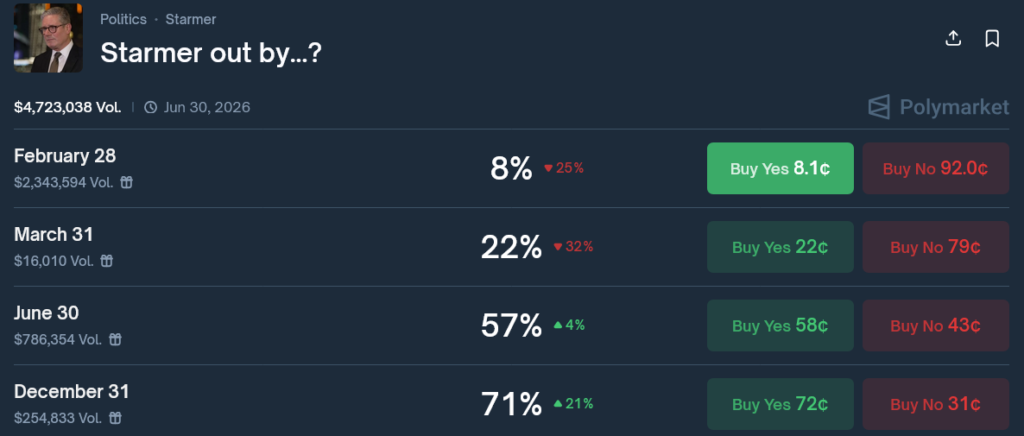
The staggered prediction market reveals escalating confidence in Starmer’s departure:
- February 28, 2026: 16¢ ($2.06M volume) – Immediate crisis exit unlikely but odds doubled this week
- March 31, 2026: 42¢ ($1,167 volume) – Spring resignation scenario gaining traction
- June 30, 2026: 58¢ ($720K volume) – Post-May local elections departure seen as likely
- December 31, 2026: 72¢ ($243K volume) – Strong consensus on 2026 exit
Volume has surged from $2 million to $4.35 million in just four days, demonstrating intense trader interest following the February 9 leadership crisis.
The market structure shows traders believe Starmer’s position becomes increasingly untenable as the year progresses, with each successive deadline showing 14 to 16 percentage point jumps in probability.
Traditional bookmakers align with this sentiment, with William Hill pricing 2026 as Starmer’s exit year at 1/5 odds, suggesting a change in Labour leadership this year is “more likely than not”.
What This Market Is Asking
The Polymarket event asks whether Keir Starmer will cease to be Prime Minister of the United Kingdom by specific deadlines throughout 2026.
Each sub-market resolves to “Yes” if Starmer is no longer PM at any point before the deadline (11:59 PM ET on the specified date).
Critically, an announcement of resignation or removal before the deadline immediately resolves the market to “Yes,” regardless of when the actual transition occurs.
This means if Starmer announces his intention to resign in March but stays until May for a leadership election, the March 31 market would still resolve “Yes.”
The resolution source is the UK government itself, though a consensus of credible reporting also suffices. This matters because Labour leadership contests typically take 6 to 8 weeks, meaning an announced resignation could occur weeks before actual departure.
Current baseline: Starmer remains Prime Minister as of February 10, 2026, following a turbulent 18 months in office after Labour’s July 2024 landslide victory that delivered a decisive parliamentary majority.
Why “December 31 Exit” Is the 72% Favorite
1. Historic Approval Crisis
Starmer holds the worst Prime Minister approval rating in Ipsos polling history dating back to 1978, with no predecessor polling as poorly on leader satisfaction.
His net favorability stands at negative 57 in January 2026, matching former PM Rishi Sunak’s lowest point and exceeded only by Liz Truss’s catastrophic tenure.
Just 23% of Britons view Starmer favorably versus 75% unfavorably, and remarkably, only 39% of 2024 Labour voters now see him positively compared to 55% negatively. Two-thirds of the public disagree that the government is competent.
2. Mandelson-Epstein Scandal
The government faces an existential crisis over Starmer’s appointment of Peter Mandelson as US Ambassador in late 2024. US Department of Justice documents released in January 2026 revealed that Mandelson maintained close ties with convicted sex offender Jeffrey Epstein after his 2008 conviction, and allegedly leaked market-sensitive information to Epstein while serving as Business Secretary in 2009.
Starmer fired Mandelson in September 2025 after initial emails surfaced, but admitted he knew about the Epstein connection when making the appointment. On February 9, Starmer told staff that Mandelson’s “disgraceful conduct” is “entirely incompatible with public service,” apologized to Epstein’s victims for “having believed Mandelson’s lies,” and referred him to law enforcement for potential prosecution.
The scandal triggered an attempted leadership coup, with a senior Labour colleague trying to topple the Prime Minister. Scottish Labour leader Anas Sarwar publicly urged Starmer to quit, stating Number 10 has “not been good enough”.
3. Catastrophic Polling Collapse
Labour has collapsed to third place in recent polling, with Reform UK leading at 31%, Conservatives at 21%, and Labour at just 17%.
An MRP poll projects Reform would win 335 seats with an outright majority of 20, while Labour would fall to sixth place behind the Greens and SNP with minimal parliamentary representation.
While some pollsters show Labour recovering slightly to 21 to 22% in early February, the gap between Reform and Labour narrowed only modestly from 11 points to 8 to 9 points.
Ipsos director Keiran Pedley noted that despite slight improvements, “the wider picture for Labour looks negative” and the public remains split on preferring Starmer versus Nigel Farage as Prime Minister.
4. May 2026 Local Elections Pressure
Starmer faces crucial local elections in May 2026, with speculation mounting that poor performance could trigger a formal leadership challenge. Conservative leader Kemi Badenoch has attacked Labour for having “no plan, no agenda,” describing Starmer as a “weak leader who is uncertain about his tenure”.
Historically, governing parties facing catastrophic mid-term losses have seen leadership changes in the aftermath. The June 30 market pricing at 58% reflects trader expectations that post-election pressure could force Starmer out within weeks of a poor result.
Why “February 28” Is Only 16%
The Cabinet Firewall Holds (For Now)
Despite the February 9 crisis, cabinet ministers have publicly rallied around Starmer. Housing Secretary Steve Reed appeared on media defending the PM, stating that forthcoming documents would prove Mandelson “misled” officials during the appointment process.
Starmer told staff on February 9, “We move forward from this point. We proceed with confidence as we continue to transform the country,” signaling no immediate resignation plans. His aides explicitly informed journalists that the Prime Minister “does not plan to resign”.
No Formal Challenge Mechanism Yet
Unlike Conservative Party rules that allow MPs to trigger a confidence vote, Labour’s process requires either voluntary resignation or a complex challenge at party conference.
With no conference scheduled until autumn, there is no immediate mechanism to force Starmer out within 18 days.
The 16% probability for February 28 essentially prices the risk of voluntary resignation under unbearable pressure, which Starmer has repeatedly ruled out.
March 31 Remains Possible at 42%
The March deadline captures scenarios where Starmer announces resignation in late February or March to allow for a spring leadership contest before May’s local elections.
This “controlled departure” strategy would give Labour time to present a new leader to voters, potentially limiting electoral damage.
The dramatic jump from 16% to 42% between late February and late March reflects this window for strategic resignation announcements.
Key Catalysts to Watch
February 14, 2026: Prime Minister’s Questions. First parliamentary appearance since crisis, with Conservative and Reform MPs expected to attack aggressively
Late February: Planned release of Mandelson appointment documents. Government promises these will prove Mandelson misled officials, but could reveal Starmer knew more than admitted
March-April: Potential formal leadership challenge. Labour MPs may gather signatures to force an extraordinary conference vote if polling does not improve
May 1, 2026: Local elections across England. Catastrophic losses would intensify pressure for immediate resignation
June 2026: Post-election polling data. If Labour finishes third or worse, cabinet unity could collapse within weeks
Autumn 2026: Labour Party Conference. Final institutional mechanism for formal leadership challenge if Starmer refuses voluntary resignation
How to Trade This Market?
Strategy 1: Long December 31 “Yes” (Medium Risk)
- Action: Buy December 31 “Yes” shares at 72¢ on Polymarket
- Thesis: Historic approval crisis, May election pressure, and Reform surge make year-end departure highly probable regardless of February crisis resolution
- Return: 38.9% gain if Starmer exits by year-end (72¢ → $1.00)
- Risk: Labour polling recovery or Reform collapse could stabilize Starmer’s position; three years remain until required general election in 2029
Strategy 2: Long June 30 “Yes” (Higher Risk)
- Action: Buy June 30 “Yes” shares at 58¢
- Thesis: May local elections will devastate Labour, forcing immediate post-election resignation in strategic leadership contest before summer recess
- Return: 72.4% gain if exit occurs by June 30 (58¢ → $1.00), approximately 145% annualized over 4.5 months
- Risk: Cabinet could hold firm through poor election results; Starmer has committed to remaining PM “this time next year” and may tough it out
Strategy 3: Short February 28 “Yes” (Lower Risk)
- Action: Sell February 28 “Yes” shares (buy “No” at 84¢)
- Thesis: No formal challenge mechanism exists within 18 days, cabinet remains united, and Starmer has explicitly ruled out resignation
- Return: 19% gain if Starmer survives through February 28 (84¢ → $1.00), approximately 400% annualized over 18 days
- Risk: Unexpected voluntary resignation or health crisis; scandal could deepen with new document releases scheduled for late February
The Verdict
The 72% consensus for a 2026 Starmer exit reflects genuine structural weakness in his premiership rather than short-term scandal volatility. With the worst PM approval ratings in 48 years of polling history, a governing party polling third behind Reform UK, and May local elections likely to deliver catastrophic losses, traders are rationally pricing a high probability of departure.
The Mandelson-Epstein crisis has accelerated the timeline, with February 28 odds doubling to 16% and March 31 nearly doubling to 42% in just four days. While immediate resignation remains unlikely due to cabinet support and lack of formal challenge mechanisms, the post-May elections window (June 30 at 58%) represents the highest probability inflection point.
Watch the February document release and May 1 local election results as the two catalysts most likely to shift these odds by 10 percentage points or more. Polymarket’s staggered market structure allows traders to express views on specific exit timelines rather than binary year/no outcomes, creating opportunities to capitalize on catalyst-driven volatility.
