
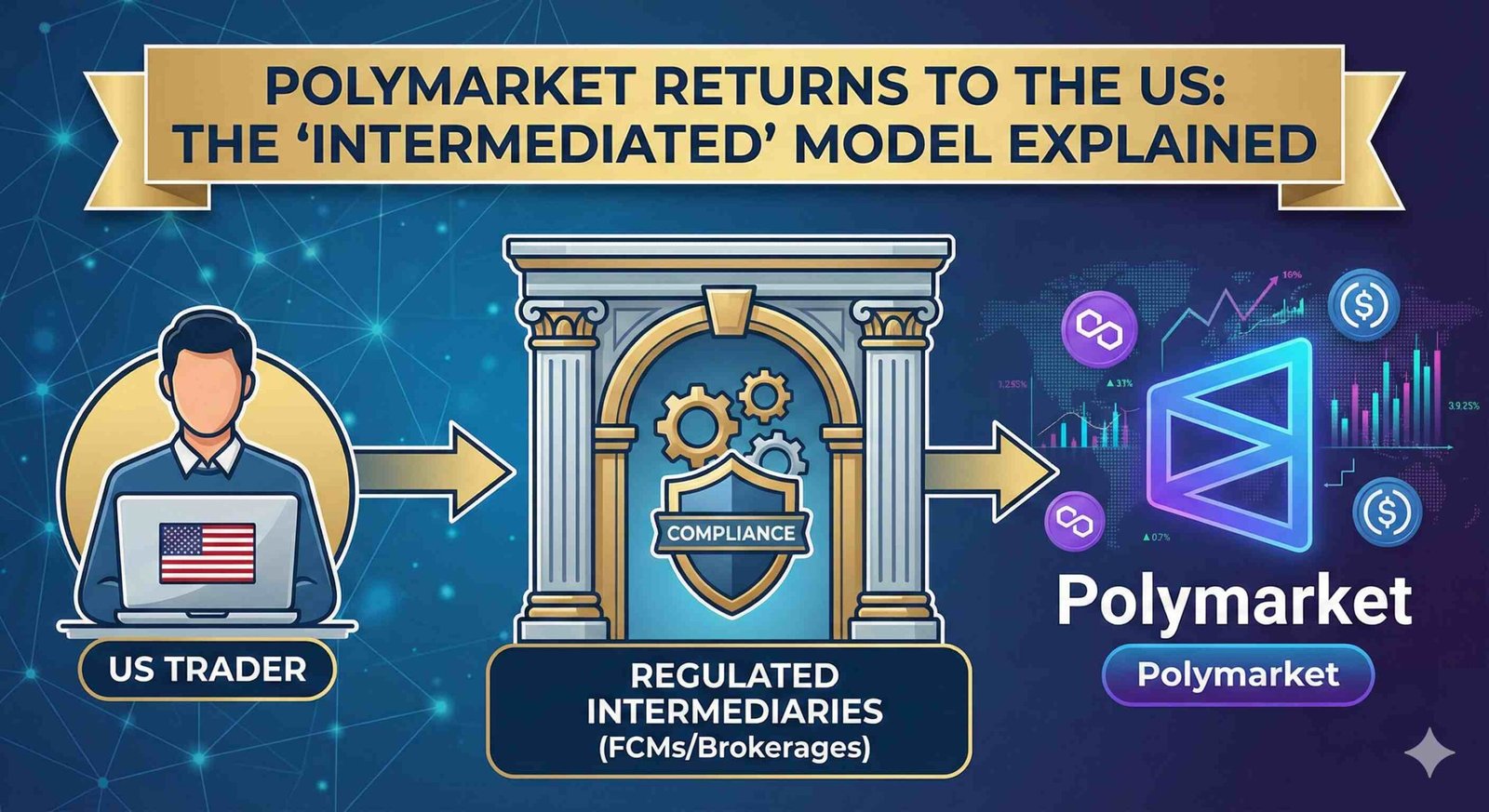
Polymarket received approval from the U.S. Commodity Futures Trading Commission (CFTC) in November 2025 to return to American markets after a three-year absence, but with a fundamental change:
U.S. users can no longer trade directly with crypto wallets. Instead, they must go through regulated brokers called Futures Commission Merchants (FCMs) under what’s known as an “intermediated” trading model.
Key Takeaways:
- U.S. users now trade Polymarket through regulated broker accounts (FCMs), not crypto wallets like MetaMask
- Polymarket operates as a Designated Contract Market (DCM), putting it under the same federal regulations as traditional futures exchanges
- Full Know Your Customer (KYC) verification is required for U.S. access, ending the anonymous trading era
- The global platform remains separate with different access rules and requirements
The History Behind Polymarket’s Return
Polymarket launched in 2020 as a decentralized prediction market where users could bet on real-world events using cryptocurrency. The platform gained massive popularity during the 2020 and 2024 U.S. presidential elections, processing billions of dollars in trading volume.
In January 2022, the CFTC issued an order determining that Polymarket operated an unregistered facility for trading event-based binary options, which are derivatives under federal law. The company agreed to pay a $1.4 million civil penalty and immediately ceased operations for U.S. customers.
For nearly three years, American traders were locked out while the platform continued serving international users. Polymarket worked with regulators to create a compliance framework that would satisfy CFTC requirements while maintaining its prediction market model.
The November 2025 approval marked a watershed moment for regulated prediction markets in the United States. Rather than operating in a legal gray zone, Polymarket now functions under the same federal oversight as established derivatives exchanges.
What Is the Intermediated Model?
The intermediated model fundamentally changes how Americans access prediction markets. Instead of connecting a crypto wallet and trading peer-to-peer, users must open accounts with licensed Futures Commission Merchants who act as regulated middlemen.
This structure exists throughout traditional financial markets. When you trade stocks, you don’t interact directly with the New York Stock Exchange; you place orders through a brokerage firm. The same principle now applies to Polymarket.
Your FCM becomes your gateway to the prediction market. They hold your funds in segregated accounts, verify your identity, manage your margin requirements, and route your orders to Polymarket’s trading venue. You never touch the underlying blockchain infrastructure directly.
The intermediated approach serves multiple regulatory purposes. It ensures customer fund protection through segregation requirements, enables transaction monitoring for market manipulation, facilitates tax reporting through 1099 forms, and provides a clear enforcement mechanism if violations occur.
Understanding Futures Commission Merchants (FCMs)
Unlike the global platform where users maintain self-custody and can track wallet activity through public APIs, the FCM model requires trusting a regulated intermediary with fund custody.
Core Functions of an FCM
A Futures Commission Merchant is a CFTC-registered entity authorized to accept customer orders for futures and derivatives contracts. FCMs serve as the critical link between retail traders and regulated exchanges.
FCMs must register with both the CFTC and the National Futures Association (NFA), a self-regulatory organization that oversees compliance. Registration requires meeting minimum capital requirements, passing background checks, and demonstrating operational competency.
Once registered, an FCM performs several essential functions. They maintain customer accounts, accept deposits and withdrawals, calculate margin requirements, execute trades on designated exchanges, provide account statements, and issue tax documentation.
Customer Fund Protection
Federal law requires FCMs to segregate customer funds from the firm’s own operating capital. This means your trading deposits sit in separate accounts that creditors cannot access if the FCM faces financial trouble.
FCMs must reconcile segregated accounts daily and report any deficiencies to the CFTC within 24 hours. They also maintain excess capital buffers beyond minimum requirements to absorb operational losses without touching customer money.
These protections didn’t exist in the old crypto wallet model. If you lost access to your private keys or fell victim to a smart contract exploit, your funds disappeared with no recourse.
Regulatory Oversight
The CFTC conducts regular examinations of FCM operations, reviewing their internal controls, risk management systems, and compliance procedures. The NFA performs additional audits focusing on sales practices and customer complaint handling.
FCMs must maintain detailed records of every customer transaction, communication, and account activity for at least five years. This creates an audit trail that regulators can review during investigations.
Violations can result in fines, suspension of trading privileges, or permanent registration revocation. This enforcement mechanism gives the CFTC direct authority over firms serving U.S. customers.
What Makes Polymarket a DCM
A Designated Contract Market is a board of trade or exchange that operates a centralized marketplace for trading derivatives contracts. By designating Polymarket as a DCM, the CFTC classified it as equivalent to established futures exchanges like the CME or ICE.
DCM status subjects Polymarket to 23 Core Principles outlined in the Commodity Exchange Act. These principles govern every aspect of exchange operations from market surveillance to emergency authority.
Polymarket must now maintain rule enforcement programs, establish position limits to prevent manipulation, ensure fair access for all participants, and operate financial integrity systems to manage counterparty risk. The platform can no longer operate as a loosely governed decentralized application.
Self-Regulatory Requirements
As a DCM, Polymarket must create and enforce its own rulebook covering trading practices, conduct standards, and disciplinary procedures. The exchange investigates potential violations, holds hearings, and imposes sanctions when traders break the rules.
This self-regulatory structure requires Polymarket to operate compliance, surveillance, and enforcement departments staffed by qualified professionals. The costs are substantially higher than running a simple blockchain application.
The CFTC reviews Polymarket’s self-regulatory performance during regular examinations. If the exchange fails to adequately police its market, the Commission can impose additional oversight or suspend the DCM designation.
Market Surveillance Obligations
DCMs must implement real-time market surveillance systems that detect suspicious trading patterns. These systems flag potential wash trades, spoofing, front-running, and coordinated manipulation attempts.
When surveillance alerts trigger, Polymarket’s compliance team must investigate the activity, gather evidence, and determine whether violations occurred. If manipulation is confirmed, the exchange reports the conduct to the CFTC for potential criminal prosecution.
This level of monitoring was impossible under the decentralized, wallet-based model where transactions occurred pseudonymously on blockchain networks.
Global Platform vs. U.S. Platform: A Detailed Comparison
Polymarket now operates two distinct platforms with different technical infrastructure, regulatory frameworks, and access requirements.
| Feature | Global Platform | U.S. Platform |
|---|---|---|
| Access Method | Direct crypto wallet (MetaMask, WalletConnect) | FCM broker accounts only |
| Identity Verification | Minimal KYC or none | Full KYC mandatory with government ID |
| Funding Method | USDC cryptocurrency on Polygon blockchain | USD deposits via ACH, wire transfer through FCM |
| Trading Anonymity | Pseudonymous wallet addresses | Full identity disclosure to FCM and regulators |
| Regulatory Oversight | Varies by jurisdiction | CFTC and NFA oversight |
| Tax Reporting | User responsibility | Automatic 1099 forms from FCM |
| Fund Custody | Self-custody in personal wallet | FCM holds funds in segregated accounts |
| Market Access | All available markets (subject to regional restrictions) | Limited to CFTC-compliant event contracts |
Why Two Platforms?
The dual structure allows Polymarket to serve international customers under its existing model while complying with U.S. derivatives law. Other jurisdictions lack the intermediation requirements that American law mandates.
U.S. users cannot switch between platforms or choose which system to use. Your geographic location, verified through KYC, determines which platform you access. Attempts to circumvent restrictions through VPNs or false documentation violate federal law.
The platforms may eventually offer different markets. Certain prediction topics that are legal internationally might violate U.S. regulations around gaming or election integrity. The U.S. DCM must ensure all listed contracts comply with Commodity Exchange Act requirements.
KYC Requirements: What U.S. Users Must Provide
Know Your Customer verification is the foundation of the intermediated model. Every U.S. user must prove their identity before accessing Polymarket through an FCM.
Required Documentation
Government-issued photo identification is mandatory. Acceptable documents include a valid passport, driver’s license, or state-issued identification card. The document must be current and show a clear photograph matching the applicant.
Proof of residential address verifies your location and ensures proper tax reporting. FCMs typically accept utility bills, bank statements, lease agreements, or government correspondence dated within the past three months. The address on this document must match the address you provide during registration.
U.S. taxpayers must supply a Social Security Number or Individual Taxpayer Identification Number. This enables the FCM to generate 1099 tax forms and report your trading activity to the Internal Revenue Service as required by federal law.
Verification Process
The FCM uploads your documents to identity verification services that check them against government databases. Advanced systems detect forged documents, altered photos, and stolen identities.
Verification typically completes within 24 to 48 hours for straightforward applications. Complex cases involving discrepancies, expired documents, or address mismatches may require additional documentation and take several days.
Some FCMs implement video verification where you appear on camera holding your identification document while answering security questions. This prevents the use of stolen or borrowed credentials.
Ongoing Monitoring
KYC is not a one-time event. FCMs must maintain current customer information and update records when circumstances change. If you move to a new address or your identification expires, you must provide updated documentation.
The FCM monitors your trading patterns for unusual activity that might indicate account compromise, money laundering, or straw trading where someone else controls your account. Suspicious behavior triggers enhanced due diligence reviews.
The 2022 Enforcement Action
The CFTC’s January 2022 order found that Polymarket offered event-based binary options to U.S. customers without registering as a DCM or operating through registered intermediaries. The platform accepted trades totaling hundreds of millions of dollars from American users.
Binary options based on real-world events are derivatives under the Commodity Exchange Act. Offering them to U.S. customers requires CFTC registration and compliance with federal regulations. Polymarket’s decentralized, crypto-based structure violated these requirements.
The company agreed to cease U.S. operations, pay a $1.4 million penalty, and block American IP addresses. This enforcement action sent a clear message that prediction markets must comply with derivatives law.
New Surveillance Capabilities
The intermediated DCM model gives regulators unprecedented visibility into prediction market trading. Every transaction includes full identity information, enabling investigators to track suspicious activity across multiple accounts.
Polymarket’s market surveillance systems now monitor for wash trading, where users trade with themselves to create false volume. They detect spoofing, where large orders are placed and quickly canceled to manipulate prices. They flag coordinated trading by multiple accounts controlled by the same entity.
When violations occur, the CFTC can subpoena the FCM for complete account records including funding sources, IP addresses, communications, and trading history. This investigative power was impossible when users traded pseudonymously through crypto wallets.
Enhanced Market Integrity
DCM Core Principles require Polymarket to prevent manipulation and ensure fair pricing. The exchange must establish position limits that cap how much a single trader can control in any market.
Position limits prevent large traders from cornering markets or moving prices through sheer size. If a market allows betting on whether a bill passes Congress, no single trader can buy such a massive position that their actions determine the market outcome.
Polymarket must also implement circuit breakers that pause trading during extreme volatility and clearly define how markets settle when event outcomes are disputed. These protections formalize processes that were ad hoc under the old model.
How to Trade Polymarket in the US in 2026?
Trading Polymarket in the U.S. now requires working through a regulated FCM broker rather than connecting a crypto wallet directly.
The onboarding process mirrors opening a traditional brokerage account with identity verification, fund deposits via bank transfer, and trading through the FCM’s platform.
While the phased rollout continues throughout 2026, the following steps outline what U.S. users can expect when accessing Polymarket through the intermediated model
Step 1: Identify Authorized FCMs
Polymarket must announce which FCMs have received approval to offer intermediated access to its DCM. Not all futures brokers automatically qualify; they must specifically register to facilitate Polymarket trading.
Check polymarket.com for the official list of authorized FCMs. See our comparison of recommended FCMs and brokerages for Polymarket US trading to help you choose the right broker. Avoid any broker claiming to offer U.S. access without appearing on this list, as they may be operating illegally.
Step 2: Open Your FCM Account
Visit the authorized FCM’s website and complete their new account application. You’ll provide personal information including your name, date of birth, address, Social Security Number, employment details, and financial information.
The application asks about your trading experience, income level, and net worth. FCMs use this information to assess whether prediction market trading is appropriate for your financial situation.
Read all account agreements carefully. These documents explain the FCM’s fee structure, margin requirements, dispute resolution procedures, and your legal rights.
Step 3: Complete KYC Verification
Upload your government-issued ID, proof of address, and any additional documents the FCM requests. Ensure documents are clear, complete, and current.
The FCM’s compliance team reviews your submission and may contact you if they need clarification or additional information. Respond promptly to avoid delays.
Step 4: Fund Your Account
Once KYC approval is complete, deposit funds using the FCM’s accepted methods. Most brokers accept ACH transfers from U.S. bank accounts, wire transfers, and checks.
Cryptocurrency deposits are unlikely under the intermediated model since FCMs hold customer funds in traditional segregated accounts. You’re trading with USD, not USDC or other digital assets.
Deposits typically clear within one to three business days depending on the funding method. The FCM will notify you when funds are available for trading.
Step 5: Access the Trading Platform
Log into the FCM’s trading interface or connect through approved API access. The experience differs from the old MetaMask-connected web interface since you’re accessing Polymarket through the FCM’s systems.
Browse available markets, review pricing, and place your trades. The FCM routes your orders to Polymarket’s DCM for execution.
Step 6: Tax Reporting
At year-end, your FCM generates a 1099 form reporting your trading gains and losses to both you and the IRS. This document simplifies tax filing compared to self-reporting crypto transactions.
Keep records of your trading activity throughout the year. While the FCM provides the official tax form, maintaining your own records helps verify accuracy and supports deductions.
Once you’re familiar with the platform mechanics, develop a systematic approach to market selection and position sizing with proven Polymarket trading strategies.
Do I still need a crypto wallet to use Polymarket in the U.S.?
No. U.S. users access Polymarket exclusively through regulated FCM broker accounts funded with U.S. dollars, not cryptocurrency wallets. You interact with the FCM’s platform, which handles all connection to Polymarket’s DCM infrastructure. Crypto wallets are only required for the separate global platform.
What’s the difference between trading on the global vs. U.S. platform?
The global platform allows direct crypto wallet access with minimal KYC, while the U.S. platform requires trading through licensed FCM brokers with full identity verification and federal reporting. The U.S. platform operates under CFTC oversight as a Designated Contract Market, while the global platform follows international regulations that vary by jurisdiction. Available markets may also differ based on regulatory restrictions.
Can I use a VPN to access the old global platform from the U.S.?
No. Using VPNs or other methods to misrepresent your location violates both U.S. derivatives law and Polymarket’s terms of service. The platform enforces geographic restrictions through IP blocking combined with KYC residence verification. U.S. residents attempting to access the global platform illegally risk federal enforcement action.
When will Polymarket’s U.S. platform be fully operational?
The phased rollout began in late 2025 following CFTC approval in November. Full implementation continues throughout 2026 as Polymarket onboards authorized FCMs, completes compliance infrastructure, and expands market offerings. Check polymarket.com for current access availability and the list of approved FCMs.
How are my funds protected under the FCM model?
Federal law requires FCMs to segregate customer funds from the firm’s own operating capital in separate accounts. These segregated accounts are protected from the FCM’s creditors and must be reconciled daily. The CFTC and NFA conduct regular examinations to ensure compliance. This provides substantially stronger protection than self-custody crypto wallets, where lost private keys or smart contract exploits result in permanent fund loss.
Will I pay more fees under the intermediated model?
FCMs charge commissions, account maintenance fees, and potentially withdrawal fees that didn’t exist in the direct crypto wallet model. However, you avoid cryptocurrency network fees, bridge fees for moving funds between blockchains, and the risk of failed transactions. The total cost depends on your trading volume and the specific FCM you choose. Compare fee schedules across authorized FCMs before opening an account.
Can Polymarket or my FCM freeze my funds?
Yes. Under the intermediated model, your FCM holds custody of your funds and must comply with federal regulations, court orders, and anti-money laundering requirements. FCMs can freeze accounts during investigations of suspicious activity, in response to legal holds, or if you violate trading rules. Learn more about fund freezing scenarios and your rights. This differs from self-custody crypto wallets where you maintain complete control absent smart contract vulnerabilities.
