

If you’ve been following prediction markets closely over the past month, you’ve probably noticed something striking: the political landscape is shifting dramatically.
One year out from the 2026 midterm elections, Polymarket is pricing in a 70% probability of Democratic House control and a 31% chance that Republicans hold on.
That’s a significant lean toward Democrats, especially when you consider the razor-thin Republican majority currently controlling the chamber.
Here’s why I’m watching this market closely, and why you should too if you’re serious about political prediction markets: this could be one of the clearest arbitrage opportunities we’ve seen since the 2024 presidential race wrapped up.
Why Democrats Are Heavily Favored?
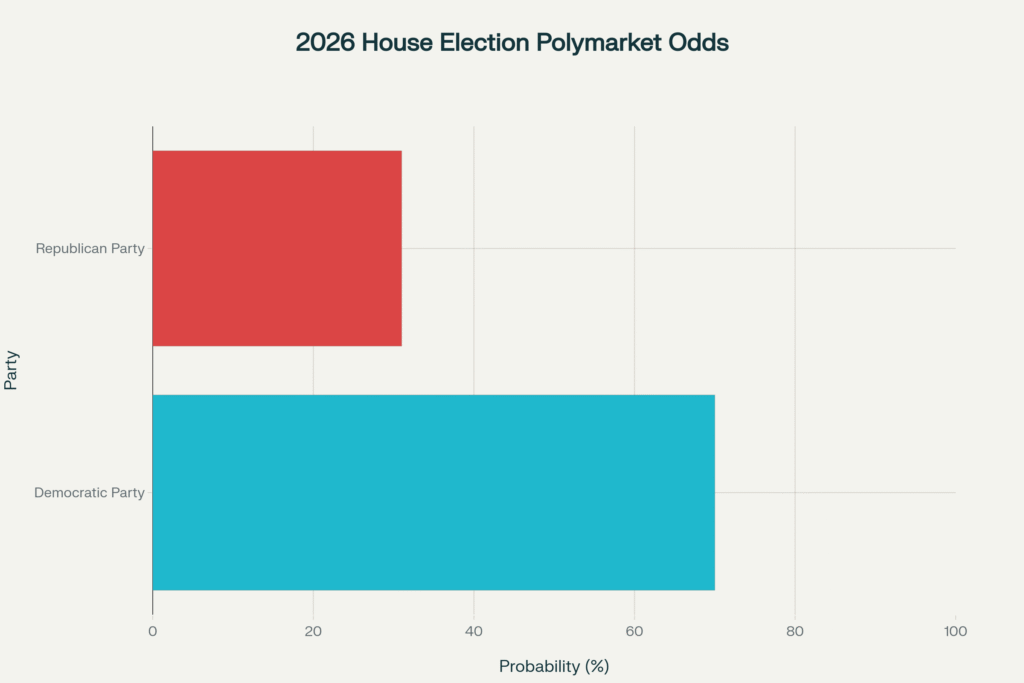
Let me start with what Polymarket is telling us right now. The odds are decisively Democratic. With $137,536 in trading volume split nearly evenly between both outcomes ($68,658 for Democrats, $68,900 for Republicans), the market has consolidated on a comfortable Democratic advantage.
But here’s the thing these odds are actually MORE conservative than what you’d expect from polling. When you look at the generic congressional ballot, Democrats are posting their strongest position since 2018:
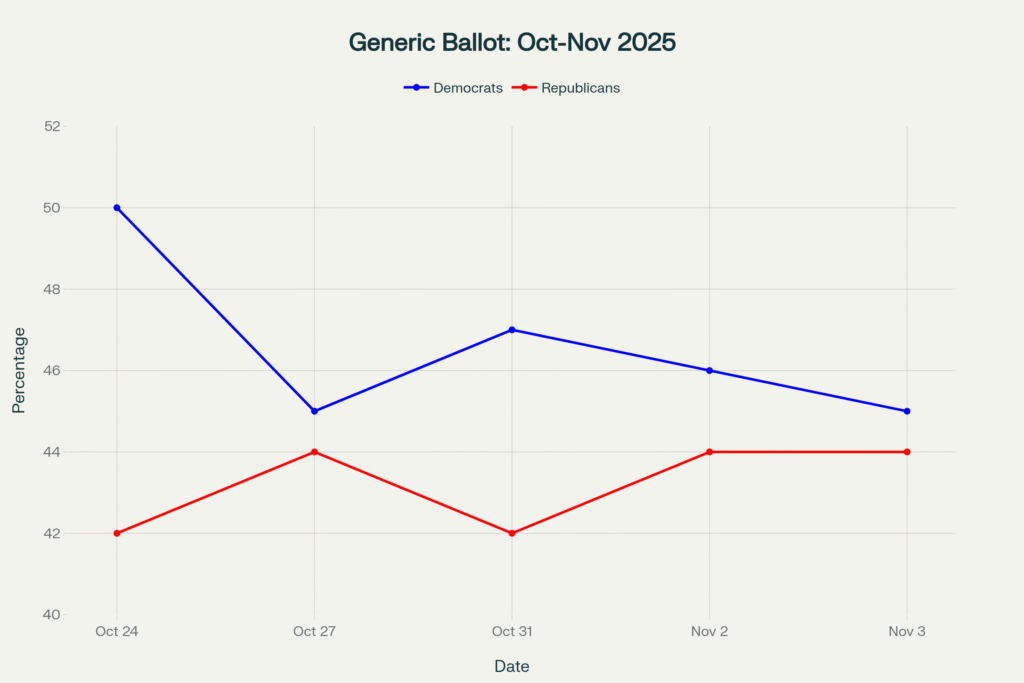
The NBC News poll from late October showed a D+8 advantage the largest lead for either party in the 2026 race to date. CNN’s polling showed D+5 with a significant enthusiasm edge. Even the more conservative aggregates show Democrats up +3 to +5.
So if polling is showing +5 to +8, but Polymarket is only giving Democrats 70% odds, that’s potentially underbaking the Democratic case.
Most statistical models would translate a consistent +5 generic ballot into 75-80% probability of House control. Let’s dig into why the market might be conservative and whether that’s justified.
The Seat Math: Democrats Need Just 3
Here’s the brutal reality for Republicans: they’re sitting on a 220-215 seat majority. That’s the thinnest margin in decades.
To maintain control, Republicans simply need to hold all 220 seats. Democrats need to flip just 3 seats to reach 218 (the majority threshold).
Think about that math for a moment. Three seats. Out of 435 House races.
According to Cook Political Report’s June 2025 ratings, Republicans have 191 “solid” seats that are unlikely to flip but that still leaves 29 Republican seats in some level of jeopardy. Democrats, by contrast, have only 174 “solid” seats, meaning they’re defending 41 seats in toss-up or worse territory.
But the key insight is this: even if Democrats lose some seats they’re defending, the arithmetic still favors a flip. Brookings Institution analyzed this mathematically.
They found that out of 37 House seats won by less than 5 points in 2024, Democrats hold 22 and Republicans only 15. That’s a structural Democratic advantage in the competitive universe.
The non-partisan Race to the WH forecast, which runs 10,000 simulations of the 2026 election, projects Democrats have a strong path to the majority based purely on historical precedent and seat geography.
The Trump Factor
Here’s what’s weighing most heavily on Polymarket traders’ minds: Trump’s approval rating is at 43%, with 55% disapproval his lowest point in his second term.
This matters enormously because it’s almost a perfect echo of 2018. When Trump hit 42% approval heading into the 2018 midterms, Democrats gained 41 House seats and took control of the chamber.
That anti-Trump wave was the fourth-largest swing toward the opposing party in any midterm since the 1930s.
Look at the historical pattern:
- 2018: Trump 42% approval → Democrats +41 seats (flipped House)
- 2010: Obama 46% approval → Republicans +63 seats (flipped House)
- 2002: Bush 66% approval → Republicans +8 seats (rare midterm gain)
- 1998: Clinton 66% approval → Democrats +5 seats (rare midterm loss)
- 2026: Trump 43% approval → Democrats projected majority
The pattern is screaming: when a president is below 50% approval heading into a midterm, the party out of power almost always gains significant ground. Trump’s 43% isn’t just low it’s almost identical to 2018.
But there’s a complication: will Trump’s voters turn out in 2026 when Trump isn’t on the ballot? That’s the critical unknown. In 2018, Trump mobilized his base even without being a candidate himself, actually outperforming expectations.
But turnout dynamics can shift. NBC’s polling shows that 40% of voters want their 2026 vote to represent “opposition to Trump,” while only 30% want to express “support” for him. That’s a 10-point messaging advantage for anti-Trump coalition.
Polymarket vs. Traditional Forecasts
So here’s my synthesis: Polymarket at 70% Democrat might be slightly conservative compared to:
- Brookings Institution: 70-75% Democrat based on historical seat math and current margins
- Race to the WH: Likely Democratic majority from 10,000 simulations
- Generic ballot suggesting 75-80% if you apply standard models
But the market’s caution isn’t crazy. Here’s why Polymarket traders might be holding back from even more aggressive Democratic pricing:
Reason 1: Redistricting Complications
Texas Republicans redrew their districts in 2022 and picked up 5 seats through redistricting. If California Democrats can’t fully offset that through their own redistricting, it makes Democrats’ job slightly harder. The market might be pricing in lingering redistricting uncertainty.
Reason 2: Liquidity and Position Management
With $137,536 total volume split evenly between outcomes, this market isn’t deep. Larger traders might be hesitant to push odds too extreme without more volume to support positions.
Reason 3: The “Always Hedge” Problem
Republican traders might simply be overrepresenting their positions. Prediction market volume doesn’t always reflect true probability sometimes it reflects who’s most motivated to trade.
Key Bellwether Districts to Watch
If you want to track how this race is actually evolving, watch these five districts:
Nebraska-02 (Omaha): Republican Don Bacon holds a Lean-R seat in Biden-won territory. Cook rates this as likely to flip. If Bacon loses, that’s your early signal of a Democratic wave.
New Hampshire-01 (Concord): Democratic Chris Pappas holds a toss-up rated seat. If he survives, good sign for Dems. If he flips red, Republican momentum is building.
New York-22 (Syracuse): Open seat, Toss-up rating. Whichever party wins this open seat signals momentum.
New York-26 (Buffalo): Tim Kennedy (D) in a Lean-D seat. If this becomes competitive or flips red, watch out—it means Republicans are overperforming.
Pennsylvania-17 (Pittsburgh): Chris Deluzio (D) in a Lean-D seat. If Republicans make this competitive, they’re having a really good year.
Timeline and Key Events Leading to November 2026
We’ve got exactly 12 months until votes are cast. Here’s what to watch:
- Now through March 2026: Candidate recruitment and early campaign spending. If quality Republican candidates struggle to emerge, that’s a bearish sign for the GOP.
- Spring 2026: Special elections and state-level contests will give us real voter data on the political environment. Watch gubernatorial races in swing states closely.
- Summer 2026: The political conventions. Trump’s behavior and rhetoric will heavily influence the political climate.
- Fall 2026: The campaign crescendo. This is when the generic ballot will stabilize and true predictive power emerges. Watch for any major scandals, economic data, or international events that could shift the environment.
Trading Implications: Is 70% the Fair Price?
Here’s my honest take for prediction market traders:
If you believe the polling and historical precedent, Democrats at 70% might be underpriced. A D+5 generic ballot should translate to roughly 75-80% House control probability. That suggests buying Democratic at 70 cents could have positive expected value.
If you’re skeptical of polling or believe Republicans have hidden strength (particularly among unlikely voters Trump might mobilize), betting Republican at 31 cents is cheap. Republicans only need to defy historical precedent, not achieve an unprecedented outcome.
The smart play might be: Wait for Q2-Q3 2026 data. Once we get through the spring special elections and see mid-year polling, the true picture will clarify. Then adjust positions accordingly. Right now, we’re pricing an election one year out a lot can change.
My 2-Cent Friendly Advice
Here’s what I tell anyone asking me about this market:
Don’t chase the 70% odds hoping they’ll move dramatically. This market is already reasonably efficient given the polling data. The 30-point spread (70-31) has already priced in enormous Democratic advantage.
Instead, think about correlated markets. Watch Polymarket’s Senate control market, gubernatorial races in 2026, and state-level House forecasts. If Democrats start surging on Senate odds, that’s a signal that House movement is coming. Vice versa with Republican momentum.
Consider timing and liquidity. This market will see massive volume spikes during campaign season. If you want better prices, trade early (now) or late (next summer). Middle of the campaign sees the most efficient pricing and thinnest spreads.
Remember: predictions aren’t destiny. One genuinely unexpected event a major scandal, economic shock, foreign policy crisis could shift these odds 10-20 points overnight. Prediction markets price known information brilliantly but struggle with true black swans.
The Bottom Line
Polymarket is giving Democrats a 70% shot at controlling the House in 2026. The generic ballot, historical precedent, seat math, and Trump’s low approval all support this lean. Professional forecasters like Brookings and Race to the WH land in the same ballpark.
But there’s enough uncertainty that smart traders can find value on both sides. Republicans at 31 cents aren’t crazy if you believe in mean reversion or hidden Trump voter enthusiasm. Democrats at 70 cents aren’t overpriced if you trust the polling.
The real opportunity isn’t in guessing the final outcome today. It’s in tracking how this market evolves through 2026, spotting the signal early when the political environment shifts, and positioning accordingly.
One year out, this race is exactly where political prediction markets should be: genuinely competitive, but with a meaningful edge to the historically-favored outcome.
