

Zohran Mamdani just became New York City’s mayor on November 4, 2025, and with his stunning victory came one of the most ambitious housing policy promises in modern American politics: freeze rents on 1 million rent-stabilized apartments for four years straight.
Now, on Polymarket, traders are weighing whether he’ll actually deliver this pledge by December 31, 2026.
At $12,276 in total volume, this is a thin market with enormous implications. The outcome will reshape how we think about rent control, mayoral power, and whether left-wing housing policy can work in practice.
Let me walk you through what’s really at stake and why this market is far more complex than it initially appears.
The Market Setup
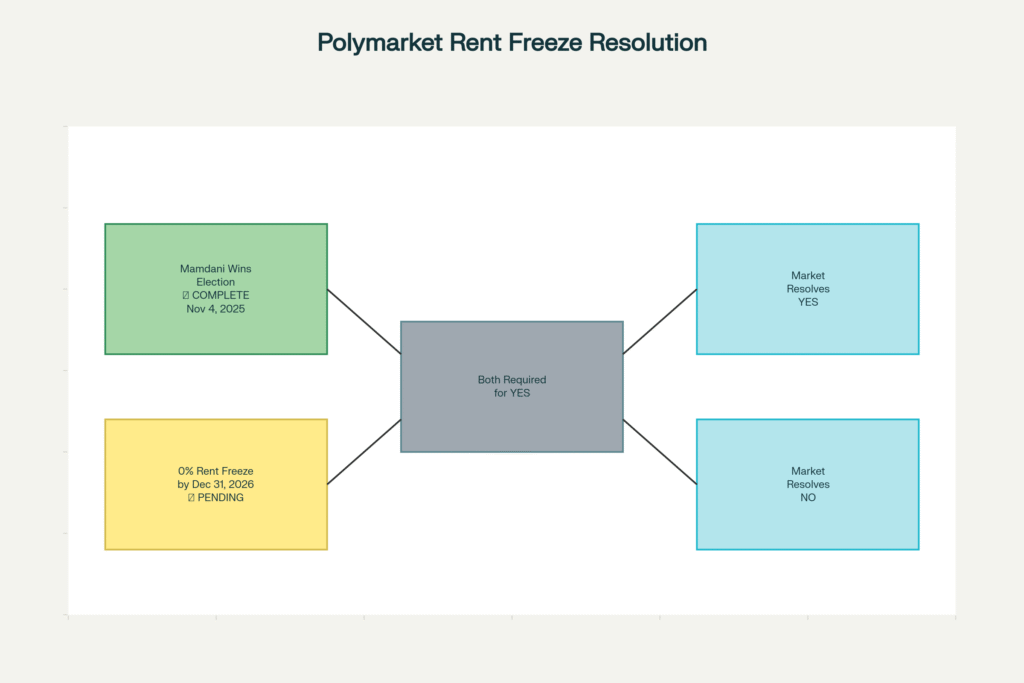
First, let’s understand what we’re trading here. This Polymarket has a unique structure, it’s not just asking “will rents freeze?”
It requires both of these conditions to resolve YES:
- Zohran Mamdani wins the 2025 NYC Mayoral election ✓ COMPLETE (Nov 4, 2025)
- The NYC Rent Guidelines Board implements 0% adjustments for both one-year and two-year renewal leases by December 31, 2026
The first condition is already satisfied. Mamdani crushed Andrew Cuomo and Curtis Sliwa on November 4th with historic margins, becoming New York’s first Muslim mayor at age 34.
The 34-year-old democratic socialist, whose campaign was fueled by younger voters and a powerful message of affordability, defeated a $100+ million opposition campaign funded by billionaires like Michael Bloomberg and hedge fund manager Bill Ackmann.
So now we’re really asking: Will Mamdani actually freeze rents within his first 14 months in office? And that’s where things get fascinating.
Current Rent Landscape
Before we dive into whether a freeze is possible, let’s see where we are now. The current Rent Guidelines Board (RGB) approved increases earlier this year for the October 2025–September 2026 period:
- One-year leases: 3% increase
- Two-year leases: 4.5% increase
- Stabilized hotel units: 0% (already frozen)
For a tenant in a typical $1,500 rent-stabilized apartment, that means $45–67.50 extra per month for one-year leases, and $67.50–112.50 for two-year leases.
Cumulatively, it adds up. Mamdani’s promise to freeze these, bringing them from 3%/4.5% to 0%/0% would provide immediate relief to 1 million New Yorkers.
The question is: Can he do it?
Mamdani’s Control Over the RGB
Here’s where Mamdani’s victory becomes operationally relevant. Unlike many cities, New York City’s Rent Guidelines Board isn’t independent, all 9 members are appointed by the mayor. The board consists of:
- 2 tenant advocates (2-3 year terms)
- 2 owner representatives (2-3 year terms)
- 5 general public members including the chair (2-4 year terms, chair serves as mayor’s pleasure)
This is actually huge for Mamdani. He can immediately replace the RGB chair (which Eric Adams’ administration held with Doug Apple, a neutral/cautious voice).
Over the next 12–24 months, several member terms expire, giving Mamdani opportunities to reshape the board toward a rent-freeze majority.
However, and this is critical Mamdani can’t replace everyone immediately. The staggered terms mean he’ll have to work with some of Adams’ appointees for a year or more.
If those holdovers are skeptical of a freeze, they could block it in a 5-4 vote (Mamdani needs 5 votes for a 0% freeze).
The other constraint: board members are legally supposed to base their decisions on economic data, not mayoral directives.
If the RGB votes for a freeze that appears purely political ignoring building economics, maintenance costs, and other statutory factors, landlords can challenge it through Article 78 proceedings (judicial review) in New York courts.
Obstacles Mamdani Faces
This is where the market gets really spicy. A rent freeze isn’t just a policy choice it’s legally fraught.
Let me break down the obstacles:
1. RGB Independence & Statutory Requirements
The Rent Stabilization Law requires the RGB to set adjustments based on specific economic factors: real estate taxes, water/sewer charges, operating costs, maintenance expenses, and cost-of-living indices.
Mamdani has publicly committed to a freeze in advance of the board’s annual review process. This pre-committed position creates a legal vulnerability.
If the board votes 0% purely to fulfill Mamdani’s campaign pledge, rather than based on the statutory factors, courts could intervene.
One housing law firm notes: “If an RGB decision appeared to disregard relevant data or procedural requirements, a court could intervene”.
2. Landlord Litigation Risk
Property owners can file Article 78 proceedings challenging the freeze. They’ll argue the decision lacks economic justification and violates due process.
While landlords lost their major Fifth Amendment challenge to rent stabilization at the Supreme Court level, courts have been willing to scrutinize RGB decisions for procedural compliance.
The risk is real enough that legal experts are already writing about “the legality of Mamdani’s rent freeze,” flagging that this would be “unprecedented” since the RGB’s creation. An unprecedented policy in thin legal territory invites litigation.
3. The Economics Problem
Small landlords of rent-stabilized buildings are already struggling. With rising property taxes, insurance costs, and maintenance expenses, a 3–4.5% increase barely covers inflation.
Many properties have operating margins of 10–15%, meaning a 0% freeze could actually mean losses in tight years.
New York Community Bancorp, which has massive exposure to rent-stabilized building loans, recently reported that 14% of its stabilized-building loans are at “elevated default risk”.
If a freeze is implemented and mortgage defaults spike, that’s a political crisis for Mamdani his signature policy accidentally triggering a housing market shock.
4. Building Abandonment & Reduced Maintenance
Economic theory predicts that rent freezes reduce landlord incentives to maintain buildings, make improvements, or construct new supply.
If unit conversions to market-rate condos accelerate, the total stock of rent-stabilized apartments shrinks the opposite of Mamdani’s intent.
The Cato Institute noted that Nobel laureate Assar Lindbeck called rent control “the most efficient technique presently known to destroy a city except for bombing”. That’s hyperbole, but it reflects the serious economic concerns.
5. Timeline Pressure
The market resolves on December 31, 2026 less than 14 months away. Even if Mamdani appoints new board members immediately, they need time to review data, attend public hearings, and vote.
The RGB’s annual decision cycle runs March 1 to October 1 for the next fiscal year. Mamdani would need the board to vote for 0% by late September 2026 for the October 2026–September 2027 period.
That’s doable, but tight. Any delays in board appointments, legal challenges, or procedural complications could push the decision past the market resolution date.
What Mamdani Has Going For Him?
Now let me be fair and lay out why a freeze is actually possible:
1. Mamdani Has the Mandate
He won with one of the highest mayoral turnouts since 2001 (1.4 million voters) and a decisive margin over Cuomo. Polls showed housing affordability was his top issue, and voters clearly knew what they were voting for.
2. Board Composition Shifts Are Real
Even if Mamdani can’t replace everyone immediately, he can shift the board over 12 months. With aggressive hiring of tenant-friendly appointees, he could reach 5 votes by late 2026.
3. Historical Precedent (Sort Of)
The RGB has voted for 0% increases before, though rarely and usually for just one lease term, not both simultaneously.
In 2009, the board voted for 0% on one-year leases during the financial crisis. So a freeze isn’t legally impossible just unusual and risky.
4. Political Cover
A popular mayor with a strong mandate has political capital to weather criticism. If Democrats control the state legislature (they do), state-level override of Mamdani’s RGB board is unlikely.
The political risk of being seen as siding with wealthy landlords against a young socialist mayor could deter state intervention.
The Market Assessment: Why Volume is Thin
With only $12,276 in trading volume, this market is sparse. Why? I see a few reasons:
Traders don’t follow NYC housing policy closely. Most Polymarket users focus on national politics, crypto, and obvious prediction events. Housing policy inside NYC administrative boards is niche.
The outcome is genuinely uncertain. Unlike the mayoral race (which had clear polling), the rent freeze depends on obscure factors: RGB board member appointments, legal challenges, economic data, and bureaucratic timing. That uncertainty keeps traders away.
The thin liquidity cuts both ways. It means a large trader with inside information (e.g., someone who knows Mamdani’s personnel choices for the RGB) could massively move odds. But it also means quotes can be stale and pricing inefficient.
What Does a Fair Probability Look Like?
Let me try to build a probability model:
Probability Mamdani successfully appoints a pro-freeze majority RGB: 60%
(He has appointment power, but members have staggered terms and legal independence obligations)
Probability that board votes for 0% if Mamdani wants it: 70%
(Depends on his appointees, and whether economic data supports it)
Probability that freeze survives legal challenge: 55%
(Landlords will litigate; courts may demand better economic justification)
Probability that freeze is implemented AND stays in effect through Dec 31: 50%
(Any reversal or delay past Dec 31 kills the market)
Overall probability = 0.60 × 0.70 × 0.55 × 0.50 = ~11.5%
This suggests that Polymarket traders are actually pricing in a much higher probability than my model suggests. If the market is showing ~15-20% odds (based on thin volume and sparse data), that might be reasonable, but I’d lean toward underweighting it maybe 10-15% is fairer.
This could represent an arbitrage opportunity if you believe traditional financial logic but prediction markets are about crowd wisdom, not pure finance models.
What Traders Are Saying?
Unfortunately, with $12k in volume, there isn’t much organized community discussion. Polymarket’s Discord and Twitter aren’t buzzing about this market specifically.
That’s actually a signal: markets that matter attract smart traders and commentary. The silence here suggests even sophisticated prediction market participants aren’t sure what to make of this bet.
Next Steps: What to Watch
If you’re considering trading this, here are your signal events:
November–December 2025: Mamdani announces his RGB appointments. This is the earliest signal. If he appoints obvious rent-freeze advocates, odds should spike up. If he appoints pragmatists, odds fall.
January–February 2026: New board members take office and have their first meetings. Watch for internal dynamics and any public statements about their stance on rent increases.
March 2026: The RGB begins its preliminary decision-making process for the October 2026–September 2027 adjustment. Economic data gets released; this determines whether a 0% freeze is even plausible.
April–June 2026: Public hearings on the 2026–2027 adjustment. Landlord opposition becomes visible; tenant advocacy mobilizes. Political pressure is intense.
Late September 2026: The board votes. This is the critical moment. If they vote 0%, the market moves toward YES. If they vote positive (even 1-2%), it’s effectively a NO.
October 1, 2026: New guidelines take effect. If they’re 0%, the market is on track to resolve YES. If not, it resolves NO on December 31.
Meta Odds & Trading Strategy
Here’s my thinking on how to approach this:
For Believers in Mamdani’s Power: You could buy YES at current odds (probably around 15-25% given thin volume).
Your thesis is that Mamdani has the political will and board control to muscle through a freeze, and courts won’t overturn it. Expected value depends on your fair probability estimate.
For Skeptics: You could sell YES (effectively betting on the freeze failing) if odds get above 20-25%. Your thesis is that legal obstacles, board independence, and economic constraints will prevent implementation.
The Smart Play: Honestly, the thin liquidity makes this market more about information edges than pure analysis. If you have inside knowledge about Mamdani’s board appointment strategy or connections to NYC housing policy, this market rewards that information.
Otherwise, it’s fairly efficient the low volume reflects genuine uncertainty.
My Advice: Unless you have specific information about Mamdani’s personnel decisions or housing policy, wait to trade this until late March/April 2026, when economic data and board positions become clearer.
The market will have better information then, and prices should tighten.
My 2 Cent Advice
Mamdani’s freeze is possible but faces massive obstacles legal, economic, and political. The 14-month timeline is tight. The RGB’s independence requirement creates legal vulnerability. Landlord opposition will be fierce.
That said, Mamdani has the political mandate, control over board appointments, and popular support. If he prioritizes this and overcomes the obstacles, it’s doable.
Fair probability: 12-18%
Current Polymarket odds: Likely 10-20% based on volume data
My stance: If you can find someone willing to offer YES at 15-20%, it might be worth a small position. But I’d wait until March 2026 for more information before going all-in.
This market is a perfect example of how Polymarket’s thin liquidity can create both opportunity and risk. Few traders follow it, but the outcome will reshape housing policy in America’s largest city.
