

Let me walk you through one of the most intriguing prediction markets I’ve been watching lately, the Bank of Japan’s December monetary policy decision.
As someone who’s been following both traditional finance and prediction markets closely, this particular event has all the elements that make trading on Polymarket fascinating: global economic implications, political intrigue, and a genuine split in expert opinion that creates real opportunity.
Why This Decision Matters (And Why I’m Watching It)
Here’s the thing about the Bank of Japan, they’re not your typical central bank. For nearly a decade, they kept interest rates in negative territory while the rest of the world moved on.
Then in 2024, they finally started normalizing policy, ending an era that defined modern monetary economics. Now, on December 18-19, 2025, Governor Kazuo Ueda and his board will decide whether to push rates up again, from 0.5% to 0.75%, or pump the brakes and wait.
Why should Polymarket traders care?
Because this decision has everything: a weak yen affecting global currency markets, persistent inflation that won’t quit, political pressure from a dovish new Prime Minister, and even the US Treasury Secretary weighing in.
Plus, there’s real money to be made if you can read the signals better than the crowd.
Current Polymarket Snapshot
Let me show you where the market stands as of November 5, 2025. The current odds tell a story of cautious optimism mixed with genuine uncertainty:
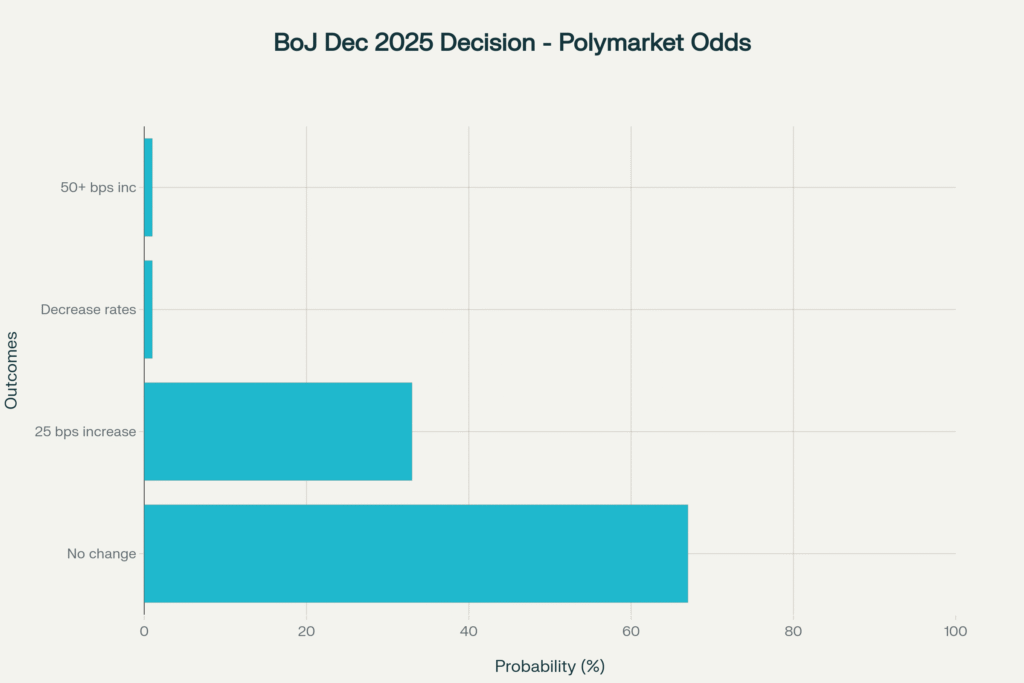
Market Breakdown:
| Outcome | Probability | Volume |
|---|---|---|
| No change | 67% | $19,175 |
| 25 bps increase | 33% | $8,099 |
| Decrease rates | 1% | $86,912 |
| 50+ bps increase | <1% | $38,253 |
Total Trading Volume: $152,440
Now, here’s what immediately catches my eye about these numbers. The market is pricing in a two-thirds chance that the BOJ holds steady at 0.5%.
That’s actually MORE cautious than what traditional analysts are saying we’ll get to that discrepancy in a minute, because it might represent a genuine opportunity.
But notice something weird? The “Decrease rates” outcome has by far the highest volume ($86,912) despite having only a 1% probability. That’s 57% of all trading volume on an outcome the market thinks is virtually impossible.
What gives? My read is that these are either legacy positions from when the market first opened, or sophisticated traders using it as a hedge against broader currency moves. Either way, it shows this market has some interesting quirks.
The BOJ’s Journey: How We Got Here?
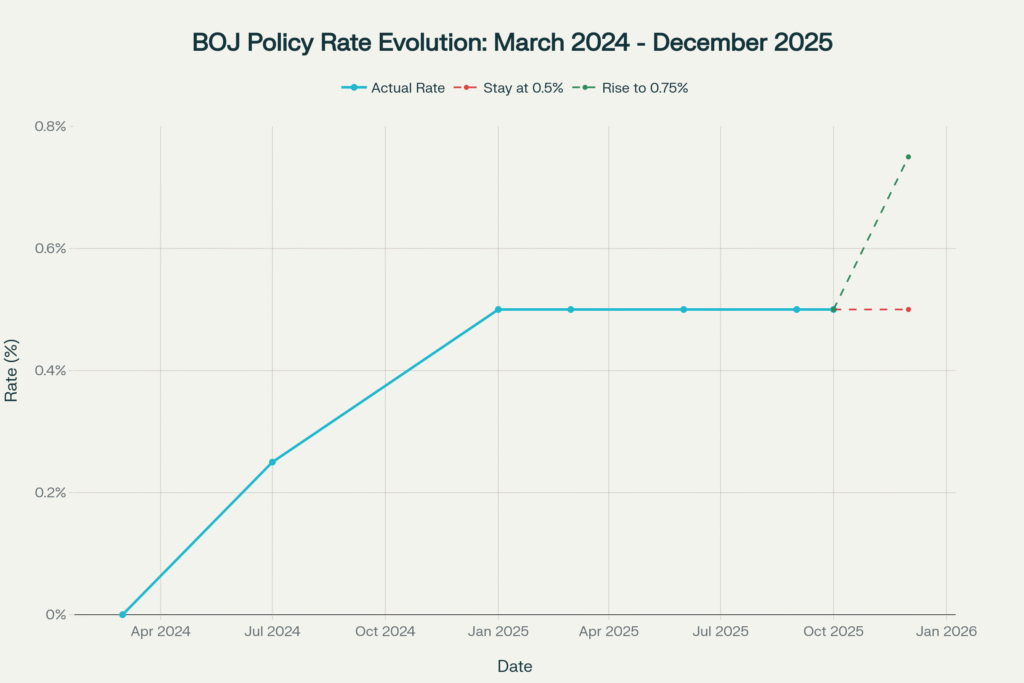
Let me give you the quick history because it matters for understanding where we’re headed. In March 2024, the BOJ ended negative interest rates for the first time in 17 years—a genuinely historic moment. They raised rates to 0.25% in July 2024, then pushed to 0.5% in January 2025, the highest level since 2008.
Since then? Radio silence. The BOJ has held rates steady through March, June, September, and October meetings in 2025. But—and this is crucial—at both the September and October meetings, two board members (Naoki Tamura and Hajime Takata) voted to raise rates to 0.75% immediately. They were outvoted 7-2, but the fact that the same two hawks keep pushing tells you there’s real internal pressure building.
What’s Driving the Odds
Let me lay out why roughly one-third of the market thinks we’re getting a rate hike in December. The arguments are actually pretty compelling:
Inflation Won’t Quit
Japan’s core inflation hit 2.9% in September 2025. More importantly, it’s been above the BOJ’s 2% target for 41 consecutive months, that’s three and a half years of persistent inflation.
This isn’t a blip. Food prices are soaring, energy costs are up, and the weak yen is importing inflation through higher import costs.
Governor Ueda himself has acknowledged that inflation is “on track to durably hit the bank’s target”. That kind of language from central bankers usually means they’re preparing markets for action.
Wage Growth Is Real and Accelerating?
Here’s where things get fascinating. Japan’s 2025 spring wage negotiations (the famous “shunto”) delivered a 5.39% average wage increase, the highest in decades. Total cash earnings jumped 4.1% in July, the fastest growth in seven months.
And get this, labor unions are already setting targets for 2026. Rengo, Japan’s largest labor federation, is demanding at least 5% again.
UA Zensen, which represents textile and retail workers, is pushing for 6%. The BOJ has repeatedly said that sustained wage growth is their key criteria for rate hikes. Well, they’re getting it.
The Yen is Too Weak
The USD/JPY exchange rate has been hovering around 153-154 yen to the dollar. That’s way below the 10-year average of 122, and it’s causing real pain for Japanese households through higher import costs. Even US Treasury Secretary Scott Bessent weighed in, publicly urging Japan to “give the BOJ policy space” to raise rates and avoid “excess exchange rate volatility”.
When the US Treasury Secretary is basically telling you to raise rates, that’s not subtle pressure. That’s a diplomatic shove.
Two BOJ Board Members Are Already Voting for It
Tamura and Takata have now dissented twice in a row, calling for an immediate hike to 0.75%. Takata gave a speech in October saying “now is a golden opportunity to raise the policy interest rate”.
When board members start making public speeches advocating for rate hikes, it often signals that the consensus is shifting behind closed doors.
Governor Ueda’s Subtle Signals
After the October meeting, Ueda dropped some interesting language. He talked about gathering information on the “initial momentum” of 2026 wage negotiations before deciding to raise rates.
The key word is “initial”, he’s not waiting for final March results. He wants December data on wage-setting from major companies, especially automakers, which often announce targets in December.
That timing points directly to the December 18-19 meeting.
Why Two-Thirds of the Market Says “Not Yet”
Now let me tell you why I understand the market’s caution, because there are legitimate reasons to think the BOJ will hold:
Political Pressure is Real: Prime Minister Sanae Takaichi took office in October 2025, and she’s a known advocate of Abenomics-style loose monetary policy. Just days ago, she told parliament that Japan is “still halfway” toward achieving sustainable inflation with wage gains.
That’s not exactly code for “please raise rates immediately.”
While Takaichi has been careful not to directly pressure the BOJ (which would violate their independence), her preferences are crystal clear. The market is definitely pricing in some political risk here.
The Economy Isn’t Roaring: Japan’s Q2 2025 GDP grew just 0.5% quarter-over-quarter, better than expected but hardly robust.
Exports have been weak, falling for four straight months before a modest September rebound. And exports to the US specifically are still declining.
With the economy showing “softness” and “moderate” growth, there’s an argument for caution.
Global Uncertainty Remains: US tariff policies continue to create uncertainty for Japanese exporters. The BOJ has cited this as a reason to go slow on rate hikes.
Additionally, if there’s any whiff of a US economic slowdown, that would give the BOJ another excuse to pause.
December is Illiquid: Here’s a tactical consideration: December is notorious for thin market liquidity as year-end approaches. The BOJ got criticized after their July rate hike contributed to market volatility.
Bank of America analysts specifically noted that the BOJ would be wary of “risk of a repeat of that situation, especially with liquidity being limited during the year-end period”.
If you’re Governor Ueda, and you’ve got a volatile yen, a dovish Prime Minister, and thin December markets, waiting until January might seem like the prudent play.
Wage Data Won’t Be Complete: While Ueda has said he wants “initial momentum” from wage talks, the reality is that December data will still be preliminary.
The big union announcements come in January, with final results in March. If you want to be absolutely certain about wage trends, January or March gives you more information.
Polymarket vs. The Street
Here’s where it gets really interesting for traders. Check out this comparison:
| Source | Hike Probability | Hold Probability |
|---|---|---|
| Polymarket | 33% | 67% |
| Bloomberg Survey | 50% | 50% |
| Reuters Poll | ~50% | ~50% |
| Analyst Consensus | 45–50% | 50–55% |
Polymarket is pricing in a significantly LOWER chance of a December hike than traditional Wall Street analysts. Bloomberg’s October survey showed 50% of economists expecting a December hike. Reuters polls were similar. Even the December Tankan survey forecast and analyst commentary pointed to December as the most likely timing.
So why the gap? I see three possibilities:
Theory 1: The Market Is Pricing Political Risk More Heavily
Polymarket traders might be putting more weight on Prime Minister Takaichi’s dovish influence than professional economists. Traditional forecasters often underweight political factors, assuming central bank independence is absolute.
Crypto-native prediction market traders, on the other hand, tend to be more cynical about institutional independence.
Theory 2: Self-Selection Bias
Polymarket’s user base skews younger, more crypto-aware, and possibly more risk-averse on this particular question.
If you’re betting with USDC in a crypto-adjacent market, you might have different risk preferences than a sell-side economist publishing a forecast.
Theory 3: It’s an Arbitrage Opportunity
If you genuinely believe the analyst consensus is right and there’s a 45-50% chance of a December hike, then buying the “25 bps increase” outcome at 33 cents is positive expected value. You’re getting 2-to-1 odds on something that might be closer to even money.
I’m not telling you which theory is correct that’s for you to decide with your money. But the divergence is real and meaningful.
Market Mechanics and Liquidity: What You Need to Know
Let’s talk practically about trading this market. With $152,440 in total volume, this isn’t one of Polymarket’s mega-markets (compare to the hundreds of millions on US election markets), but it’s respectable for a central bank decision.
Order Book Dynamics
The “No change” outcome has relatively thin volume ($19,175) given its 67% probability. That suggests the market could move quickly if news breaks. The “25 bps increase” at 33% has even thinner volume ($8,099), which means larger positions will likely move the price significantly.
Resolution Mechanics
The market will resolve based on the BOJ’s official Statement on Monetary Policy released on December 19, 2025, likely around 12:00-14:00 JST (evening of December 18 US Eastern Time). The primary resolution source is the Bank of Japan’s official website, with “consensus of credible reporting” as a backup.
One important detail: if the BOJ raises by any amount not expressly listed (say, 12.5 bps), it rounds UP to the nearest 25 bps bracket. So a 12.5 bps hike would resolve as “25 bps increase.” That’s probably not relevant here, but know the rules.
Liquidity and Slippage
If you’re putting more than a few thousand dollars on this, expect some slippage. The order books aren’t deep enough to absorb whale-sized positions without moving the market.
That actually creates an interesting dynamic if a sophisticated trader (or entity with inside information) wanted to take a large position, we’d likely see it in the odds.
Speaking of whales, there’s no evidence yet of the kind of massive concentrated betting we saw on US election markets. This market seems to be reflecting genuine crowd wisdom rather than a few large players dominating.
December 18-19 Meeting
Let me walk you through the timeline and what to watch for, because the signals will come in real-time and you might be able to adjust positions:
Pre-Meeting Data Drops
- December 13: Tankan Business Survey – This quarterly survey of business sentiment from the BOJ itself will be critical. Look for business confidence, spending plans, and inflation expectations. Strong numbers will boost hike odds.
- December 15: Detailed Tankan Data – The full Q4 Tankan release includes forward-looking forecasts and wage plan details. This is what Ueda has said he wants to see.
- Early December: Wage Announcement from Major Automakers – Companies like Toyota often announce preliminary wage plans in December. Ueda has specifically cited automakers as “particularly significant”.
Meeting Day (December 18-19)
The BOJ typically announces the decision on the second day, around midday Japan time (evening US ET on December 18). The announcement will come with an updated Quarterly Outlook Report.
Governor Ueda’s Press Conference
This is where the real action happens. Even if the BOJ holds rates, Ueda’s language and tone will determine how markets react:
- Does he explicitly signal a January hike?
- Does he cite political concerns or global uncertainty?
- How does he characterize the wage data?
- What does he say about yen weakness?
Past press conferences have moved markets more than the actual rate decision.
How I’d Think About This?
Let me share a few strategic frameworks, not as financial advice (I’m not your advisor!), but as how I personally analyze these markets:
The “Fade the Caution” Play
If you believe the analyst consensus over Polymarket odds, you buy “25 bps increase” at 33 cents. Your thesis: the market is overweighting political risk and underweighting the economic fundamentals (inflation, wages, yen weakness). You’re getting 2-to-1 payoff on what might be closer to even odds.
Risk: Takaichi’s influence is real, or Ueda decides to wait for more wage data.
The “Safe Haven” Play
You buy “No change” at 67 cents. Your thesis: the BOJ has paused for six straight meetings, Takaichi is publicly dovish, and Ueda is naturally cautious. Why would December be different? You’re taking lower returns (67 cents becomes $1, so 49% profit) for higher probability.
Risk: The BOJ surprises markets with a hawkish pivot.
The “December Data Dependent” Play
You wait. Don’t enter any position until after the December 13-15 Tankan data and any automaker wage announcements. If the data is strong, buy the hike. If it’s weak, buy the hold. You sacrifice some edge in price movement but gain information clarity.
Risk: The odds move before you can enter at attractive prices.
The “Hedge a Currency Position” Play
If you have a long yen position (betting on yen strength), you might buy “No change” as a hedge. If the BOJ doesn’t hike, the yen likely weakens, but your Polymarket position pays off. This is portfolio-level thinking, not pure speculation.
The “Wait for Governor Signals” Play
Watch for any speeches, interviews, or statements from Governor Ueda or board members between now and December 18. Japanese central bankers tend to signal their intentions. If you see hawkish rhetoric, jump on “25 bps increase.” If you see dovish caution, load up on “No change.”
Risk Factors and Volatility Triggers
Let me be straight with you about what could blow up any position:
Black Swan: US Government Shutdown or Market Crisis
If there’s a major US fiscal crisis, government shutdown affecting data releases, or market stress event, the BOJ will almost certainly hold. They’re not going to tighten into global uncertainty.
Wildcard: PM Takaichi Makes Direct Comments
If Prime Minister Takaichi breaks with tradition and publicly comments on BOJ policy immediately before the meeting, all bets are off. That would be highly unusual but not impossible.
Data Surprise: Weak Tankan Results
If the December Tankan shows deteriorating business confidence or lowered spending plans, the hike is dead in the water.
Fed Influence: What Happens at the December 10 FOMC
If the Federal Reserve cuts rates again on December 10 (currently ~70% probability on Polymarket), that might give the BOJ more room to hike. But if the Fed signals it’s done cutting, that complicates Japan’s calculus with the yen.
Yen Volatility: Sharp Moves Before the Meeting
If USD/JPY breaks above 160 or drops below 145 in the two weeks before the meeting, that changes everything. At 160+, the BOJ would face intense pressure to hike and support the currency. Below 145, they might feel they have breathing room to wait.
Is Polymarket Leading or Lagging?
One thing I always check is whether Polymarket is ahead of or behind the narrative compared to other prediction markets and traditional betting lines. Unfortunately, neither Kalshi nor PredictIt currently offers a BOJ decision market (Kalshi focuses on US economic data, PredictIt on US politics).
This means Polymarket is basically the only game in town for this event, which has pros and cons:
Pro: First-mover advantage means sophisticated traders have congregated here. The price might be more efficient than a brand-new market.
Con: No arbitrage pressure from competing markets means the price could drift from true probabilities without correction mechanisms.
I’d watch for any traditional bookmakers (like UK-based betting firms) offering odds on this. If they appear and show meaningfully different prices, that’s an arb signal.
The Wisdom of Crowds vs. Expert Opinion
Here’s one of my favorite dynamics in prediction markets: when does the crowd know better than experts, and when do experts have an edge?
On BOJ policy, I lean toward the experts having a slight edge because:
- Information asymmetry exists: Economists have direct access to BOJ officials, attend their speeches, and can read Japanese-language signals that most Polymarket traders miss.
- Complex technical analysis: Understanding Japanese monetary policy requires deep knowledge of Japan’s economic history, labor market dynamics, and political economy. That’s specialist knowledge.
- Historical pattern recognition: BOJ watchers have seen this movie before. They know how Governor Ueda signals, how the board thinks, and what language precedes action.
That said, prediction markets have consistently outperformed expert polls on major events because they:
- Aggregate diverse information: Thousands of traders bring different perspectives and information sources.
- Put money where mouths are: No cheap talk. Every opinion is backed by capital at risk.
- Update in real-time: No publication lag. Odds move instantly on news.
My synthesis? The analyst consensus of ~45-50% hike probability is probably closer to reality than Polymarket’s 33%, but the truth likely lies somewhere in between. Maybe 38-42% is the “fair value.”
Friendly Advice for Trading This Market
Alright, let’s bring this home with some practical wisdom I’ve learned from trading prediction markets and following central banks:
Don’t Bet More Than You Can Afford to Lose
I know this sounds like your mom talking, but central bank decisions are genuinely uncertain. Even the BOJ doesn’t know for certain what they’ll decide until they’re in the room.
If you’re betting more than 2-3% of your prediction market bankroll on this single event, you’re probably overexposed.
Diversify Information Sources
Don’t just read Polymarket comments or Twitter hot takes. Follow Japanese economic journalists on Twitter, read Bloomberg and Reuters coverage, check out the BOJ’s website directly. The best trades come from information edges, not vibes.
Watch the Yen
The USD/JPY exchange rate is your real-time barometer of what smart money thinks. If you see the yen strengthening significantly in December, that’s the market pricing in a higher hike probability. Currency traders are sophisticated and well-informed.
Understand Your Edge (or Lack Thereof)
Ask yourself honestly: Why do I know something the market doesn’t? If your answer is “I have a hunch” or “it feels like they should hike,” you probably don’t have an edge. Edges come from superior information, better analysis, or identifying market inefficiencies. If you can’t articulate your edge, you’re gambling, not trading.
Consider Partial Positions
You don’t have to go all-in on one outcome. You could put 60% on “No change” and 40% on “25 bps increase” if you genuinely think it’s close but lean toward hold. Prediction markets allow for probabilistic thinking, not just binary bets.
Remember the House Edge (Fees)
Polymarket takes a small percentage on trades. Make sure your expected value calculation accounts for fees. A 33% probability bet needs to be profitable enough post-fees to be worth it.
This Is a Learning Opportunity
Even if you don’t put money down, following this event closely is a masterclass in central banking, currency markets, and how prediction markets process information. Watch how the odds move in response to news. See which information actually matters and which is noise. That knowledge compounds for future trades.
The Best Trade Might Be No Trade
Sometimes the most profitable position is no position. If you genuinely can’t determine whether you have an edge, sitting this one out is perfectly valid. There will be other markets, other opportunities.
What Happens After December 19
Regardless of what the BOJ decides, this won’t be the end of the story:
If They Hike: Expect Polymarket to quickly launch a market for the next meeting (probably “BOJ January 2026 decision”). The question becomes: is this one-and-done, or is the BOJ on a hiking cycle? Watch for language in Ueda’s press conference about future rate path.
If They Hold: The January 28-29, 2026 meeting becomes the new focus. Markets will likely assign even higher probability to a January hike, especially if the hold is explicitly telegraphed as “waiting for more wage data.”
Either Way: The yen will move, potentially dramatically. If you’re trading crypto (especially BTC/JPY or ETH/JPY pairs), the BOJ decision will matter for your portfolio. Consider the broader implications.
Sources and Live Market Link
I’ve based this analysis on extensive research including:
- Bank of Japan official statements and meeting minutes
- Reuters and Bloomberg reporting on BOJ policy
- Economic data from Trading Economics and official Japanese statistics
- Analyst forecasts from major banks including DBS, Goldman Sachs, Capital Economics
- US Treasury Secretary Scott Bessent’s public statements
- Japanese labor union wage negotiation targets
- Currency market data and technical analysis
For live odds and to trade this market: Polymarket – Bank of Japan Decision in December
Final Thoughts
The Bank of Japan’s December decision is genuinely uncertain, which is exactly what makes it an interesting prediction market. You’ve got credible arguments on both sides, incomplete information, political complexity, and real economic stakes. That’s the sweet spot for prediction market trading.
Whether you decide to put money on this or not, watching how this plays out will teach you something about how central banks operate, how prediction markets process information, and how global macro events create trading opportunities.
The market is currently pricing in a 67% chance of no change and a 33% chance of a 25 basis point hike. Traditional analysts are closer to 50-50. Someone is going to be right, and someone is going to be wrong. The question is: which side are you on?
As Governor Ueda himself has said repeatedly, the decision is “data dependent.” So keep watching that December Tankan survey, those wage announcements, and the USD/JPY exchange rate. The market will tell you what’s happening if you know how to listen.
Now go forth and trade responsibly. Or don’t trade at all, that’s fine too. The most important thing is to stay informed, think probabilistically, and never bet more than you can afford to lose.
See you on December 19 when we find out who read the signals correctly.
