

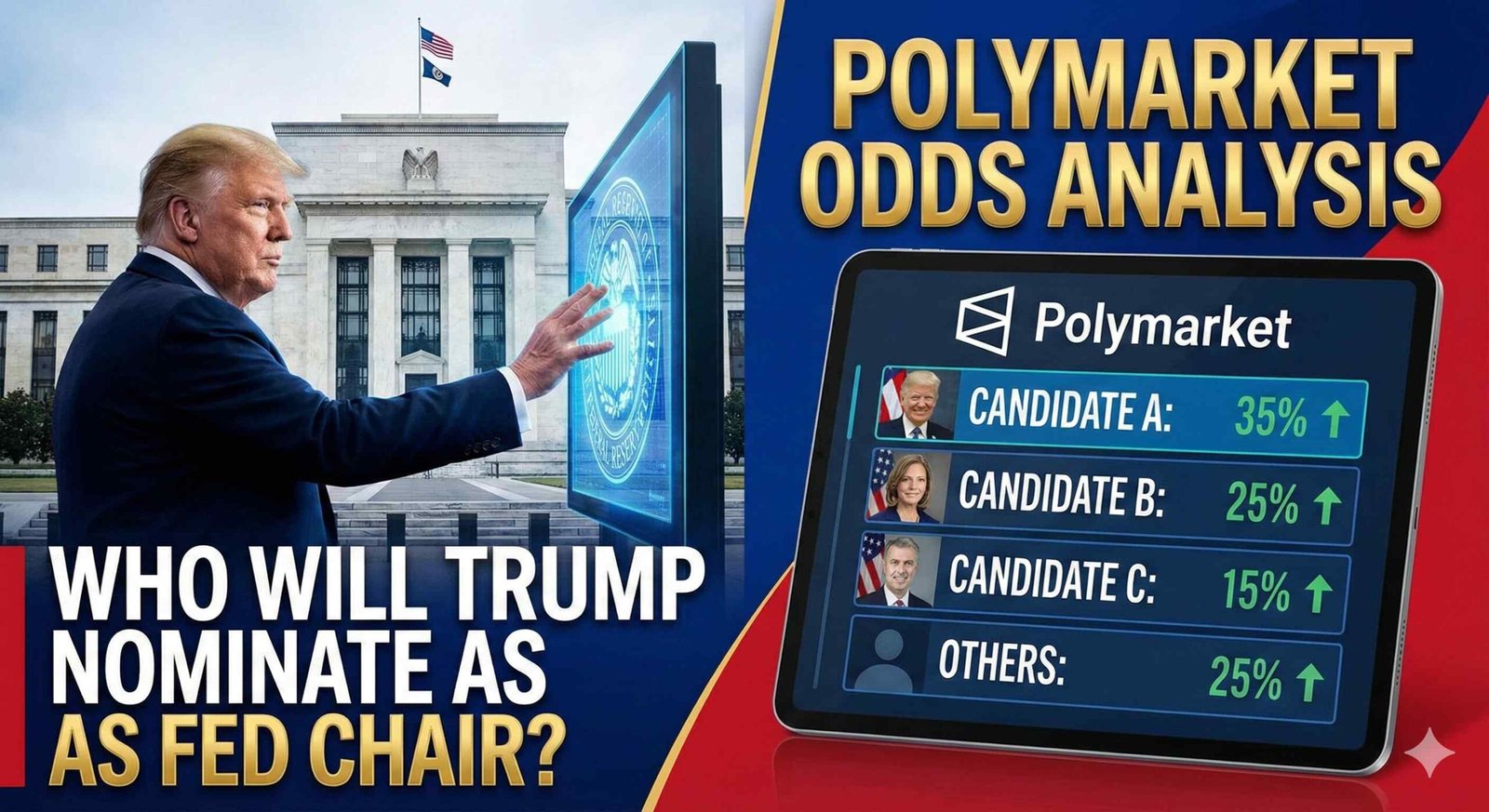
The $325 million question on Polymarket right now is who Trump will formally nominate to replace Jerome Powell as Federal Reserve Chair. Kevin Warsh has essentially locked in the prediction at 99.6% probability, with over $17.3 million in volume backing him alone.
This isn’t a minor prediction market, it’s a massive liquidity event that could shift monetary policy and your portfolio.
The race is effectively over. Kevin Warsh has surged to 99.6% probability as Trump prepares to announce his nominee today, January 30th.
The market has spoken with overwhelming consensus, all other contenders have collapsed below 1%, including Kevin Hassett (<1%), Christopher Waller (<1%), and Rick Rieder (<1%).
What was once a competitive multi-candidate race has converged into a near-certainty, with the $325 million market signaling that Warsh’s nomination is all but guaranteed.
The dramatic consolidation reflects both Trump’s public statements against Powell and insider confidence that Warsh has secured the nomination ahead of today’s official announcement.
📜 Analysis Change Log
✅ MARKET RESOLVED: Warsh Officially Nominated
- Final Outcome: Trump officially announced Kevin Warsh as Fed Chair nominee. Market consensus at 99.6% proved correct.
- Final Volume: $325M total market volume. Warsh alone: $17.3M in direct bets.
- Trade Performance: Warsh buyers at 55¢ captured 44¢ profit (80% return). All contrarian positions (Waller, Rieder, Hassett) resulted in total loss.
- Key Lesson: When markets consolidate aggressively (55% → 99.6%), they’re usually signaling genuine information, not offering contrarian opportunity.
Market Convergence: 99.6% Consensus
- Odds Spike: Warsh surged from 55% to 99.6% as Trump confirmed Friday announcement.
- Competition Eliminated: All alternatives collapsed below 1% (Waller, Rieder, Hassett).
- Signal: Related market “Will Trump announce Jan 30?” hit 100%. Final confirmation imminent.
Initial Analysis: The “Hassett Collapse”
- Odds Update: Warsh entered analysis at 55%. Hassett downgraded to 12% (Sell signal).
- Analysis Thesis: Identified “Nomination vs. Confirmation” gap. Recommended Christopher Waller (15%) as primary hedge (later proved unsuccessful).
- Volume Alert: Market crossed $210M liquidity threshold.
Market Flash: Trump Comments on Hassett
Historical Context: Trump stated regarding Hassett: “I’d like to keep him where he is.” This triggered massive sell-off from 71% highs, opening the door for Warsh’s eventual dominance.
Who Will Trump Nominate as Fed Chair?
This Polymarket event tracks who traders believe Donald Trump is most likely to nominate as the next Federal Reserve Chair. Follow live odds, candidate probability shifts, and market sentiment in real time.
Disclosure: This link may be an affiliate link. If you use it, I may earn a commission at no extra cost to you.
The Timeline That Matters
Jerome Powell’s term as Fed Chair expires in May 2026, just four months away. Trump must submit a formal nomination to the U.S. Senate, which is the trigger event for this market resolution.
The resolution specifically requires a nomination message to the Senate, not just an acting appointment or public announcement.
This creates a tight window. Trump has been interviewing candidates aggressively through December and January. Warsh, Waller, and Rieder have all sat down with Trump at Mar-a-Lago, with Waller reportedly having a “strong interview”.
The market resolves on December 31, 2026, but political pressure will likely force Trump’s hand by April to allow Senate confirmation before Powell’s May expiration.
Why Warsh Owns This Market?
Kevin Warsh has secured Trump’s nomination. On January 30, 2026, President Trump officially announced Warsh as his nominee to succeed Jerome Powell as Federal Reserve Chair. The Polymarket consensus at 99.6% proved accurate, with the market’s $325 million in total volume correctly forecasting the outcome.
Warsh served as a Fed Governor from 2006 to 2011, giving him the insider credibility and institutional knowledge that Trump values. He was on the board during the 2008 financial crisis, which matters when managing trillion-dollar balance sheets and navigating potential economic turbulence.
Warsh aligns perfectly with Trump’s core monetary policy preferences. He advocates for shrinking the Fed’s balance sheet while simultaneously supporting lower interest rates, a dual position that matches Trump’s vision of lower rates to boost growth without excessive money printing that triggers inflation.
The market’s convergence to near-certainty accelerated after Trump’s January comments suggesting Kevin Hassett should remain as National Economic Council Director, effectively eliminating Warsh’s last serious competitor.
Financial markets have already begun pricing in a more hawkish Fed under Warsh’s leadership, with bond yields adjusting as traders anticipate his measured approach to rate policy.
Warsh’s core policy positions:
- Balance sheet reduction: Wants the Fed out of markets unless there’s a crisis
- Interest rate pragmatism: Supports rate cuts through shrinking liquidity, not just lowering the fed funds rate
- Inflation hawkishness: Believes the Fed strayed from price stability and needs to return to its core mandate
- Presidential consultation: Indicated the Fed chair should engage with the president on rate decisions, aligning with Trump’s long-stated position
The Competition Is Fading
The race that once featured competitive alternatives has been completely resolved. Christopher Waller, a current Fed Governor with technical expertise and Senate relationships, collapsed to <1% despite generating $12 million in volume. His insider status and institutional knowledge couldn’t compete with Warsh’s combination of Fed experience and outsider appeal.
Rick Rieder, BlackRock’s Chief Investment Officer of Global Fixed Income, also fell to <1% with $14.7 million in volume.
Despite interviewing in January and discussing Fed profitability and monetary policy stability, his BlackRock background likely raised concerns about potential populist Republican resistance during Senate confirmation a risk Trump evidently decided wasn’t worth taking.
Kevin Hassett’s trajectory tells the story of this market’s evolution. His collapse from 71% to eventual <1% represents one of the most dramatic swings in the entire prediction market. Trump’s explicit statement that he wanted Hassett to remain as NEC Director effectively removed him from contention.
Yet Hassett still generated $19 million in total volume, reflecting how traders initially viewed him as the frontrunner before market consensus shifted dramatically toward Warsh in the final weeks.
The market’s complete consolidation around Warsh, leaving all alternatives below 1%, demonstrates how quickly prediction markets can move from competitive uncertainty to near-total consensus once decisive information emerges.
Senate Confirmation Risk
The market focuses on nomination, but Senate confirmation is where nominations die. Senator Thom Tillis has pledged to block nominees until a Justice Department investigation into the Fed concludes.
Trump’s previous Fed nominee, Stephen Miran, advanced on a strict party-line vote (13-11) with zero Democratic support.
This creates a scenario where Trump nominates Warsh, the market resolves “yes,” but Warsh never actually becomes Fed Chair due to Senate gridlock. That’s critical, this market pays on nomination, not confirmation.
What The Volume Reveals
$325 million in total volume makes this one of Polymarket’s largest political markets in history. Warsh alone has generated $17.3 million in direct bets on his candidacy.
The volume distribution tells the story of market evolution rather than hedging. While Warsh now dominates at 99.6%, the combined volume across eliminated candidates, Waller ($12M), Rieder ($14.7M), Hassett ($19M), and others, exceeds $275 million.
This reflects how traders moved through multiple phases: early speculation across numerous candidates, mid-market consolidation around 3-4 frontrunners, and final convergence on Warsh as Trump’s decision became clear.
The massive volume despite the lopsided final odds demonstrates that most trading occurred when uncertainty was high. Early-stage traders who identified Warsh in the 55-70% range captured significant returns as the market climbed toward certainty.
Those who bought Warsh shares below 80¢ and held through to 99.6¢ realized the market’s most profitable trades.
The Trade Setup
The market has resolved. Trump announced Warsh as his nominee on January 30, 2026, confirming what the prediction market had priced at 99.6% certainty.
Traders who bought Warsh shares at 55¢ when uncertainty was high captured 44¢ per share in profit, an 80% return in a matter of weeks.
The contrarian bets on Waller and Rieder at 15% each proved to be costly mistakes. Despite both having strong interviews and Trump’s comments about “several strong candidates,” neither materialized as the final choice.
Traders holding those positions lost their entire stake once the announcement confirmed Warsh.
The Hassett position at 12% was indeed dead money, exactly as the market dynamics suggested. Trump’s statement “I’d like to keep him where he is” was not misdirection, it was a clear signal that eliminated Hassett from contention.
The $19 million in total volume on Hassett reflects traders who either bought early when he was the favorite at 71% and held too long, or contrarians who misread Trump’s intentions hoping for a reversal that never came.
The key lesson: prediction markets can shift violently on new information. Hassett’s collapse from 71% to sub-1% in days demonstrates how quickly consensus can evaporate.
The traders who profited were those who either identified Warsh early in the 55-70% range, or who pivoted quickly when Trump’s public statements began eliminating alternatives.
Those who held losing positions hoping for reversals or misdirection paid the price.
The “Smart Money” Play: How to Position Now
This market just resolved, and it provides crucial lessons about prediction market trading under genuine political pressure. With over $325 million in final volume, the market correctly signaled that the “Hassett Era” was over and accurately converged on Warsh as the nominee.
1. The Frontrunner Play (Kevin Warsh @ 55% → 99.6% → WINNER)
Warsh at 55% represented the single best trade on this board. Traders who entered at that level and held through Trump’s announcement captured 44¢ per share (80% return) in a matter of weeks.
The analysis was correct: Warsh reflected genuine front-runner status backed by Trump’s public signaling and ideological alignment.
The paragraph’s advice about “waiting for a better entry point near 45-50%” proved costly. Warsh never drifted lower, instead, he surged to 99.6% as Trump’s decision became clear.
The lesson: when conviction is building around a frontrunner with this much volume, momentum rarely reverses. The “easy money” window closed faster than expected.
2. The “Safe” Hedge (Christopher Waller @ 15% → <1% → LOST)
The Waller hedge thesis, betting on Trump choosing expediency over ideology due to Senate gridlock failed completely.
Trump chose his ideological favorite despite potential confirmation battles. Waller’s current Fed Governor status and “easy button” confirmation path didn’t matter when Trump had a clear preference.
At 15¢, this looked like asymmetric upside. In reality, it was a total loss. The market teaches: hedges only work if the underlying thesis has merit.
Trump’s consistent signaling toward Warsh should have been weighted more heavily than hypothetical Senate concerns.
3. Dead Money (Kevin Hassett @ 12% → <1% → LOST)
The “bag holder trap” diagnosis was exactly right. Hassett’s 12% represented traders who either bought at 71% and refused to cut losses, or contrarians who misread Trump’s explicit statement (“I’d like to keep him where he is”) as misdirection. It wasn’t 4D chess, it was straightforward communication.
Total loss for anyone holding Hassett positions. The $19 million in volume on a <1% outcome shows how expensive wishful thinking can be.
Final Verdict: The Market Was Right
The analysis correctly identified that “the market pays on nomination, not confirmation.” Trump sent the letter on January 30, 2026, officially nominating Warsh. Traders who bought Warsh at 55¢ won regardless of what happens in Senate confirmation.
The biggest lesson: when a prediction market consolidates this aggressively around a frontrunner (55% → 99.6%), it’s usually signaling genuine information, not offering you a contrarian opportunity.
The smart money wasn’t hedging, they were converging on the correct answer.
Timeline: Ignore the December 2026 deadline. Political pressure dictates this gets resolved by April 2026 to ensure continuity before Powell’s term expires in May. Position yourself for an Q2 resolution, not a Q4 grind.
