

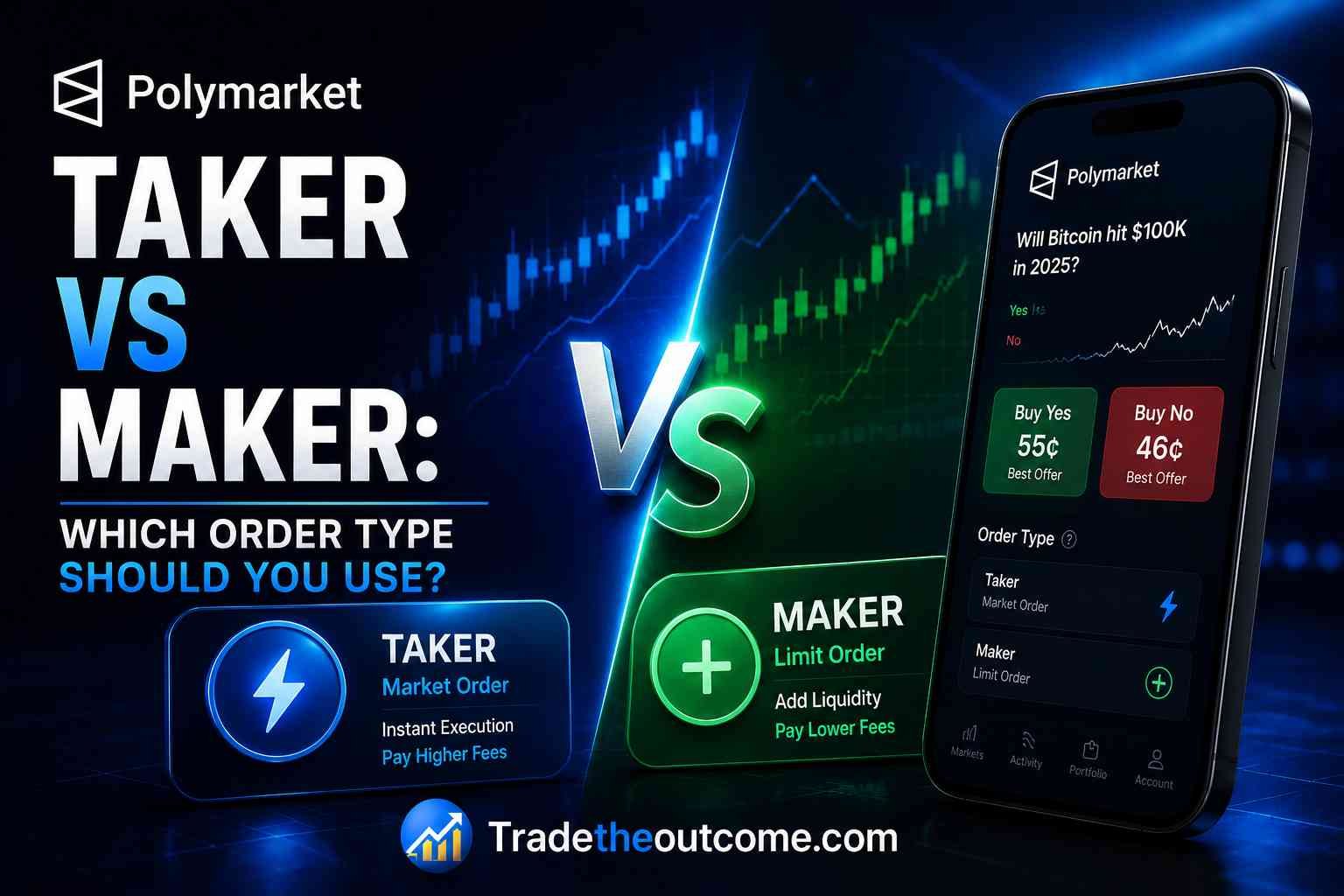
The maker vs taker distinction on Polymarket determines both how your order executes and what you pay. A taker order fills immediately against existing book depth, triggering a fee.
A maker order rests as a limit order, pays no fee, and earns a daily USDC rebate when filled. The choice is a direct tradeoff between execution speed and trading cost.
As of March 30, 2026, Polymarket expanded its taker fee structure across nearly all market categories, making this decision more consequential than it was in the platform’s earlier zero-fee era.
The only categories that remain permanently fee-free are geopolitics and world events. For every other market, the order type you submit directly affects what you pay per trade.
Key Takeaways
The core differences before the mechanics go deeper.
- Taker orders execute immediately at the best available price; maker orders sit on the order book until a counterparty fills them.
- Polymarket charges taker fees on most market categories in 2026; maker orders always pay zero.
- Fees follow a probability-based curve that peaks near 50¢ and approaches zero toward 0¢ or 100¢.
- Makers earn daily USDC rebates through the Maker Rebates Program when their limit orders get taken.
- Defaulting to taker orders out of habit, rather than deliberate intent, is the most common cost leak for regular traders.
How taker and maker orders work on Polymarket
Polymarket runs a Central Limit Order Book (CLOB), the same structure used by stock and crypto exchanges to match buyers and sellers. Order matching happens off-chain through Polymarket’s operator, with settlement finalized on the Polygon blockchain.
Understanding which side of that book you land on determines whether you are a maker or a taker. Most new traders are unaware their order type is even being assigned, because Polymarket’s default interface submits taker orders without surfacing the distinction explicitly.
Taker orders
A taker order crosses the spread. When you click the buy or sell button and the order fills against prices already sitting on the book, you are a taker. You accepted what was available rather than naming your own price.
In Polymarket’s standard interface, the quick-buy flow submits a taker order by default, executing at the best available price in that moment.
Because a taker order removes liquidity from the book, the platform charges a fee. In thinner markets, you may also absorb slippage, meaning the price you receive differs from the price you saw when you initiated the trade.
In liquid markets with tight spreads, this gap is small. In niche or low-volume markets, it can meaningfully affect your effective entry.
Maker orders
A maker order rests on the book. You specify the price you are willing to pay or accept, and the order waits until another trader is willing to fill it at that price. This is a limit order. In Polymarket’s interface, submitting a limit order at a price that does not immediately cross the current spread guarantees maker status, as confirmed in the Polymarket order lifecycle documentation.
There is one important nuance: if your limit order’s price crosses the spread at the moment of submission, the matching engine fills it immediately and you are treated as a taker. The rule is mechanical. If the order rests and waits, it is a maker order. If it matches on submission, it is a taker order, regardless of what order type label you intended.
The fee and rebate difference
Polymarket’s taker fee formula is: Fee = Θ x C x p x (1 − p), where Θ is the fee coefficient for the market category, C is the number of shares traded, and p is the price per share in USDC.
The formula creates an inverted parabola: fees are highest when the share price sits near 50¢, reflecting maximum uncertainty in the market, and approach zero at the extremes near 0¢ or 100¢. According to the Polymarket Maker Rebates Program documentation, maker orders pay no fee and instead earn a rebate funded by taker fees collected in the same market.
Rebates are distributed daily in USDC directly to your wallet. The payout is performance-based: you receive a share of the taker fees proportional to the liquidity you provided that actually got filled.
A minimum accrued balance of $1 USDC is required before a daily distribution fires. The rebate percentage varies by market category, ranging from approximately 20% in crypto markets to 25% across most standard categories.
Concrete examples from Polymarket US illustrate the scale. Buying 1,000 contracts at $0.65 as a taker costs $11.38 in fees; the maker on the other side of that trade earns a $2.84 rebate.
At $0.10, the taker pays $4.50 and the maker earns $1.13. These numbers compound quickly for anyone trading at scale. As PokerNews reported in April 2026, Polymarket had to quickly revise an early version of this formula after an unexpected distortion in low-price markets created fees that were much higher than intended relative to the actual position size.
Taker vs maker at a glance
A side-by-side comparison across the dimensions that affect a practical trading decision.
| Dimension | Taker order | Maker order |
|---|---|---|
| Execution timing | Immediate | Fills when a counterparty matches your price |
| Fee (most categories) | Yes, formula-based, peaks near 50¢ | Zero |
| Rebate eligibility | No | Yes, daily USDC via Maker Rebates Program |
| Fill certainty | High, fills immediately if book liquidity exists | Not guaranteed; depends on market reaching your price |
| Slippage risk | Yes, especially in thinner markets | None; you set the price |
| Price control | None; accepts best available | Full; you name the price |
| Best suited for | Fast-moving markets, time-sensitive entries, near-certain prices | Patient traders, larger positions, fee-sensitive strategies |
When to use a taker order?
Taker orders justify their cost in one primary scenario: when immediate execution matters more than the fee. A market moving fast, an event resolving within minutes, or any situation where the cost of missing the entry exceeds the cost of the taker fee all support using a taker order. The decision should be deliberate, not default.
The fee curve also works in your favor at the extremes. If you are buying a contract priced at $0.05 or $0.95, the taker fee is close to negligible because p x (1 − p) approaches zero at those probabilities. In a market sitting near $0.50, by contrast, the taker fee peaks.
Checking where the market price sits before submitting takes two seconds and tells you whether a limit order would save meaningful cost.
- Breaking news has moved a market and you need exposure before it reprices further.
- You are trading a 15-minute or short-duration crypto market where a limit order has no time to rest and fill.
- The contract price is near 0¢ or 100¢, where taker fees are minimal under the formula.
- The market has deep order book depth and your position is small enough that slippage is negligible.
When to use a maker order?
A maker order is the better default choice for any trade where price matters more than immediacy. You eliminate the taker fee entirely, set the exact price you want, and earn a USDC rebate if filled.
The only cost is execution uncertainty: a limit order that never reaches your price never fills, and you may miss the trade altogether if the market moves away from you.
For active traders building larger positions, the rebate math compounds. The daily USDC payout from the Maker Rebates Program is proportional to the volume of your liquidity that gets taken, so traders posting competitive limit orders in high-volume markets can generate a meaningful secondary return on top of their trading edge.
Professional liquidity providers on Polymarket almost exclusively operate as makers for exactly this reason.
- You are sizing a position of 500 shares or more where the taker fee would be a real dollar amount at mid-probability prices.
- The order book shows a visible bid-ask spread and you want to post inside it rather than cross it.
- You believe the market will move to your price before the event resolves or before your order expires.
- You are trading in a fee-enabled category and want to participate in the rebate program rather than fund it.
One practical detail absent from most explanations: if you post a limit order and the market price moves through your level before it is matched, you may receive a better fill than you specified, but you remain a maker as long as your order was resting at submission.
The CLOB processes fills by price-time priority, so posting early at a competitive price improves your fill probability relative to others at the same level.
Putting the order type decision to work
The maker-taker model on Polymarket makes fee costs unusually transparent compared to traditional sportsbooks, which embed vigorish invisibly in the spread on every single bet.
On Polymarket, the fee is visible, calculated in advance, and avoidable on the maker side. For most market categories in 2026, the practical default is a maker limit order unless you have a concrete reason to prioritize speed. The Polymarket fees breakdown shows the exact Θ coefficient by category, so you can calculate the actual dollar cost of a taker order before submitting.
For US-based traders specifically, the Polymarket US fee and withdrawal guide covers how the regulated platform handles the same maker-taker distinction under its CFTC-compliant structure.
Geopolitics and world events remain fee-free on both versions of the platform, so order type is purely a mechanical question there. For every other category, a maker order is the cheaper entry, a potential source of daily rebate income, and the structurally patient choice.
Frequently Asked Questions
Common questions about maker and taker orders on Polymarket, answered directly.
What is the difference between maker and taker orders on Polymarket?
A taker order executes immediately against existing book liquidity and triggers a fee on most market categories. A maker order is a limit order that rests on the book until a counterparty fills it; it pays no fee and earns a daily USDC rebate through the Maker Rebates Program when filled. The core difference is speed and immediacy on the taker side versus price control and zero cost on the maker side.
Do maker orders always get filled on Polymarket?
No. A maker order only fills if another trader submits an order at or beyond your specified price before the order expires or the event resolves. If the market never reaches your price, the order goes unfilled and you miss the trade. This execution risk is the primary tradeoff: makers get price control and no fees, but sacrifice the fill certainty that taker orders provide.
Is it better to be a maker or taker on Polymarket?
For most trades in most markets, maker orders are the better choice because they cost nothing and can earn daily rebates. Taker orders are justified when immediate execution is genuinely necessary, such as in fast-moving markets or short-duration contracts resolving within minutes. In geopolitics and world events markets, which carry no taker fees, the distinction has no cost implication either way.
What is the Polymarket Maker Rebates Program?
The Maker Rebates Program distributes a share of taker fees collected in eligible markets back to liquidity providers each day. Rebates are paid in USDC directly to the maker’s wallet, with a minimum accrued balance of $1 USDC required for a daily payout. The rebate percentage varies by market category; as of 2026, most categories return approximately 20 to 25% of the corresponding taker fee back to the maker whose order was filled.
