
Polymarket is accessible in Nigeria without a VPN, and Nigerian users can create an account in under two minutes using an email address or a crypto wallet, with no identity verification required on the international version of the platform.
The key practical challenge for Nigerian users is the USDC on-ramp: Binance suspended all Naira services in February 2024, so the standard advice to “just buy USDC on Binance” does not apply, and Nigerian traders need a different route to fund their Polymarket wallet.
As of May 2026, no geo-block prevents Nigerian IP addresses from loading polymarket.com, and no Nigerian regulator has issued a public enforcement action targeting individual users of the platform.
The regulatory picture at the operator level is more complex following the Investments and Securities Act (ISA) 2025, which President Bola Tinubu signed in March 2025, classifying digital assets as securities under the Securities and Exchange Commission (SEC Nigeria).
That law has direct implications for unlicensed offshore platforms, but as of this writing, its practical enforcement against Polymarket users has been zero.
This guide covers both problems that other Nigeria-focused Polymarket articles skip: how to actually acquire USDC in Nigeria in 2026 given the Binance restrictions, and what the ISA 2025 framework actually means for individual traders versus platform operators.
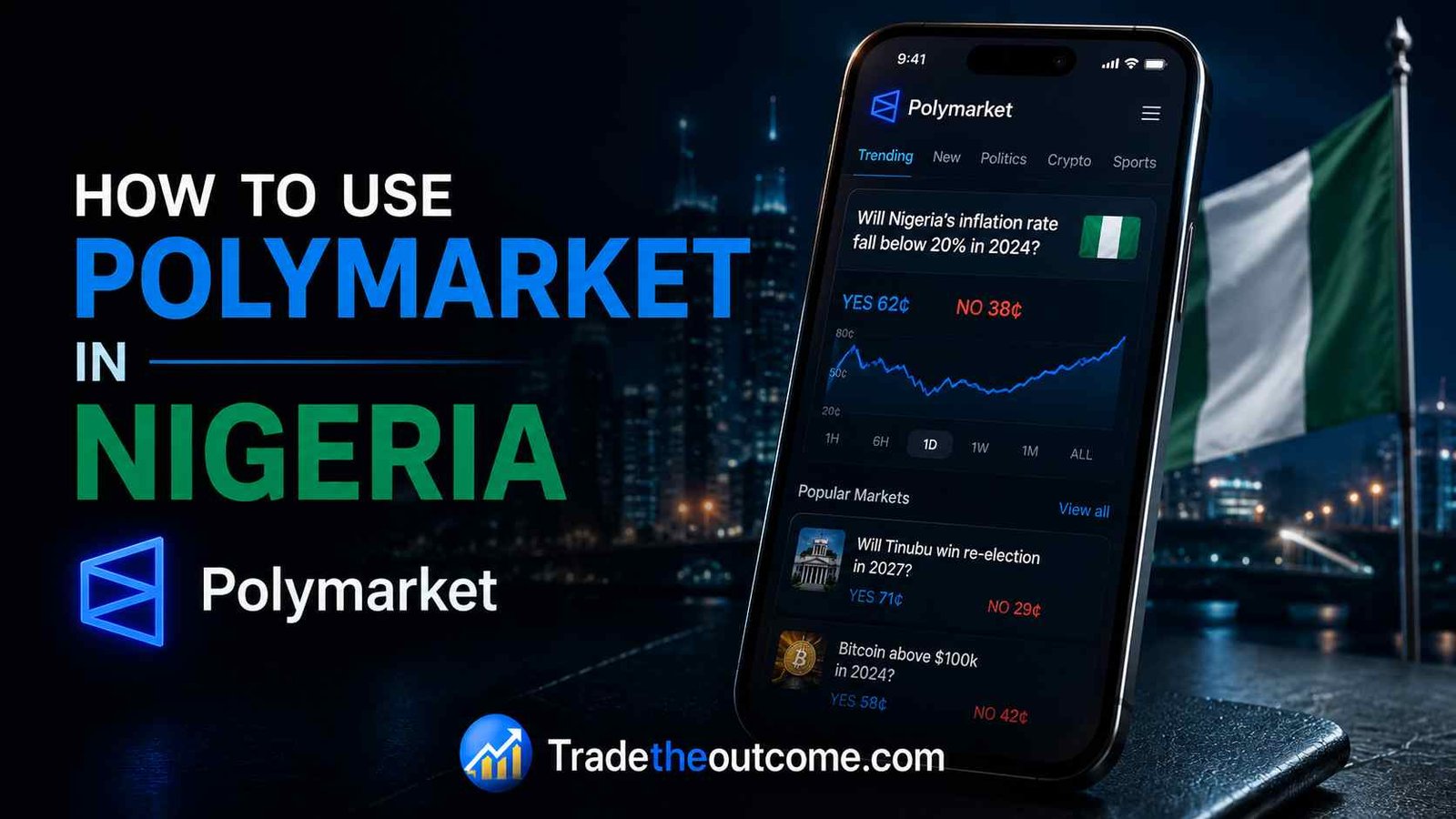
How to Use Polymarket in Nigeria
Learn how Polymarket works in Nigeria, how prediction market odds function, how to explore live events, and how users get started with market participation. This guide explains the platform step by step so you can understand how prediction markets work before placing trades.
Disclosure: This link may be an affiliate link. I may earn a commission at no extra cost to you.
What Polymarket is and how it works for Nigerian users?
Polymarket is a decentralized prediction market where users trade shares on whether specific real-world events will resolve YES or NO, with each share price representing the market’s live probability estimate for that outcome.
For a thorough explanation of the order-book mechanics and how markets resolve through smart contracts and oracle data sources, the foundational explainer on how Polymarket works covers the platform from the ground up.
Nigerian users access the global version of the platform, not the US-regulated version that went live in late 2025. The global version uses a non-custodial model, meaning your wallet and funds are under your direct control at all times.
Trades settle automatically via UMA’s Optimistic Oracle once a market resolves; winnings appear in your wallet as pUSD (Polymarket’s dollar-pegged stablecoin), which you can then withdraw as USDC to an external exchange and convert to Naira.
There is no centralized counterparty holding your funds, which is a meaningful distinction from licensed betting platforms under Nigerian law.
How to create a Polymarket account from Nigeria?
There are two account paths available to Nigerian users. The email route is faster and removes the need to manage a seed phrase at the start. The wallet route gives you full non-custodial control from day one and is the better choice if you already hold crypto. Both are available at Polymarket’s sign-up help page, and neither requires identity documents from Nigerian users.
Option A: Email signup (magic link)
- Go to polymarket.com. The site loads without restriction on Nigerian IP addresses.
- Click Log In and enter your email address. A magic link arrives in your inbox within seconds.
- Click the link to activate your account. Polymarket creates an embedded wallet tied to your email automatically.
- Sign the two on-screen messages: one to connect your wallet and one to enable trading. No transaction fees at this step.
- Your account is live. Proceed to the funding step below before placing any trades.
Option B: Wallet signup (MetaMask or Rabby)
- Install MetaMask or Rabby as a browser extension on Chrome or Firefox.
- Add the Polygon network to MetaMask: go to chainlist.org, search for Polygon Mainnet, and click Add to MetaMask. This is the network Polymarket runs on and must be set correctly before depositing funds.
- Go to polymarket.com, click Log In, and select your wallet from the options.
- Sign both signature requests to connect and enable trading.
- Your wallet is now connected. Proceed to acquire and deposit USDC using the method below.
The non-custodial wallet setup guide covers MetaMask installation, Polygon network configuration, and wallet security practices in more detail if you are setting up your first self-custody wallet.
How to buy USDC in Nigeria and fund your Polymarket wallet
This section is the one Nigerian-specific problem most Polymarket guides skip entirely. Binance, which is the default USDC source recommended in most global Polymarket tutorials, removed all Naira services in February 2024 following regulatory pressure from the Central Bank of Nigeria (CBN).
Nigerian telecom providers also block the Binance website, meaning most Nigerian users cannot access it without a VPN. The following alternatives work reliably in Nigeria in 2026.
Option A: Bybit P2P (recommended for most users)
- Bybit’s P2P marketplace allows direct Naira-to-crypto trades with other users, with payment via bank transfer, OPay, or PalmPay.
- Search for USDC sellers on Bybit P2P and select a verified merchant with high trade volume and a completion rate above 95%.
- Complete the Naira transfer to the merchant’s account, confirm receipt, and the USDC is released to your Bybit wallet.
- Withdraw from Bybit to your MetaMask (or Polymarket deposit) address. When withdrawing, select Polygon as the network explicitly. Do not use Ethereum mainnet by default; Ethereum mainnet gas fees can cost $10 to $20 on top of the deposit, and Polymarket’s minimum deposit on Ethereum is $10 versus $3 on Polygon.
Option B: Yellow Card
- Yellow Card is a licensed African crypto exchange that operates in Nigeria and supports direct Naira-to-USDC purchases via bank transfer.
- Complete Yellow Card’s KYC process (NIN and BVN are typically required), purchase USDC, and withdraw to your Polygon wallet address.
- Yellow Card is one of the few platforms with explicit SEC Nigeria licensing, which reduces banking friction when using Nigerian accounts.
Option C: Quidax or Busha
- Both Quidax and Busha are Nigerian-founded exchanges operating under SEC Nigeria’s Accelerated Regulatory Incubation Programme (ARIP).
- They support Naira deposits and USDC purchases, with withdrawals to external Polygon wallets.
- Rates on these platforms are typically competitive with Bybit P2P and come with the added assurance of a domestic regulatory footprint.
Once your USDC is in your MetaMask wallet on the Polygon network, go to your Polymarket account, click Deposit, and send USDC to your displayed deposit address. The platform converts USDC to pUSD on arrival.
Settlement is near-instant on Polygon, and fees are fractions of a cent. For a full breakdown of what Polymarket charges per trade, the Polymarket fee structure guide explains maker, taker, and withdrawal costs in detail.
Placing your first trade on Polymarket
With pUSD in your account, trading is straightforward. Browse markets from the homepage or use the search bar to find events you have a read on. Polymarket currently has active markets on Nigerian and African economic and political outcomes alongside its global politics, sports, and crypto categories.
- Click any market and read the resolution criteria before buying. Resolution source and date are stated clearly in each market description. Misreading the resolution criteria is the most common first-trade error.
- A share price of $0.68 means the market estimates a 68% probability of YES. If you hold to resolution and the outcome is YES, you receive $1.00 per share.
- Set your position size in the trade panel, review the estimated shares and potential return, then confirm. On liquid markets with over $100,000 in volume, the bid-ask spread is tight. On low-volume markets, the spread can be wide and acts as a hidden entry cost.
- Confirmed trades appear in your Portfolio tab. You can sell before resolution to lock in a gain or cut a loss.
For a structured approach to market selection and an understanding of which categories on Polymarket have historically produced the best-calibrated odds, the Polymarket strategy guide for 2026 covers volume thresholds, category accuracy patterns, and how to identify markets with real informational edge.
Nigeria’s regulatory landscape and what it means for Polymarket users
Nigeria’s crypto regulatory environment underwent its most significant change in decades when President Tinubu signed the Investments and Securities Act 2025 into law on March 25, 2025.
As TechCabal reported at the time, the law formally recognized digital assets as securities under SEC Nigeria’s authority, repealing the 2007 framework and creating, for the first time, a statutory licensing regime for crypto exchanges operating in Nigeria.
Under the ISA 2025, Section 26 prohibits anyone from establishing or operating a securities exchange in Nigeria without SEC registration. Polymarket is not registered with the SEC Nigeria and does not hold a VASP (Virtual Asset Service Provider) license in Nigeria.
That creates an operator-level legal risk for the platform itself. Importantly, the law’s enforcement history so far has targeted platforms and their operators, not individual users placing trades. No Nigerian enforcement action against individual Polymarket users had been reported as of May 2026.
The tax position changed alongside the regulatory framework. The Nigeria Tax Administration Act (NTAA) 2025 integrated digital assets into the personal income tax framework. From 2026, crypto trading profits, including prediction market winnings, are subject to capital gains tax at rates up to 25%.
Polymarket does not report to Nigerian tax authorities, and the platform itself issues no tax documentation, which places the record-keeping obligation entirely on the individual user. Keeping a log of your entry prices, exit prices, and resolved market outcomes is essential if you are trading at meaningful size.
One nuance worth noting: the CBN’s restrictions on banks engaging with crypto entities, which date from its 2021 directive, have not been formally lifted even after ISA 2025.
The practical consequence is that moving Naira into and out of unlicensed crypto rails still carries friction at the banking level, which is why the on-ramp options described above favor SEC-licensed or locally established platforms over direct bank transfers to offshore exchanges.
The same operator-versus-user distinction applies in most other accessible markets globally where national regulators have not yet issued country-specific enforcement orders against Polymarket.
Before you trade from Nigeria
Polymarket is open to Nigerian users at the platform level, and the signup and trading mechanics are identical to any other accessible country. The Nigeria-specific work happens before your first deposit: choosing the right Naira-to-USDC on-ramp and making sure you withdraw on Polygon rather than Ethereum mainnet. Getting that step right saves meaningful money in fees and avoids the bridging step that catches most new users off guard.
The regulatory environment is the variable to watch. ISA 2025 gives the SEC Nigeria expanded tools to pursue unlicensed platforms, and Nigeria has demonstrated it is willing to use regulatory pressure against international crypto entities, as the 2024 Binance situation showed.
Individual user enforcement remains theoretical rather than active for now, but anyone deploying significant capital on Polymarket from Nigeria should monitor SEC Nigeria guidance and keep clean records of all crypto activity for tax purposes under the NTAA 2025.
Frequently Asked Questions
Common questions Nigerian traders ask before their first Polymarket trade.
Is Polymarket available in Nigeria?
Yes. Polymarket has no geo-block on Nigerian IP addresses as of May 2026, and the site loads without a VPN. Nigerian users access the international version of the platform, which uses non-custodial wallets and does not require identity verification at sign-up. The platform has no Nigeria-specific block in place.
Is Polymarket legal in Nigeria?
Polymarket operates in a legally ambiguous position in Nigeria. The ISA 2025, signed in March 2025, requires crypto platforms operating as securities exchanges in Nigeria to hold an SEC Nigeria license, which Polymarket does not have. However, this creates operator-level legal risk for the platform, not explicit criminal liability for individual Nigerian users accessing a foreign platform. No enforcement action against individual Nigerian Polymarket users has been reported as of May 2026.
How do I buy USDC in Nigeria to fund Polymarket?
The most reliable routes in 2026 are Bybit P2P (which supports Naira payment via OPay, PalmPay, and bank transfer), Yellow Card (a licensed African exchange with direct Naira-to-USDC purchases), and Quidax or Busha (both Nigerian-founded exchanges under SEC Nigeria’s ARIP). After purchasing USDC, withdraw to your MetaMask wallet using the Polygon network, not Ethereum mainnet, to avoid unnecessary gas fees.
Do I have to pay tax on Polymarket winnings in Nigeria?
Yes. Under the Nigeria Tax Administration Act (NTAA) 2025, crypto trading profits are subject to capital gains tax at rates up to 25% starting in 2026. Polymarket does not provide tax statements, so you are responsible for maintaining your own records of positions opened, resolved, and withdrawn. Consult a Nigerian tax professional for specific guidance on how to report prediction market income to the Federal Inland Revenue Service (FIRS).
