

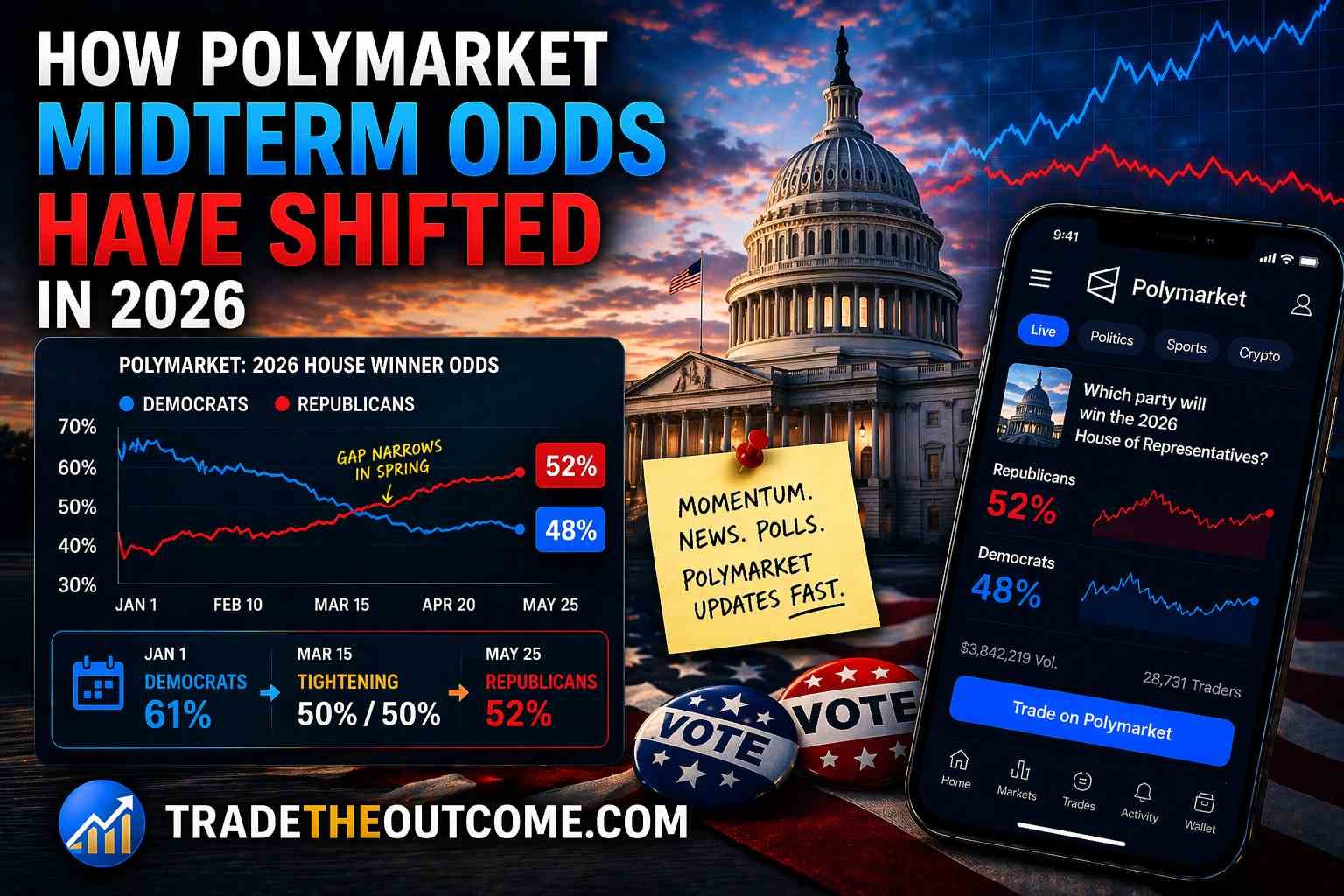
Polymarket odds for the 2026 midterms did not start where they are today. Democrats sit at 84.5% to win the House as of April 2026, but just eight months ago the race looked completely different. Tracking how these odds have moved reveals the key events, data shifts, and market reactions that sharp traders need to understand. This is a full month-by-month breakdown of how 2026 midterm predictions on Polymarket have evolved this year.
Why Tracking Odds Shifts Matters for Traders
Most casual readers check prediction market odds once and treat them as a final verdict. Serious traders do the opposite. They track how odds move, why they move, and whether the market is overreacting or underreacting to new information.
If you are new to how Polymarket works as a platform, our guide on what is Polymarket explains the basics before you dive into the data below.
The 2026 midterm cycle has seen dramatic swings driven by Trump’s approval ratings, tariff announcements, special election results, and shifting generic ballot polling. Each of these events left a visible mark on Polymarket odds. Here is the full timeline.
Month-by-Month Breakdown: August 2025 to April 2026
August 2025: The Market Opens Near 50/50
When the House control market first gained serious liquidity in August 2025, odds sat close to 50% for both parties. Historically, midterms favor the party out of power, and with Trump in the White House, Democratic optimism was present but not dominant. Generic ballot polling showed a modest Democratic advantage of 3 to 5 points, and the market reflected that uncertainty.
September to October 2025: Republican Momentum and a Brief Dip
Republican odds briefly climbed in late September and October 2025. A temporary uptick in Trump’s approval ratings, driven by positive economic data and a quieter news cycle, pushed GOP House odds as high as 42%. This was the highest Republican position in the entire cycle. Polymarket traders responded to short-term sentiment rather than structural fundamentals, which in hindsight was a mispricing opportunity for Democratic buyers.
November 2025: Democrats Surge Past 60%
November 2025 marked a turning point. Off-year election results showed Democrats outperforming expectations in state-level races, which Polymarket traders interpreted as a leading indicator for 2026. Generic ballot polling widened to a Democratic advantage of 7 to 9 points. Democratic House odds broke through the 60% threshold for the first time and held there. Volume on the market also increased significantly as institutional traders entered positions.
December 2025: Stabilization in the 65 to 70% Range
December saw consolidation rather than further movement. Odds stabilized between 65% and 70% for Democrats as the holiday news cycle slowed market activity. This was also the period when total market volume on the House control contract crossed $2 million, signaling that big money was taking the race seriously. The lack of major political shocks kept the range tight for most of the month.
January 2026: Tariff Announcements Shake the Market
January 2026 brought the first major volatility spike of the year. Trump’s expanded tariff announcements triggered economic anxiety, and consumer confidence surveys dropped sharply. Polymarket traders responded immediately, pushing Democratic House odds from 70% to nearly 76% within two weeks. This was the fastest single-month move in the cycle and was primarily driven by concern about Republican vulnerability on economic issues heading into an election year.
February 2026: Special Election Results Add Fuel
A special House election in a competitive district produced a larger-than-expected Democratic margin. Special elections are closely watched by prediction markets as real-world tests of the political environment, and this result pushed Democratic odds above 78%. Political forecasters began openly comparing the environment to 2018, when Democrats flipped 40 House seats. That comparison alone drove further trading activity and higher Democratic prices on Polymarket.
March 2026: Odds Cross 80% for the First Time
March 2026 was the month Democrats crossed the 80% threshold on Polymarket for the first time. Trump’s national approval rating fell to a new cycle low, sitting below 42% in multiple polls. Combined with a generic ballot showing Democrats up by 10 to 12 points, Polymarket traders pushed odds to 82% by month end. Total market volume crossed $4 million, the highest in the contract’s history to that point.
April 2026: Democrats Reach 84.5% and Hold
As of mid-April 2026, Democratic House odds sit at 84.5% with Republicans at 15.5%. The market has been relatively stable in this range for several weeks, suggesting traders believe current fundamentals support a Democratic House flip. However, with roughly six months until election day, a lot can still change. Whether these odds are justified or overpriced is analyzed in our detailed piece on Democrats’ House odds on Polymarket in 2026.
Key Events That Moved the Odds
| Date | Event | Dem Odds Before | Dem Odds After |
|---|---|---|---|
| Oct 2025 | Trump approval uptick | 55% | 52% (dip) |
| Nov 2025 | Off-year Dem overperformance | 56% | 63% |
| Jan 2026 | Tariff shock announced | 70% | 76% |
| Feb 2026 | Special election Dem win | 76% | 78% |
| Mar 2026 | Trump approval hits cycle low | 79% | 82% |
| Apr 2026 | Continued polling strength | 82% | 84.5% |
What Traders Should Watch for the Rest of 2026
The odds have moved decisively in one direction, but the election is still months away. Several factors could shift the market significantly before November 2026.
- Economic data: If inflation cools and GDP growth stays positive, Republican odds could recover. If tariffs trigger a recession, Democratic odds may push even higher.
- Trump approval rating: Every major shift in Trump’s approval has moved the market within days. Watch monthly poll averages closely.
- Candidate recruitment: Republicans recruiting strong candidates in competitive districts could tighten specific seat markets.
- Special elections: Any additional special elections before November will be treated as referendums on the national environment and will move odds fast.
- October surprises: Prediction markets react instantly to news. Major scandals, foreign policy events, or unexpected economic shocks can swing odds 5 to 10 points overnight.
Frequently Asked Questions
What were Democrats’ House odds on Polymarket at the start of 2026?
Democrats entered 2026 with approximately 68 to 70% odds of winning the House on Polymarket, reflecting a favorable but not dominant position heading into the election year.
What caused the biggest single jump in Democratic House odds?
The January 2026 tariff shock was the single largest catalyst, pushing Democratic odds from roughly 70% to 76% in under two weeks as economic anxiety among voters surged.
Are Polymarket odds a reliable predictor for midterm elections?
Prediction markets have a strong track record but are not perfect. They aggregated real money and information efficiently, but as history shows, they can overprice favorites. See our full 2026 Midterm Election Predictions analysis for context on market accuracy.
Can Republican odds recover before November 2026?
Yes. At 15.5%, Republicans are not out of the race. A significant positive economic shift, a drop in Democratic enthusiasm, or a major scandal could move the market meaningfully. Betting markets have seen bigger reversals in shorter timeframes.
Want to Trade These Odds?
Polymarket lets you buy and sell shares on real political outcomes using real money. If you think the market has it wrong, you can profit from it.
Trade on Polymarket