

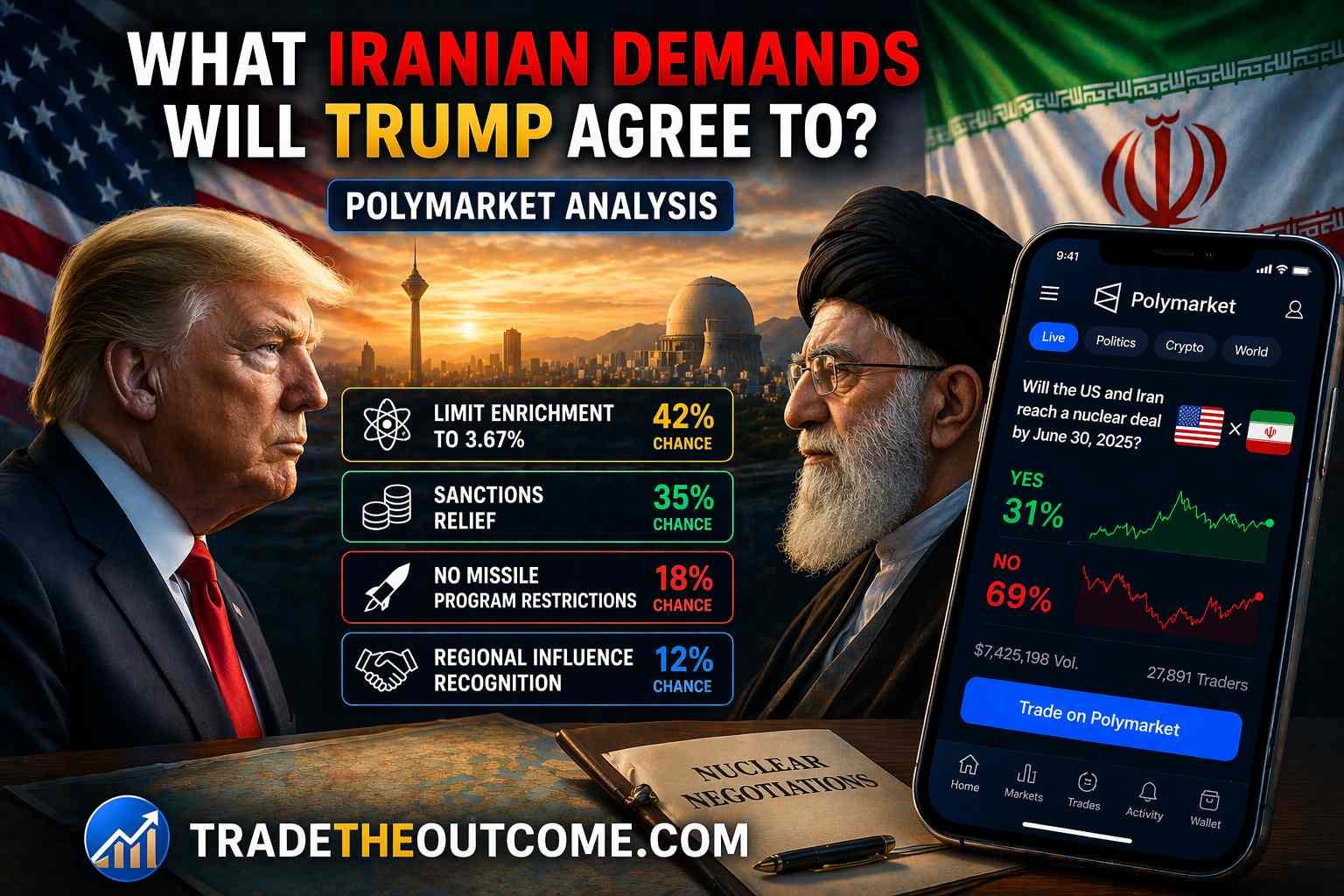
With 13 days left until resolution on April 30, 2026, one Polymarket contract is asking a blunt question: which of Iran’s demands will Donald Trump actually agree to before the month ends? The market has already seen over $1 million in total volume, with a striking $335,000 traded in a single 24-hour window.
The leading outcome right now is “Unfreeze Iranian Assets” at 52% implied probability. That is a real-money bet on one of the most volatile diplomatic situations in the world.
What Iranian Demands Will Trump Agree To?
This Polymarket event tracks which Iranian demands traders believe the US may accept in ongoing negotiations. Market pricing reflects expectations around sanctions relief, nuclear concessions, and diplomatic trade-offs, offering a real-time view of how negotiations may evolve.
Disclosure: This link may be an affiliate link. I may earn a commission at no extra cost to you.
What Is This Market and How Does It Work?
This is a Polymarket prediction market titled “What Iranian demands will Trump agree to in April?” Polymarket is a prediction market platform where you buy shares that pay $1 if a stated outcome happens and $0 if it does not. The price of a share directly reflects what traders collectively believe the probability of that outcome is.
For example, if “Unfreeze Iranian Assets” shares are priced at $0.52, that means the market collectively estimates a 52% chance that the US will agree to unfreeze Iranian assets before April 30, 2026. The market resolves to “Yes” if the United States publicly agrees to unfreeze Iranian assets, or to another specific demand, by that date.
Current Prices at a Glance
- Unfreeze Iranian Assets: 52% implied probability (leading outcome)
- Oil Sanction Relief: 44% implied probability
- Enrichment of Uranium: 38% implied probability
- Transit Fees in the Strait of Hormuz: 8% implied probability
- Total Volume: Over $1 million, with $335,000 in the past 24 hours
- Liquidity: $152,000
- Resolution Date: April 30, 2026
The market also resolves “Yes” if the United States agrees to continuous enrichment of uranium by Iran for any future amount of time, including limitations, restrictions, or specified terms such as caps on enrichment level or monitoring requirements, provided the United States accepts continued enrichment.
Recent News You Need to Know
The Islamabad Talks Collapsed on April 11
The most important recent event is the failure of the Islamabad negotiations. US Vice President JD Vance led a delegation that held more than 21 hours of closed-door discussions with Iranian officials in Pakistan, hosted by Pakistan’s prime minister. On April 11 and 12, Vance confirmed publicly that no agreement was reached and that the US had left its “final and best offer” on the table.
Iran refused to provide a long-term, verifiable commitment to abandon its nuclear weapons program, which was the core US red line. The US had called for Iran to drop all ambitions for nuclear weapons, while Iran insisted on its right to enrich uranium as a non-negotiable point.
The Frozen Assets Dispute: Conflicting Reports
On April 10, a Reuters source described as a senior Iranian official claimed the US had agreed to release frozen Iranian assets held in Qatar and other foreign banks, describing this as a sign of US “seriousness.” The source said the assets were “directly linked to ensuring safe passage through the Strait of Hormuz.”
However, the White House denied this claim the same day. The $6 billion in question was originally frozen in 2018 when Trump withdrew from the original Iran nuclear deal and reimposed sanctions. The funds were briefly released in a 2023 prisoner swap before being blocked again. This back-and-forth is exactly what is driving the 52% price on the Polymarket contract.
Earlier Progress in February and March
The talks did not start in April. Iran and the United States began a series of negotiations starting in February 2026, first in Oman and later in Geneva. In a February 27 statement, Oman’s foreign minister described a “breakthrough,” saying Iran had agreed to zero stockpiling of uranium and to degrade existing stockpiles into fuel. Iran also showed flexibility on enrichment, including the possible transfer of 400 kg of highly enriched uranium under a consortium arrangement, according to Reuters.
But progress made in February stalled by April. The Arms Control Association published an analysis in late March 2026 arguing that US negotiators arrived at the Islamabad talks “ill-prepared for serious nuclear talks.” That context matters when reading the current Polymarket odds.
What the Prices Are Actually Telling Us
A 52% price on “Unfreeze Iranian Assets” is close to a coin flip. That means the market sees this outcome as genuinely uncertain: possible, but not likely enough to call with confidence. Given that Iran itself claimed the US agreed to asset relief and the US denied it, the market is essentially pricing the gap between those two stories.
The 44% on “Oil Sanction Relief” is also notable. It suggests traders see sanctions easing as nearly as likely as asset unfreezing, which makes sense because both are economic concessions that Iran has consistently demanded. The two outcomes are correlated: if the US moves on one, it might move on both.
The 8% on “Transit Fees in the Strait of Hormuz” is low, reflecting that this is a very specific and controversial concession. Allowing Iran to charge fees on shipping through the Strait would be seen as a major strategic defeat for the US, making it unlikely in the short term.
The 38% on “Enrichment of Uranium” is the most geopolitically loaded number. It means roughly one-in-three traders think the US will formally agree to Iran continuing some level of enrichment. Given that VP Vance just described this as a red line, that number looks high. It may reflect the possibility of a compromise framework rather than a full concession.
How Traders Might Think About This Market?
Case for Buying YES on Unfreeze Iranian Assets
An Iranian senior source directly told Reuters that the US agreed to asset release on April 10. Even though the White House denied it, the denial was not emphatic, and the linkage to Hormuz passage suggests a quiet deal could be in progress. A trader might consider buying YES here if they believe the denial is tactical rather than final, especially with a 13-day window remaining and high diplomatic pressure on both sides.
Case for Buying NO on Unfreeze Iranian Assets
The official US position is a denial. The Islamabad talks broke down completely on April 11 with no agreement. VP Vance stated publicly that the US left its “final and best offer” on the table and Iran rejected it. If the talks are truly frozen, there may be no agreement on any demand before April 30. A cautious trader might consider NO on all four outcomes, given that the most recent confirmed event is a collapse, not a breakthrough.
Case for Staying Out
This market is being driven by fast-moving diplomatic events where official statements contradict each other within hours. The $335,000 in 24-hour volume suggests large and informed traders are already very active here. For a beginner, it can be risky to trade against experienced participants who may have better access to real-time information. Staying out is a valid position when information is this contested.
Practical Advice for Beginners
If you are new to prediction markets, here are some ground rules before you trade this contract:
- Use only money you can afford to lose completely. Prediction markets are not savings accounts. Every position can go to zero.
- Keep your position size small. Even experienced traders rarely put large amounts on a single binary outcome. A small position gives you exposure to the idea without catastrophic downside.
- Prices near 50% are the hardest to trade. A 52% implied probability is essentially telling you the market does not know. That is not an invitation to bet big. That is a warning label.
- Read the full market rules page on Polymarket before trading. The exact resolution criteria matter. For example, this market has specific definitions of what counts as “agreement” and what counts as a valid announcement.
- Watch for news, not just prices. In a fast-moving diplomatic situation like this one, a single press release from the White House or an Iranian state media statement can move prices by 20 points in minutes.
The Bottom Line
As of April 17, 2026, the Polymarket contract on Iranian demands gives a 52% chance to asset unfreezing and a 44% chance to sanction relief. Both numbers sit near the coin-flip range, accurately reflecting a diplomatic situation where Iran claimed a US concession on assets, the US denied it, and a full Islamabad negotiation round collapsed just six days ago with no deal. The data is genuinely mixed, and that is precisely what the odds are saying.
