

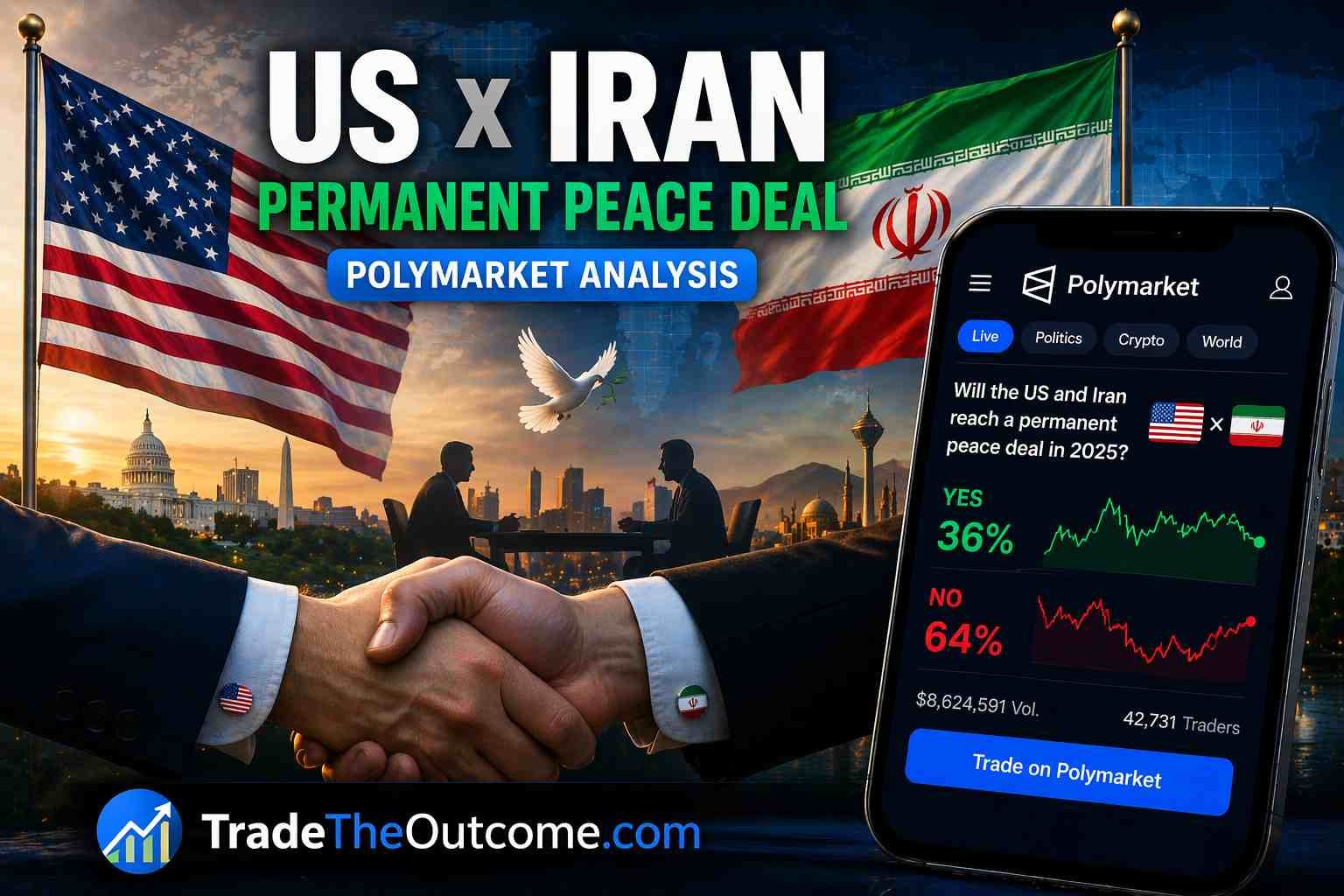
Polymarket traders are pricing only a 28% chance of a permanent US-Iran peace deal by April 22, 2026. After 21 hours of talks in Islamabad collapsed on April 12 and the US launched a naval blockade days later, the market is sending a clear signal.
This article breaks down what the current odds mean, what the latest news shows, and what a beginner trader should know before placing a position.
US x Iran Permanent Peace Deal
Polymarket traders are pricing a permanent US–Iran peace deal as a delayed outcome rather than an immediate one. Mid-year timelines dominate current odds, reflecting optimism around negotiations but skepticism that a lasting agreement can be reached quickly given unresolved nuclear and geopolitical tensions.
Disclosure: This link may be an affiliate link. I may earn a commission at no extra cost to you.
What This Market Is and How It Works?
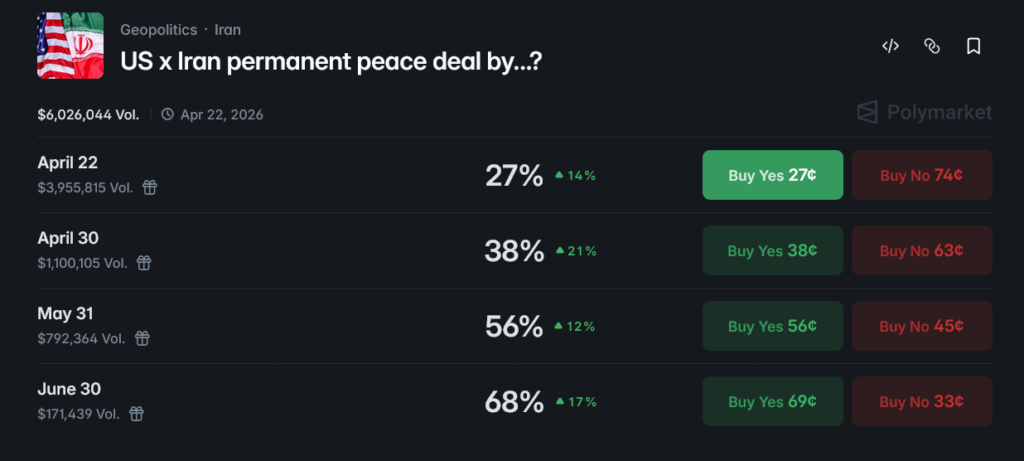
The Polymarket market asks a simple question: will the United States and Iran reach a permanent peace deal by a specific date? The market offers four resolution dates: April 22, April 30, May 31, and June 30, 2026.
Each date has its own YES and NO shares. If you buy a YES share and a qualifying deal is announced before that date, the share pays out $1. If no deal happens, it pays $0. A NO share pays $1 if no deal is reached, and $0 if a deal is confirmed.
According to the market rules, a deal must involve the governments of the United States and Iran providing clear public confirmation that a qualifying agreement has been definitively established.
Statements of progress, ceasefire extensions, or other statements that do not constitute a definitive announcement will not count as resolution.
Current Prices and What They Mean?
As of April 15, 2026, the market shows the following implied probabilities across all four resolution dates, with a total volume of approximately $4.2 million:
- April 22: YES at 28¢ (28% probability)
- April 30: YES at 38¢ (38% probability)
- May 31: YES at 56¢ (56% probability)
- June 30: YES at 68¢ (68% probability)
The $4.2 million in total volume shows this is a heavily traded, high-attention market. That level of liquidity means prices reflect a large pool of informed opinion, not just a few large bets.
The April 22 date is especially significant. The two-week US-Iran ceasefire announced around April 7 to 8 is scheduled to expire around that same date. Traders are essentially pricing in the probability that a full permanent deal can be confirmed before the ceasefire window closes.
What Happened in Islamabad?
On April 11, 2026, a high-level US delegation arrived in Islamabad for direct peace talks. The team included Vice President JD Vance, special envoy Steve Witkoff, and Jared Kushner. The Iranian delegation included Foreign Minister Abbas Araghchi and Parliament Speaker Mohammad Bagher Ghalibaf.
After 21 hours of negotiations, the talks ended without an agreement on April 12. According to NPR, Vance confirmed at a press conference in Islamabad that the US presented its final offer and Iran refused.
The core US demand was a verifiable commitment that Iran would never develop nuclear weapons, including a total ban on uranium enrichment.
Iranian officials described the US terms as “excessive” and “unreasonable,” while the US side insisted Iran refused to provide the guarantees Washington required. Neither side reached even a partial framework.
The Naval Blockade: A Major Escalation
Following the collapse of the Islamabad talks, President Trump announced a naval blockade of Iran. US Central Command confirmed the blockade began on Monday, April 13, 2026 at 10:00 a.m. ET, applying to all ships travelling to or from Iranian ports.
Iran warned that any military vessels entering near the Strait of Hormuz would be considered a breach of the ceasefire. The Guardian reported that the blockade is designed to cripple Iran’s oil-dependent economy and force Tehran to reopen the strait to Gulf allies and to accept the total enrichment ban.
Iran’s economy relies heavily on oil exports. A sustained blockade adds enormous pressure to any negotiation timeline, but it also increases the risk of the ceasefire breaking down entirely before a deal can be reached.
Is There Any Path to a Deal?
Despite the blockade, there are signals that diplomacy is not completely dead. President Trump has signaled he is open to resuming talks through Pakistani mediation, and UN officials have publicly urged both sides to de-escalate. Iran’s 10-point plan, which Trump earlier called a “workable basis,” remains on the table in principle.
However, the fundamental disagreement remains. The US wants a complete, verifiable end to Iran’s nuclear program. Iran has so far refused to accept that condition as a precondition for any agreement. Deep mutual distrust built over decades makes rapid resolution extremely difficult.
What the Prices Are Actually Telling You?
The 28% YES price for April 22 reflects the market’s collective judgment that a permanent, qualifying peace deal within the next seven days is very unlikely, but not impossible. With the ceasefire expiring around that date and the naval blockade now active, traders are pricing in serious risk of breakdown before any deal.
The jump from 28% at April 22 to 68% at June 30 shows traders believe there is significant probability of a deal eventually being reached, just not quickly. The market is not saying peace is impossible. It is saying peace probably takes more time than the ceasefire window allows.
The data is not mixed here. The near-term odds are clearly bearish for a deal, while longer-dated odds reflect a more cautious hope that back-channel talks and economic pressure could eventually produce an agreement.
How Traders Might Think About These Positions
Reasons to Consider Buying NO on April 22
A trader might consider a NO position on the April 22 market because the fundamental disagreement on nuclear enrichment has not been resolved. With talks broken down and a blockade now live, the structural conditions for a permanent deal within seven days are not in place. At 72¢ for NO, the market is already pricing this as the more likely outcome.
Reasons to Consider Buying YES on Later Dates
A trader interested in longer odds might look at the May 31 or June 30 markets. Economic pressure from the blockade could force Iran back to the table. Pakistani and UN mediation channels remain open. Trump has previously reversed hard positions quickly, and the 56% to 68% YES prices on later dates suggest the market sees this scenario as possible. However, the path requires a significant shift from at least one side.
Reasons to Stay Out
This market is heavily influenced by unpredictable factors such as military incidents, leadership decisions, and back-channel communications that are not public. A trader who is not following the news closely could be caught off guard by a sudden escalation or a surprise diplomatic breakthrough. If the ceasefire collapses, all YES positions across all dates could drop sharply overnight.
Practical Advice for Beginners
Geopolitical markets like this one carry high uncertainty. A few basic rules matter here:
- Read the resolution rules carefully. This market requires a definitive public confirmation of a permanent deal, not just a ceasefire extension or a statement of progress. Check the full rules on the market page before placing any trade.
- Keep position sizes small. Even a well-reasoned trade can lose money if a single unexpected event shifts the situation. Never put more into a prediction market than you can afford to lose entirely.
- Be careful at extreme odds. A 28% YES price means there is a real, non-trivial chance of resolution. Do not treat it as a guaranteed NO just because it looks unlikely.
- Watch the ceasefire expiry date. Around April 21 to 22, the two-week ceasefire window closes. Any news of an extension or collapse will move prices immediately.
- Follow credible primary sources. The BBC, NPR, and official government statements are the fastest way to verify whether a qualifying resolution event has occurred.
The Bottom Line
Polymarket is currently pricing a permanent US-Iran peace deal at just 28% by April 22, reflecting the collapse of the Islamabad talks and the start of the US naval blockade.
The data lines up with those odds: no agreement framework exists, the core nuclear dispute is unresolved, and military escalation is now underway.
Longer-dated markets offer higher YES probabilities, but they carry the uncertainty of an unpredictable geopolitical situation where conditions could shift dramatically in either direction.
