


Iran is in turmoil. As nationwide protests continue to grip the country and economic collapse looms, prediction market traders on Polymarket have dramatically increased their bets that Supreme Leader Ali Khamenei will lose power by mid-2026.
But should you take these odds seriously? And if you’re thinking about trading on this volatile market, what do you actually need to know?
What’s the Current Situation?
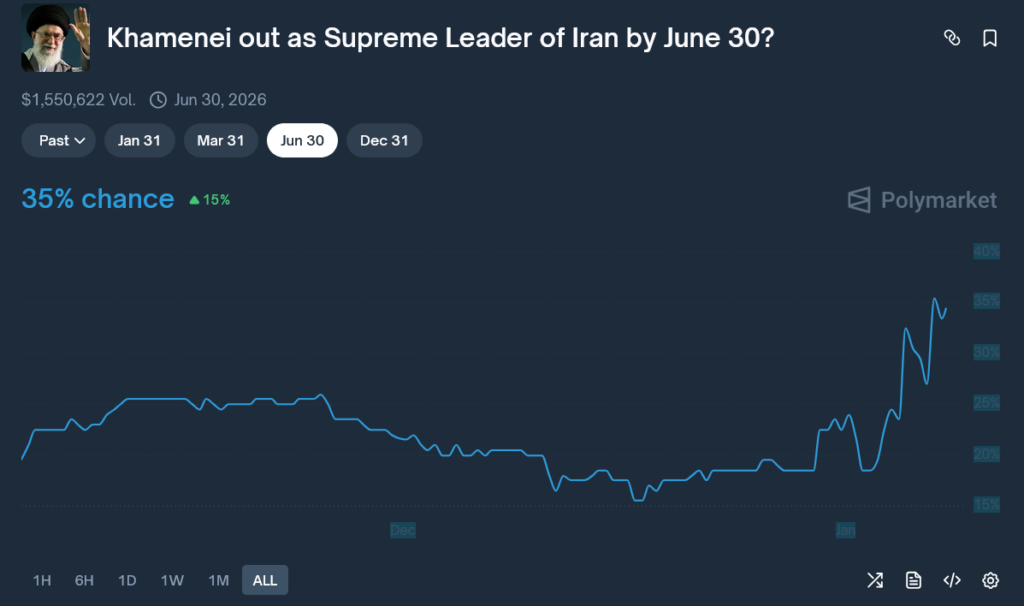
As of January 7, 2026, Polymarket is pricing the probability that Khamenei will be removed from power by June 30, 2026, at roughly 34.5%. That’s not a trivial wager, it suggests nearly 1-in-3 odds that Iran’s Supreme Leader (who has served since 1989) could lose his position within the next five and a half months.
Polymarket asks whether Ayatollah Ali Khamenei will no longer be Supreme Leader of Iran by June 30, 2026, 11:59 PM ET.
If Khamenei is removed from power for any length of time before the deadline, the “Yes” side settles at $1.00 per share. If he remains Supreme Leader through the entire period without interruption, “Yes” shares settle at $0.00 and “No” shares settle at $1.00.
What counts as “removed from power”?
According to Polymarket’s resolution criteria, Khamenei is considered removed if he:
- Resigns from the position
- Is detained or arrested
- Is prevented from fulfilling his duties as Supreme Leader
- Otherwise loses his position for any reason
The key word is “any length of time.” Even a temporary removal, due to illness, coup, detention, or forced resignation would trigger a “Yes” resolution. The market doesn’t require permanent regime change or a successful transition. It only requires that Khamenei lose his position once before June 30.
Who resolves this market?
The primary resolution source is official information from the Iranian government. However, if government sources are silent or unreliable, Polymarket will use “a consensus of credible reporting” from international media and intelligence sources.
Why this matters for traders:
This relatively low bar for “Yes” resolution creates interesting dynamics. You’re not betting on whether Iran’s regime collapses entirely, only on whether the 85-year-old Khamenei, who has ruled since 1989, exits the stage for any reason in the next six months.
Current Odds Snapshot: The Numbers
As of January 7, 2026, here’s where the market stands:
| Date | Yes Price | No Price | Implied Probability |
|---|---|---|---|
| Jan 7, 2026 | $0.345 | $0.655 | Yes 34.5%, No 65.5% |
| Dec 7, 2025 | $0.28 | $0.72 | Yes 28%, No 72% |
| Nov 7, 2025 | $0.25 | $0.75 | Yes 25%, No 75% |
What this tells us:
The “Yes” price has climbed 38% in two months, moving from 25¢ in early November to 34.5¢ today. This is a significant shift driven by rapidly deteriorating conditions in Iran.
At 34.5¢, the market is pricing in roughly 1-in-3 odds that Khamenei will be out by June 30. That’s not a prediction of certainty, but it’s far from dismissing the possibility. For context, this is higher than the market priced any point in 2024 or early 2025.
Trading volume is massive:
This market has accumulated $8.13 million in total trading volume, making it the most liquid Khamenei-related prediction market on Polymarket. High liquidity means:
- Tighter bid-ask spreads
- Faster order execution
- Lower slippage on large positions
- More efficient price discovery
Compare that to related markets:
| Market Deadline | Current Odds (Yes) | Trading Volume | Liquidity Status |
|---|---|---|---|
| By Jan 31, 2026 | 9% | $666,679 | Moderate |
| By Mar 31, 2026 | 20% | $400,240 | Low |
| By June 30, 2026 | 34.5% | $8,130,895 | Very High |
| By Dec 31, 2026 | ~40% | $376,188 | Low |
Price trend interpretation:
The steady climb from 25% to 34.5% reflects two forces:
- Genuine deterioration in Iran’s political and economic stability
- Increased attention from international traders watching geopolitical risk
The market is telling you that traders with money at stake believe the situation is getting worse, not better. But at 34.5%, they’re still pricing Khamenei as more likely than not to survive the next six months.
Why the Market Is Priced Here: The Drivers?
The 34.5% odds aren’t random. Several concrete factors are pushing this market higher. Let’s break down what’s actually driving the price:
Driver #1: Currency Collapse and Economic Catastrophe
Iran’s rial hit 1.47 million per US dollar on January 6, 2026, an all-time low. To put this in perspective:
- In 2015, when the nuclear deal was signed, the rate was about 32,000 rials per dollar
- In 2022, when the current Central Bank chief took office, it was 430,000
- Today it’s 1.47 million a 75% collapse in just three years
This isn’t just numbers on a screen. Real inflation is running at 75% annually (far above the official 42-48% figure), meaning the cost of food, medicine, and basic goods is doubling every 14-18 months. About 57% of Iranians are experiencing malnutrition, and 50% of working-age men are unemployed or underemployed.
When a population can’t afford food, political stability evaporates fast.
Driver #2: The Largest Protests Since 2022
Starting December 28, 2025, nationwide demonstrations erupted after bazaar merchants in Tehran closed their shops to protest the currency collapse. Within 10 days, the movement spread to:
- 285 locations across 92 cities in all 31 provinces
- 36+ people killed (including 4 children)
- 2,076+ arrested
- 60+ injured by pellet guns, tear gas, and live ammunition
This is the most widespread unrest since the 2022 Mahsa Amini protests that shook the regime. The difference? This time it’s economically driven, which historically is more dangerous for authoritarian regimes than purely political protests.
Driver #3: Regional Isolation and Military Weakness
Iran lost key military leverage in 2025:
- Syria’s Assad regime collapsed in December 2024, cutting Iran’s land bridge to Lebanon
- Top IRGC commanders killed in Israeli strikes in June 2025
- Hezbollah weakened after 2023-2024 conflict with Israel
- Iraqi militias increasingly unreliable
Without its proxy network, Iran is more vulnerable to both internal collapse and external pressure.
Driver #4: Khamenei’s Age and Health Speculation
Khamenei is 85 years old and has had limited public appearances in recent weeks. While there’s no confirmed serious illness, markets are pricing in the actuarial reality: the older a leader gets, the higher the probability of sudden incapacity.
Intelligence reports (unconfirmed) suggest Khamenei has prepared an escape plan to Moscow if the situation becomes untenable. Whether true or not, the mere circulation of such reports moves prediction market prices.
Driver #5: Trump’s Return and US Pressure
President Trump warned on January 6 that if Iran “violently” suppresses protesters, the US would “come to their rescue.” While vague, this signals potential US intervention, whether diplomatic pressure, sanctions escalation, or covert support for opposition groups.
Markets hate uncertainty, and Trump’s Iran policy is unpredictable. This adds a premium to the “Yes” price.
Risk Factors: What Moves This Market Higher or Lower
Understanding what moves prices is how you time your trades. Here’s your actionable checklist:
Bullish Drivers (Push “Yes” Price Up):
✅ Health crisis confirmed – If Khamenei is hospitalized, has a stroke, or dies, “Yes” price spikes to 80-95% instantly
✅ Military or IRGC splits – Any credible report of Revolutionary Guard factions breaking from Khamenei would be explosive
✅ Protest escalation – If death toll exceeds 100, or if strikes spread to oil workers/transportation, pressure intensifies
✅ Currency hits 2 million rials/USD – Psychological breaking point that signals total economic failure
✅ Trump announces targeted action – Sanctions on Khamenei personally, military threats, or explicit support for regime change
✅ Bazaar strikes expand nationwide – Merchants are the economic backbone; if they stay closed, the government can’t function
✅ Succession talk in Iranian media – Any official discussion of a post-Khamenei transition is a leading indicator
Bearish Drivers (Push “Yes” Price Down):
❌ Khamenei makes strong public appearance – Seeing him active and in command would calm removal fears
❌ Protests fizzle out by mid-January – Historical precedent: winter protests often lose momentum in spring
❌ Currency stabilizes above 1.3M – If the rial stops falling, panic subsides
❌ No US intervention – If Trump’s threats prove empty, external pressure drops
❌ Regime successfully crushes dissent – Brutal crackdowns have worked before (2019, 2009); if death toll climbs but protests stop, “No” price rallies
❌ Economic relief measures – If government subsidies or emergency currency policies ease inflation, pressure valve releases
❌ No credible succession rumors – Silence from intelligence sources and Iranian insiders would suggest stability
| Factor | Current Status | Impact on “Yes” Odds |
|---|---|---|
| Currency Collapse | 1.47M rials/USD | Strong positive |
| Protest Deaths | 36+ killed | Moderate positive |
| Economic Crisis | 75% real inflation | Strong positive |
| Regional Isolation | Syria fell, weak proxies | Moderate positive |
| Health Concerns | Age 85, recent absence | Very strong positive |
Trade Strategy: Should You Take a Position?
Now the critical question: Is this trade worth your capital?
Let me give you a framework to decide.
Step 1: Calculate Your Personal Probability Estimate
The market says 34.5%. What do you think?
Ask yourself:
- Do I believe the probability is higher than 34.5%? (Buy “Yes”)
- Do I believe it’s lower than 34.5%? (Buy “No”)
- Do I have no strong view? (Don’t trade)
Example:
If you think there’s a 50% chance Khamenei is out by June 30 based on your analysis of protest momentum and his age, then buying “Yes” at 34.5¢ offers value. Your expected return is roughly (0.50 × $1.00) – $0.345 = $0.155 per share, or 45% potential profit.
Conversely, if you think the real probability is only 15% (regime is stronger than media suggests), then buying “No” at 65.5¢ is the trade.
Step 2: Entry Rules – When to Buy
For “Yes” Buyers (betting Khamenei exits):
✅ Wait for a dip below 30¢ if you want a margin of safety. The price spiked from 28¢ to 34.5¢ in 30 days; pullbacks happen after news cycles cool.
✅ Buy on confirmation of escalation – If protest deaths exceed 50, or if credible health rumors surface, enter aggressively.
✅ Scale in gradually – Don’t dump your full position at once. Buy 25% now, 25% at 32¢, 25% at 30¢, and hold 25% for a major catalyst.
For “No” Buyers (betting Khamenei stays):
✅ Wait for a spike above 40¢ – If panic drives the price up after a big news event, that’s your entry.
✅ Buy after successful crackdown – If protests are suppressed by end of January and Khamenei makes a strong public appearance, “No” price will be undervalued.
✅ Bet on historical base rates – Regimes rarely collapse in 6 months. The Shah’s Iran took 13 months of protests (1978-1979) before the revolution succeeded.
Step 3: Position Sizing – How Much to Risk
This is a geopolitical event with binary resolution. Size your risk accordingly.
Recommended allocation: 1-3% of your total Polymarket portfolio per position.
Example:
- If you have $10,000 in Polymarket funds, allocate $100-$300 to this trade.
- If you have $1,000, allocate $10-$30.
Why so small? Because:
- You can’t predict coups, health crises, or Trump’s next move
- Illiquidity can trap you at bad prices
- Binary events have no “partial win”
Step 4: Stop-Loss and Take-Profit Levels
For “Yes” Buyers:
🛑 Stop-loss: Exit if price drops to 25¢ (down ~27% from entry). This signals market confidence is eroding.
💰 Take-profit targets:
- Partial exit at 50¢ (+45% gain) – Lock in profits if price spikes on news
- Full exit at 70¢ (+103% gain) – If a major event makes exit likely, cash out
- Hold to expiry if you have high conviction and catalysts keep coming
For “No” Buyers:
🛑 Stop-loss: Exit if “No” price drops to 55¢ (equivalent to “Yes” hitting 45¢). This means the situation is worse than you thought.
💰 Take-profit targets:
- Partial exit at 75¢ (“Yes” drops to 25¢) – Lock in gains if protests fizzle
- Full exit at 85¢ (“Yes” drops to 15¢) – If regime demonstrates total control
- Hold to expiry if Khamenei makes repeated strong appearances
Step 5: News Catalysts to Watch
Set alerts for:
- Iranian state media (IRNA, Press TV) – Official announcements
- Iran International (opposition outlet) – Protest updates and regime news
- @Polymarket on X – Market commentary and price moves
- US State Department briefings – Intervention signals
- Al Jazeera, Reuters – Credible international coverage
Trade the news, but don’t chase spikes. If “Yes” jumps 15% in an hour, wait 24 hours for price to settle before entering.
Step 6: Example Scenario Walkthrough
Hypothetical Trade:
You believe the market is underestimating the crisis. Your personal probability: 45% chance Khamenei exits by June 30.
- Entry: Buy “Yes” at $0.34 (current price)
- Position size: $200 (2% of $10,000 portfolio)
- Shares purchased: 588 shares ($200 ÷ $0.34)
- Stop-loss: Exit at $0.25 (-26% loss = -$52)
- Target 1: Sell 50% at $0.55 (+62% gain on half = +$62)
- Target 2: Sell remaining 50% at $0.75 (+120% gain on half = +$120)
Outcome scenarios:
| Scenario | Probability (Your View) | Return |
|---|---|---|
| Khamenei exits by June 30 | 45% | +$300 (+150%) |
| Khamenei stays but price hits $0.55 | 20% | +$62 (+31%) |
| Stop-loss hit at $0.25 | 35% | -$52 (-26%) |
Expected value: (0.45 × $300) + (0.20 × $62) + (0.35 × -$52) = $129.90 profit on $200 risked = +65% expected return.
That’s attractive risk-reward if your 45% probability estimate is correct. But if you’re wrong and it’s really 25%, you’ll likely hit your stop-loss.
What to Watch Next?
Current snapshot (as of Jan 7, 2026):
- Price: $0.345 (“Yes”), $0.655 (“No”)
- Implied probability: 34.5% chance Khamenei exits by June 30
- Market trend: Rising steadily (up from 25% in November)
- Liquidity: Excellent ($8.13M volume)
Market bias:
The price is reflecting genuine instability in Iran, but 34.5% likely overestimates the near-term probability of regime collapse. Historical base rates suggest authoritarian regimes with intact security forces don’t fall in 6 months without military defections or external intervention.
However, the tail risk is real. Khamenei’s age, the economic catastrophe, and protest momentum create meaningful collapse risk.
What to watch this week:
📌 Protest death toll – If it exceeds 50 by Jan 15, price will climb
📌 Bazaar strike continuation – If merchants stay closed through Jan 10, economic pressure intensifies
📌 Khamenei public appearance – Any strong showing would drop “Yes” price 5-10%
📌 Trump policy announcement – New sanctions or threats would boost “Yes”
📌 Currency movement – If rial hits 1.6M per USD, panic accelerates
My view:
The 34.5% price is slightly high but not absurd. A fair value estimate is probably 25-30% based on historical precedent and the regime’s repressive capacity. But the risk is asymmetric: if things spiral, the price could hit 70-80% fast. If they stabilize, it drops to 15-20%.
Risk statement:
This is a high-volatility, binary-outcome market. Only trade with capital you can afford to lose. Geopolitical events are inherently unpredictable. Past performance of prediction markets is not a guarantee of future accuracy.
