

If you care about prediction markets, elite accountability, or just how real power behaves under legal pressure, the Epstein files market is about as pure a test case as you will find.
The question is simple on its face: Will Trump release the Epstein files by a fixed deadline? The mechanics under the hood are anything but simple.
In this article, I will walk through what the market is actually pricing, why the odds exploded after the Epstein Files Transparency Act, how traders are thinking about legal and bureaucratic risk, and how you might approach this market strategically.
I will keep this conversational, but detailed, and use both tables and a visual of the odds shift to make the structure clear.
If you want to trade this market yourself, you can sign up here
What This Market Is Really Asking?
The Polymarket contract is framed as “Will Trump release Epstein files by [date]”. In practice, it is not about Trump waking up one morning and deciding to drop PDF bombs on Truth Social. It is about whether the Executive Branch, under Trump, complies in time with a legal mandate that now exists.
Key points from the setup you provided:
- Congress passed, and Trump signed, the Epstein Files Transparency Act.
- The law forces the Department of Justice to release all relevant unclassified Epstein related records, including:
- investigative materials
- immunity deals
- internal communications
- The law sets a hard completion date of December 19 for the release.
- The Polymarket market is keyed to a slightly later deadline, December 31, which builds in a small grace window.
So the core question is no longer “Will Trump choose to do this”, it is “Will the system successfully execute this legal requirement on schedule, or will something break”.
How the Odds Moved Around the Law?
Before the law, the market was mostly pricing political will. After the law, it is pricing logistics and litigation risk.
Here is a simplified version of how the YES odds evolved around key dates:
| Date | Approx YES Odds | What Was Happening |
|---|---|---|
| Pre Nov 20, 2025 | 20% – 35% | Trump calling release a distraction, executive discretion dominant |
| Mid November 2025 | Rising from 30s | Bipartisan pressure, Congress releases 23,000 pages of documents |
| Nov 20, 2025 | Jump to ~65% | Trump signs Epstein Files Transparency Act into law |
| Late November | Stabilizes ~70% | DOJ starts compliance work, traders price admin and legal friction |
Visually, the shift looks something like this:
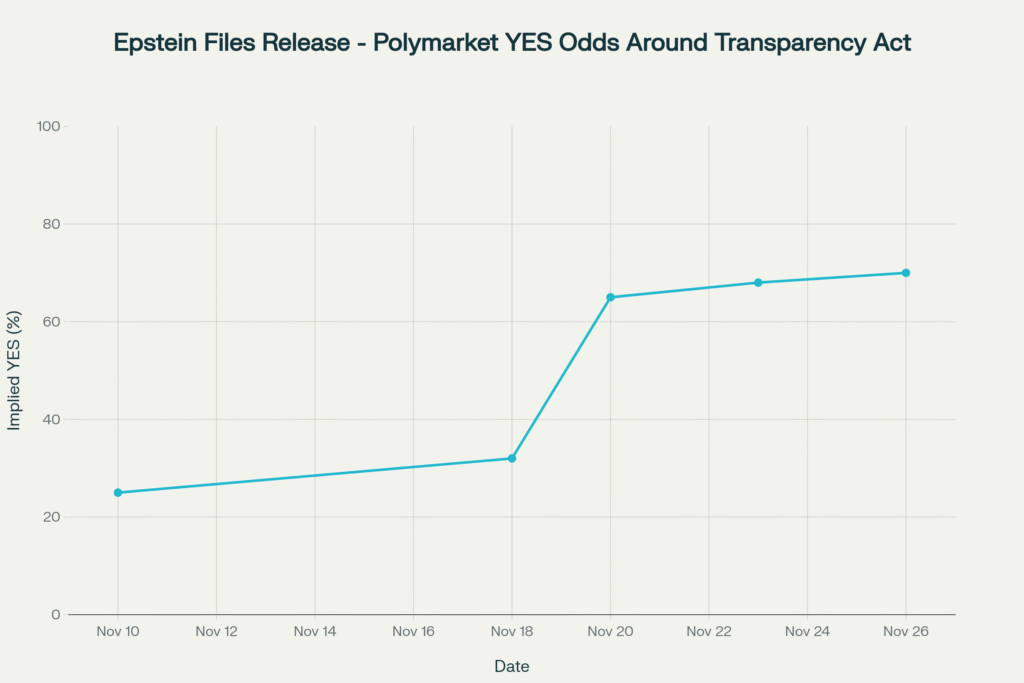
The spike on November 20 is the key. Overnight, the event turned from “maybe” to “must”, subject to the system actually functioning as designed.
Where the Market Stands Now?
From the data you gave:
- Total volume across date brackets is about 2.08 million USDC.
- For the key December 31 bracket:
- YES trades around 0.70 (70 percent implied probability).
- NO is around 0.30 (30 percent).
- About 720,000 USDC of volume sits in this YES versus NO split.
There is also an earlier November 30 related market priced at less than 1 percent, with over 742,000 USDC traded. That is useful because it shows the crowd already “gave up” on an immediate, purely voluntary release before the legislative schedule kicked in. The action is now firmly centered on the legally mandated December window.
A simple summary table:
| Date | Approx YES Odds | What Was Happening |
|---|---|---|
| Pre Nov 20, 2025 | 20% – 35% | Trump calling release a distraction, executive discretion dominant |
| Mid November 2025 | Rising from 30s | Bipartisan pressure, Congress releases 23,000 pages of documents |
| Nov 20, 2025 | Jump to ~65% | Trump signs Epstein Files Transparency Act into law |
| Late November | Stabilizes ~70% | DOJ starts compliance work, traders price admin and legal friction |
| Outcome (by Dec 31) | YES 0.70 | NO 0.30 | Market pricing by contract 0.70 USDC for YES and 0.30 USDC for NO. Implied chances 70 percent and 30 percent. Total volume across dates 2,082,842 USDC indicating high liquidity and serious money involved |
If you want to trade this market yourself, you can sign up here
How We Got Here – Timeline and Catalysts
To really understand the odds, it helps to walk through the key events that re-priced this market.
Pre law phase – politics dominated
- Odds sat mostly in the 20 to 35 percent band.
- Trump publicly framed the Epstein file push as a distraction and resisted ad hoc release calls.
- At that point, traders had to guess:
- Does Trump think the files hurt him more, or his rivals more?
- Does he see value in weaponizing selective disclosure?
Pressure phase – Congress turns up the heat
- In mid November, bipartisan pressure grew.
- Even some Republicans pushed for transparency, including high-profile figures like Lauren Boebert.
- Lawmakers released around 23,000 pages of related material themselves.
- The odds moved up, not because the files were dropping, but because it became clear Congress was willing to legislate around the White House.
Pivot phase – the Act is signed
- On November 20, Trump signed the Epstein Files Transparency Act.
- This flipped the event from:
- “Will the president choose to do X”
- to “Will the Executive Branch comply with a statute that says it must do X by Y date”.
- YES odds jumped sharply, landing in the mid 60s and then drifting toward 70 percent as traders absorbed the details.
Post law phase – legal and admin friction priced in
- After the act, the DOJ began steps like requesting judges to unseal Ghislaine Maxwell related records.
- The market then settled into a high but not certain band around 70 percent, which essentially says:
- The law is strong.
- But there are real risks around execution and courtroom interference.
What Is Pushing YES Up?
There are a few major bullish pillars that support that 70 percent YES price.
The statutory mandate
The biggest support for YES is simple: this is now a legal requirement, not a polite request. The Act:
- Forces release of all unclassified Epstein related records.
- Restricts the government from withholding material for vague reasons like reputational harm or political embarrassment.
- Includes internal communications and immunity deals, not just external filings.
Traders are effectively saying, “even in a chaotic system, when Congress spells it out plainly and publicly, it is very hard for the Executive Branch to completely ignore them, especially under this much scrutiny”.
Political incentives may actually favor release
There is also a subtle political argument:
- If Trump believes the files implicate rivals more (for example, Bill Clinton) than himself, there is a direct incentive to comply quickly and loudly.
- Using a mandated release as a “see, I am the one exposing them” moment could be politically valuable.
That alignment between legal compulsion and perceived political advantage is supportive for YES.
What Is Keeping NO Alive?
If all you saw was the law and the 30 day deadline, you might price YES even higher than 70 percent. The reason NO still has real weight is that prediction market traders are very aware of two types of risk: administrative friction and judicial interference.
Administrative friction – time, volume, and redaction
The law gives roughly 30 days (to December 19) to do a huge amount of work:
- locate all relevant records across agencies
- deduplicate and index
- run them through classification checks
- redact where legally required:
- victim identities
- ongoing investigations
- some intelligence sources and methods
None of this is trivial. Even if everyone involved is working in good faith, there is a non-trivial chance that the process simply overruns the clock. Polymarket’s December 31 cutoff is not the law’s date, but it is close enough that a modest slip in execution could break the contract terms.
This entire “bureaucratic risk” is what props up the 30 percent NO pot.
Judicial interference – injunction and stays
The other big piece of bear thesis is the courts.
- Federal judges, particularly those involved in related cases like Ghislaine Maxwell’s, may feel a duty to protect:
- victim privacy
- ongoing sealed cooperation agreements
- fairness in still active proceedings
- Third parties who appear in the files could petition for:
- temporary restraining orders
- preliminary injunctions
- narrow stays on specific segments of the files
If any such order intersects with a core chunk of what the Act requires, DOJ might not be able to fully “complete” release by December 19, even if they dump partial files. Depending on how the Polymarket rules are written, partial compliance might not be enough to count as YES.
Traders backing NO often lean on this “technical defeat” path: not that the government refuses the law, but that the courts slow it just enough.
A Closer Look at the Main Drivers
Here is a compact factor table, summarizing how different elements push odds:
| Date | Approx YES Odds | What Was Happening |
|---|---|---|
| Pre Nov 20, 2025 | 20% – 35% | Trump calling release a distraction, executive discretion dominant |
| Mid November 2025 | Rising from 30s | Bipartisan pressure, Congress releases 23,000 pages of documents |
| Nov 20, 2025 | Jump to ~65% | Trump signs Epstein Files Transparency Act into law |
| Late November | Stabilizes ~70% | DOJ starts compliance work, traders price admin and legal friction |
| Outcome (by Dec 31) | YES 0.70 | NO 0.30 | Market pricing by contract 0.70 USDC for YES and 0.30 USDC for NO. Implied chances 70 percent and 30 percent. Total volume across dates 2,082,842 USDC indicating high liquidity and serious money involved |
| Factor | Directional Effect | Why It Matters |
|---|---|---|
| Epstein Files Transparency Act | Strongly up (YES) | Removes executive discretion, hard statutory language |
| Short 30 day window | Down (NO) | Heavy processing burden, time risk |
| Court orders on sealed files | Down (NO) | Judges can partially block or slow release |
| Political use against rivals | Up (YES) | Incentive to release if perceived to hurt opponents more |
| Public pressure and media | Up (YES) | Harder to quietly slow walk with the world watching |
If you want to trade this market yourself, you can sign up here
Strategic Thoughts For Traders
If you were thinking about how to position around this, here are some structured ideas based on the data you supplied.
Focus on timing risk, not the abstract release question
If you believe the files are coming out eventually, but are not certain they will make the December 19 legal target plus the extra days to December 31, you can explicitly separate those views:
- Long a broader “any release by X” contract on another platform.
- More cautious sizing on the strict Polymarket December 31 market.
That way, if the government misses the date but does release in January, one leg pays even if the other does not.
Watch for legal news, not just political noise
At this stage, the big re-pricing events are less likely to be Trump on television, and more likely to be:
- a DOJ filing describing a phased schedule
- a court order granting or denying unsealing requests
- a lawsuit filed by a named party seeking to block disclosure
This is the sort of information that often shows up first on legal news feeds or specialized court trackers, then hits mainstream headlines, then finally gets fully priced.
Big Picture – What This Market Is Signaling?
Even beyond the trade mechanics, this market is interesting as a signal about how people think US institutions behave under stress.
If you want to trade this market yourself, you can sign up here
- The pre law pricing told you that traders did not believe Trump would voluntarily open the Epstein vaults.
- The post law pricing tells you that once Congress writes a clear rule, the crowd mostly believes the system will grind its way to compliance.
- The residual NO probability is a kind of measure of faith, or lack of it, in the ability of courts and bureaucracy to execute cleanly in high stakes political situations.
In other words, this is not just a market on one set of documents. It is a live, financialized poll on the question:
“When the law says powerful people must be exposed, do the gears of government actually move, or do they stall just long enough to keep the worst secrets buried”.
Right now, at roughly 70 percent YES, traders are betting that the gears will move in time, but they are not willing to bet the house on it.
