

Here’s what happened yesterday that should matter to every prediction market trader, the Supreme Court heard oral arguments in what might be the most consequential case of Trump’s second presidency, and Polymarket odds collapsed in real-time as justices grilled the administration’s lawyers.
By the end of Wednesday’s hearing, Trump’s chances of winning dropped from 39% to just 25%, a 14-point swing during a single court session.
I’ve been tracking this market since it launched in September with $668,173 in volume, and what we witnessed November 5th was a masterclass in how prediction markets process new information faster than traditional analysis.
Let me walk you through why this case matters, what the justices revealed about their thinking, and where the smart money is heading.
$89 Billion and Presidential Power
This isn’t just another legal dispute. At stake is $89 billion in tariff revenue already collected from February through September 2025, plus the constitutional question of whether any president can impose sweeping tariffs by declaring a national emergency.
Trump used the International Emergency Economic Powers Act (IEEPA) to justify tariffs on virtually every trading partner, from 25% on Canadian goods to variable rates affecting 190+ countries.
The Federal Circuit Court already ruled 7-4 against Trump in V.O.S. Selections, Inc. v. Trump, holding that these five Executive Orders (14193, 14194, 14195, 14257, and 14266) exceeded presidential authority under IEEPA.
But the courts stayed their injunction pending this Supreme Court appeal, keeping the tariffs in place.
If the Supreme Court affirms the lower court ruling, Trump faces potential refunds exceeding $100 billion and a massive constitutional rebuke of his emergency powers doctrine.
If he wins, it sets a precedent for unprecedented presidential authority over the economy during declared emergencies.
The Market Tells the Story
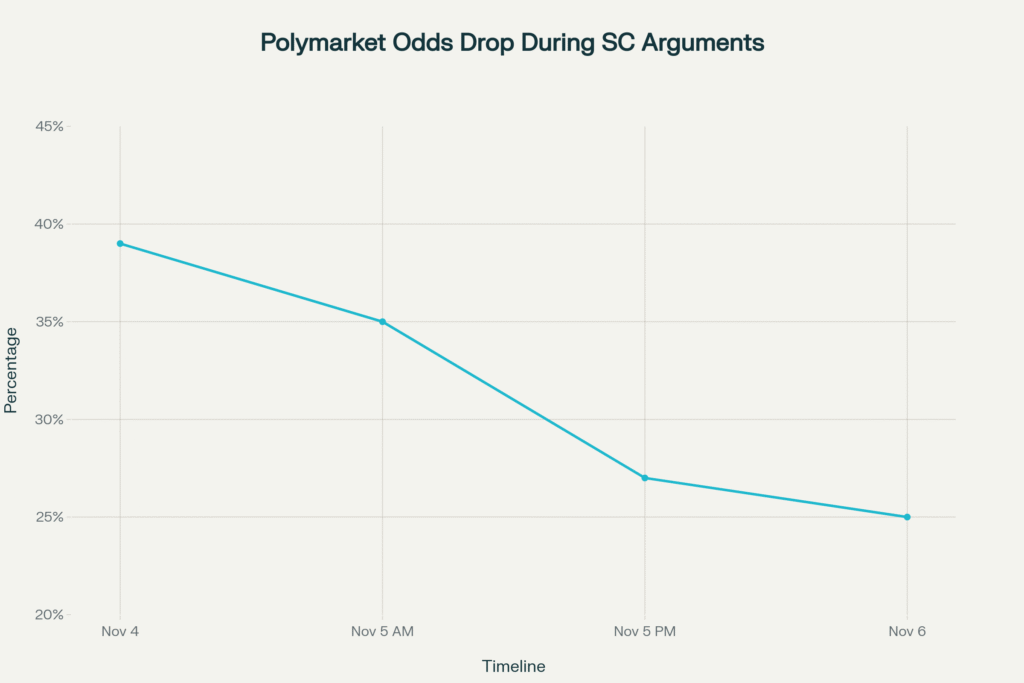
What made November 5th fascinating for traders was watching sophisticated algorithms and human intuition process judicial skepticism in real-time. Polymarket odds started at 39% Tuesday night, held around 35% Wednesday morning, then collapsed to 27% by market close.
The pattern was consistent across platforms. Kalshi showed similar movement, and even Facebook traders noted the odds falling to just 18% on some contracts. By Thursday morning, the consensus had settled around 25% probability of a Trump victory.
This isn’t random volatility, it’s the market pricing in a fundamental shift in judicial sentiment that traditional legal observers took hours to process and articulate.
What the Justices Revealed?
The oral arguments revealed something prediction markets spotted immediately: even Trump-appointed conservative justices expressed serious doubts about the administration’s legal theory.
Chief Justice John Roberts cut straight to the constitutional core, telling Solicitor General D. John Sauer: “The imposition of taxes has always been a fundamental power of Congress”. Roberts’ framing immediately signaled that the Court’s conservative majority wasn’t buying the administration’s emergency powers argument.
Justice Amy Coney Barrett proved even more devastating, asking Sauer directly: “Can you point to any other instance in the code or historical precedent where the phrase ‘regulate importation’ has been interpreted to grant tariff-imposing authority?”.
When the government’s top lawyer couldn’t provide clear precedent, Barrett’s follow-up questions suggested she viewed the administration’s interpretation as unprecedented overreach.
Justice Neil Gorsuch raised the separation-of-powers concern that legal scholars have been highlighting: “What would prevent Congress from completely relinquishing its duty to regulate foreign commerce or even to declare war, to the President?”. His hypothetical exposed the slippery slope problem with Trump’s theory.
Even Justice Brett Kavanaugh, often sympathetic to executive power, focused his questions on the 1971 Nixon tariff precedent rather than defending Trump’s broader claims. That suggested Kavanaugh might accept narrow emergency tariff authority but reject Trump’s sweeping interpretation.
The liberal justices were predictably hostile. Justice Ketanji Brown Jackson noted that “IEEPA was designed to restrict, not expand, presidential power”, while Justice Elena Kagan emphasized how the major questions doctrine should apply to such significant economic policy.
Why Trump’s Position is Weak?
Let me break down the core legal dispute because it explains why prediction markets moved so decisively against Trump:
Trump’s Theory: IEEPA Section 1702 authorizes the president to “regulate… importation” of foreign goods during national emergencies. The administration argues this language encompasses tariff authority, and that U.S. trade deficits constitute the required “unusual and extraordinary threat”.
The Problems:
- Constitutional Separation of Powers: Article I, Section 8 explicitly grants Congress, not the president the power “to lay and collect Taxes, Duties, Imposts and Excises.” Trump’s theory essentially argues Congress can delegate away its core constitutional function.
- IEEPA’s Legislative History: When Congress passed IEEPA in 1977, it was specifically designed to constrain presidential emergency powers, not expand them. The law replaced broader emergency authorities that Congress viewed as prone to abuse.
- The Major Questions Doctrine: Under recent Supreme Court precedent, when an agency or executive claims authority over issues of “vast economic and political significance,” Congress must speak clearly. Trump’s tariffs affect hundreds of billions in trade exactly the type of major question requiring explicit congressional authorization.
The Challengers’ Argument: V.O.S. Selections and other businesses argue that “regulate importation” means regulatory restrictions (like sanctions), not revenue-generating taxes.
They point out that if Congress intended to grant tariff authority, it would have said so explicitly.
The Federal Circuit Precedent
The Supreme Court isn’t writing on a blank slate. In V.O.S. Selections, Inc. v. Trump, the Federal Circuit Court of Appeals ruled 7-4 that Trump’s IEEPA tariffs exceeded presidential authority.
The majority opinion, written by Judge Moore, emphasized that while IEEPA grants broad emergency powers, it doesn’t authorize unlimited tariff authority that essentially rewrites America’s entire trade policy.
The court noted that IEEPA has historically been used for targeted sanctions and asset freezes, not comprehensive trade restructuring.
The 4-judge dissent, led by Judge Taranto, argued that IEEPA’s plain text does authorize these tariffs and that the majority applied an improperly restrictive interpretation.
But even the dissent acknowledged the unprecedented scope of Trump’s tariff program.
This 7-4 split at the appellate level was significant because Federal Circuit judges are specialists in trade law. When trade law experts overwhelmingly reject the administration’s theory, it signals deep legal problems.
The Economic Reality
The numbers explain why this case has attracted $668k in Polymarket volume despite being a technical legal dispute:
- $89 billion in tariff revenue collected February-September 2025
- 190+ countries affected by the Executive Orders
- 15-25% import cost increases on affected goods
- $300-500 billion estimated annual economic impact
U.S. Customs and Border Protection data shows these aren’t symbolic tariffs—they’re generating massive revenue while disrupting global supply chains.
If the Supreme Court overturns them, the potential refunds could exceed $100 billion, creating both fiscal and diplomatic crises.
Market Mechanics: Why Odds Collapsed So Fast
Wednesday’s price action revealed sophisticated prediction market dynamics. Unlike traditional polling or expert analysis, Polymarket processes information continuously as events unfold.
Volume Analysis: At $668,173 total volume, this market attracted serious traders, not casual speculators. The Wall Street Journal noted that while volume was under $500k (smaller than major political markets), the traders appeared informed and responsive to legal developments.
Real-Time Information Processing: Unlike law professors or policy analysts who need time to digest and publish commentary, prediction markets synthesize new information instantly.
When Chief Justice Roberts challenged the constitutional foundation of Trump’s argument, algorithms and human traders immediately repriced the probability of success.
Cross-Platform Consistency: The fact that Kalshi showed similar movement to Polymarket suggests this wasn’t platform-specific noise but genuine market consensus. When independent prediction markets converge on the same signal, it’s usually reliable.
Comparing Market Odds to Expert Analysis
Here’s where prediction markets get interesting: they’re now more bearish on Trump’s chances than legal scholars were even before the hearing.
Pre-Hearing Expert Consensus: Constitutional law professors were already skeptical, with most estimating 20-30% chance of Trump victory based on precedent and statutory interpretation.
Pre-Hearing Market Odds: Polymarket sat around 39-40%, suggesting traders were either more optimistic than experts or pricing in some probability of judicial deference to presidential power.
Post-Hearing Convergence: Markets at 25% now align closely with expert analysis at 20-25%, suggesting the hearing provided the missing information traders needed.
The Outlier: Some legal scholars are even more pessimistic than markets, with Brookings Institution experts suggesting Trump’s chances might be closer to 15% given the constitutional and statutory problems.
What to Watch
The Supreme Court will likely decide this case by June 2026, with several key milestones for traders:
December 2025: The Court may issue procedural orders or request supplemental briefing, which could signal their thinking.
January-March 2026: Traditional Supreme Court decision season. If they rule early, it suggests a clearer consensus.
June 2026: End of Court term. Complex, divided decisions often come in June.
Market Resolution: Polymarket resolves by December 31, 2026, giving plenty of cushion beyond the Court’s likely decision timeline.
Alternative Scenarios: What If Trump Loses?
Even if the Supreme Court rules against Trump on IEEPA authority, don’t assume all tariffs disappear. Treasury Secretary Scott Bessent has indicated the administration would rely on alternative legal authorities.
Section 232 (National Security): Trump has used this for steel and aluminum tariffs. Broader application possible.
Section 301 (Unfair Trade Practices): Already applied to China; could expand to other countries.
Antidumping/Countervailing Duties: Traditional trade enforcement tools available.
Congressional Authorization: Trump could seek explicit tariff authority from Congress, though Democrats would likely resist.
This means a Supreme Court loss wouldn’t necessarily end Trump’s trade war, it would just force him to use different legal tools.
Trading Strategy
Based on the current 25% odds, here’s how I’d approach this market:
For Bears (Betting Against Trump): The 25% still seems high given the constitutional problems and judicial skepticism. Legal scholars are more pessimistic than markets, suggesting potential value in selling Trump’s chances below 20%.
For Bulls (Betting on Trump): The only path to victory requires conservative justices embracing unprecedented executive power theory. Possible but unlikely given November 5th questioning.
The Timing Play: Supreme Court decisions are binary and can move markets 50+ points instantly. Consider position sizing and exit strategies.
Information Edges: Follow Supreme Court reporters on Twitter, read SCOTUSblog, and watch for any supplemental briefing orders. These markets reward information advantages.
My Take: Why 25% Still Seems High
After watching Wednesday’s oral arguments and reading the Federal Circuit decision, I believe Polymarket’s 25% probability overestimates Trump’s chances.
The Constitutional Problem is Fatal: Article I gives Congress exclusive power to tax. Trump’s theory requires the Court to accept that Congress can delegate away its core constitutional function through vague statutory language. That’s a huge leap.
Conservative Justices Showed Real Skepticism: Roberts, Barrett, and Gorsuch asked tough questions that suggested they’re not buying the administration’s argument. You need 5 votes to win if Trump loses these three conservatives, it’s over.
IEEPA’s Text and History: The 1977 law was designed to constrain presidential power, not expand it. Legislative history strongly supports the challengers’ interpretation.
Fair Odds: I’d estimate Trump’s true probability closer to 15-20%. The only path to victory requires the conservative majority to embrace an unprecedented theory of executive power during emergencies.
That said, Supreme Court predictions are notoriously difficult, and institutional deference to presidential foreign affairs powers could surprise. But based on available evidence, this looks like a likely loss for Trump.
The Bigger Picture
This case isn’t just about tariffs it’s about the boundaries of presidential power in the 21st century.
If Trump wins, any future president could declare economic emergencies and restructure major sectors through executive action. If he loses, it reinforces constitutional limits on executive authority.
For prediction market traders, these constitutional cases offer unique opportunities because they’re less about politics and more about legal interpretation.
The November 5th hearing provided a rare real-time glimpse into judicial thinking, and markets processed that information faster than traditional analysis.
Whether you’re trading this specific market or not, watching how prediction platforms handle complex legal events like this reveals their growing sophistication as information aggregators.
Yesterday’s price action suggests prediction markets are becoming genuine alternatives to expert analysis not just for elections, but for institutional decision-making across government.
