


There’s $663.87 million riding on Super Bowl LX, making it the largest prediction market event in Polymarket history. For context, that’s 700 times bigger than the Iranian regime collapse market and more than the GDP of some small nations. Every NFL fan, sports bettor, and prediction market trader has a position.
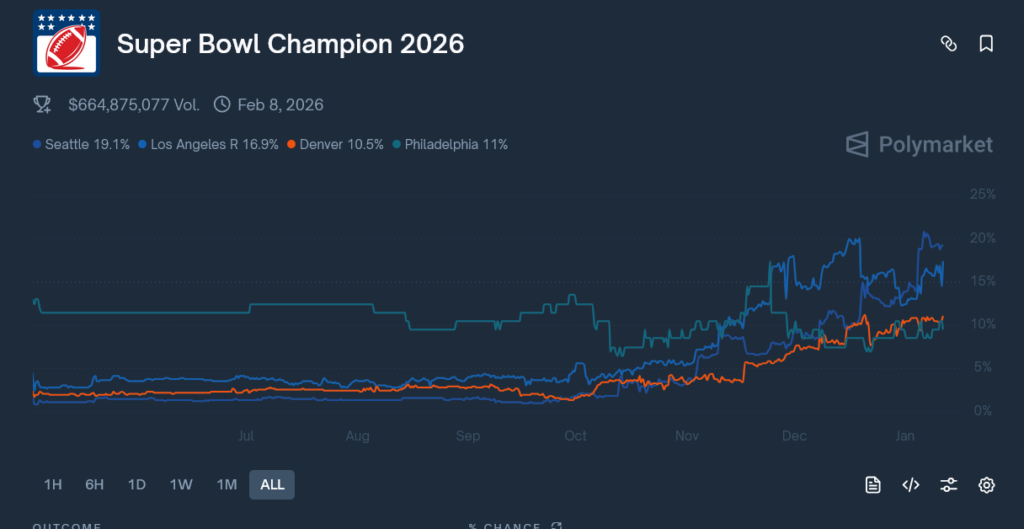
The Seattle Seahawks sit at 19% probability to win, Los Angeles Rams at 17%, and Philadelphia Eagles at 11%. These three teams account for nearly half the market. But here’s the thing about massive, efficient markets: the consensus is usually right, but the edges exist in the small gaps between platforms.
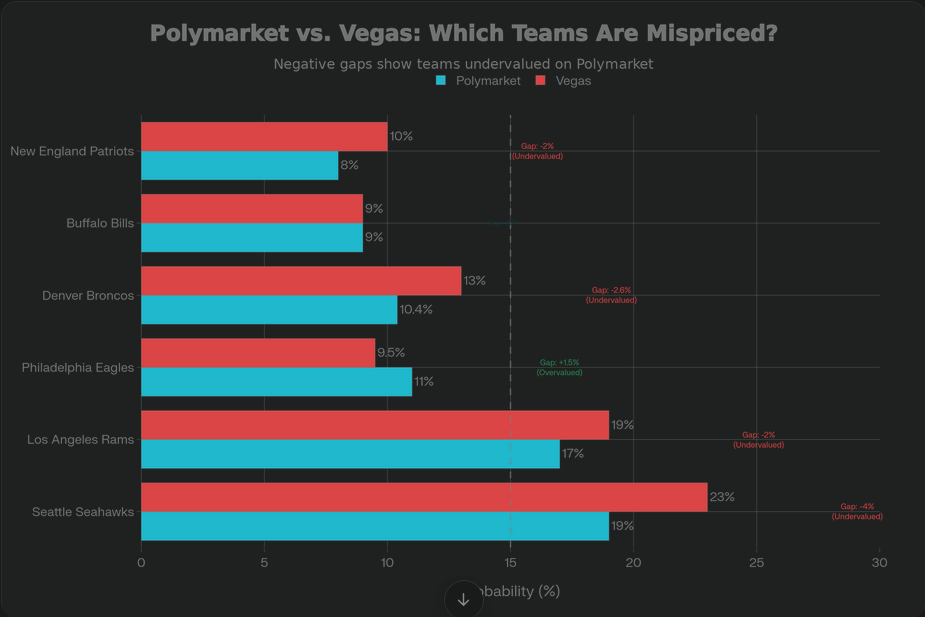
When you cross-reference Polymarket against traditional Vegas sportsbooks, something interesting emerges. Polymarket is systematically undervaluing favorites by 2-4% compared to Vegas odds. That’s not huge, but in a market this liquid and efficient, 2-4% edges are worth trading.
Who Will Win Super Bowl 2026?
This Super Bowl Champion market is actively trading on Polymarket. Track real-time odds, team probabilities, and market sentiment as the 2026 NFL season unfolds.
Disclosure: This link may be an affiliate link. If you use it, I may earn a commission at no extra cost to you.
Let me break down each contender, show you where the value actually is, and explain why this market behaves completely differently than geopolitical prediction markets.
Why This Market Is Different (And Why That Matters)?
Before diving into team analysis, understand what makes the Super Bowl market unique compared to Iran regime collapse, Greenland acquisition, or Israel-Iran strikes.
Complete information environment: All 14 playoff teams are locked in. Regular season records are final. Playoff bracket is set. There are no unknown variables like “will Khamenei have a medical crisis” or “will Trump change his mind.” The outcome is determined by 14 known teams playing playoff football over the next 29 days.
Highly efficient pricing: Vegas sportsbooks have spent decades optimizing Super Bowl odds. Thousands of professional bettors arbitrage inefficiencies. Polymarket is simply converging toward Vegas consensus. Unlike geopolitical markets where you might have unique insights, here the “wisdom of crowds” is extraordinarily refined.
No black swans: Short of a meteor hitting a stadium, there are no external shocks. The Super Bowl winner comes from this 14-team bracket. Period.
Short timeline: February 8 is 29 days away. That’s 4 rounds of playoffs. Each round eliminates teams and narrows uncertainty. By Conference Championship (January 25), only 4 teams remain. The market becomes more certain every week.
What this means for traders: Edges are smaller. You’re not betting on “will something unprecedented happen” – you’re betting on “which strong team will win a known tournament.” Value comes from finding teams mispriced relative to Vegas, not from unique geopolitical insights.
The Favorite: Seattle Seahawks (19%)
The Seahawks finished with the best NFC record and secured home field advantage throughout the playoffs. That’s huge in the NFL – worth an estimated 3-5 percentage points in win probability. They don’t travel until the Super Bowl itself.
Why They’re Favored:
Their defensive line is genuinely elite. DTs Leonard Williams and Byron Murphy anchor the interior. Edge rushers Marcus Lawrence and Uchenna Nwosu provide pass rush. Defensive coordinator Mike Macdonald is considered a “schematic wizard” who finds ways to exploit opponent weaknesses.
In their regular season finale, Seattle absolutely dominated the San Francisco 49ers – a team many considered a Super Bowl contender. That performance solidified their status as NFC favorite.
The Concerns:
Any injury to their elite defensive unit changes everything. This is a defense-first team. If Williams or Lawrence goes down, their Super Bowl odds plummet.
Also, playoff football is chaotic. Home field helps but doesn’t guarantee anything. Lower-seeded teams catch fire. Remember the 2007 New York Giants (10-6 wild card) beating the 18-0 Patriots? The best team doesn’t always win in the NFL.
The Polymarket vs. Vegas Gap:
Here’s what’s interesting. Vegas gives Seattle +330 odds, which translates to roughly 23% implied probability. Polymarket shows 19%. That’s a 4-point gap.
What this tells traders: Polymarket is slightly undervaluing Seattle compared to Vegas consensus. If you trust Vegas efficiency (and you generally should), Seattle at 19% represents value. But it’s not massive value – we’re talking 4 percentage points, not 40%.
The Second Favorite: Los Angeles Rams (17%)
Wait, the second favorite is only a #5 seed? How does that work?
The Rams are what analysts call a “dangerous playoff team.” They didn’t win their division (Seattle did), so they’re a wild card. But their 12-5 record and elite offense make them legitimate Super Bowl contenders.
Why They’re Competitive:
Their offense is historically efficient. Analysts describe it as “one of the most efficient offenses in 10+ years”. Matthew Stafford, despite being 37 years old with back issues, is still slinging it. When Cooper Kupp is healthy, the Rams’ passing game is nearly unstoppable.
Defensively, they generate pressure without blitzing. Byron Young ranks 7th in pressure rate. Jared Verse, Kobie Turner, and Braden Fiske all create havoc up front. That’s critical in playoff football where quarterback pressure determines outcomes.
Their first playoff matchup is against Carolina – objectively the weakest team in the playoff field. That’s a massive advantage. Win that game and build momentum.
The Critical Concerns:
Here’s what one analyst said: “If the Rams win the Super Bowl, it’s because their offense carried them. If they don’t, it’s because their secondary fell apart”.
Their outside corners – especially Emmanuel Forbes – get “dunked on” by bigger receivers. If they face a team with elite wide receivers in a crucial playoff game, that weakness could be fatal.
Cooper Kupp’s health is the single most important variable for the Rams. The analyst’s brutal assessment: Kupp “spends more time in the medical tent than anybody in the league”. If Kupp is out or limited, Rams’ Super Bowl odds drop significantly.
Matthew Stafford’s age and injury history is also concerning. At 37 with chronic back problems, one bad hit could end their season.
The Polymarket vs. Vegas Gap:
Vegas gives them +425 (19% implied). Polymarket shows 17%. Again, Polymarket is undervaluing them by 2 percentage points.
Trading angle: Monitor Cooper Kupp injury reports obsessively. If he’s confirmed healthy for playoffs, Rams at 17% might be value. If he’s questionable, sell immediately.
The Sleeper Value: Denver Broncos (10.4%)
This is where it gets interesting from a trading perspective.
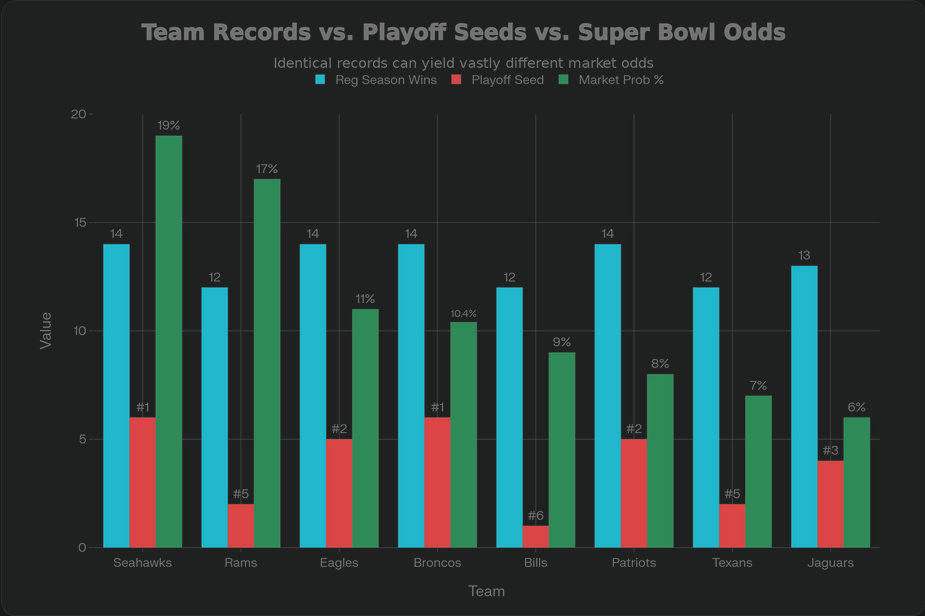
Denver finished 14-3 – tied for the best record in the entire NFL with Seattle and New England. They secured the AFC #1 seed, meaning home field advantage throughout the AFC playoffs.
Yet Polymarket prices them at only 10.4% to win the Super Bowl.
Why That’s Strange:
There’s a related Polymarket asking “Will Denver Broncos win the AFC Championship?” That market shows 27% probability.
Let’s do the math. If Denver has a 27% chance of winning the AFC Championship, and the AFC Championship winner faces the NFC Championship winner in the Super Bowl, Denver should have roughly 13-14% Super Bowl odds (depending on NFC opponent quality).
Yet Polymarket shows 10.4%.
The Value Calculation:
Vegas gives Denver +650 odds, which implies ~13% probability. That aligns with the “27% AFC × ~50% Super Bowl” calculation.
But Polymarket is 2.6 percentage points lower than Vegas.
Why This Gap Exists:
My theory: Traders are underestimating home field advantage in the AFC playoffs. Denver doesn’t travel until the Super Bowl. Every other AFC contender (Patriots, Bills, Texans, Jaguars) faces road games.
Home field in NFL playoffs is worth approximately 3-5% in win probability. That compounds over multiple rounds. Denver’s path to the Super Bowl is measurably easier than other AFC teams with similar records.
Trading Recommendation:
Denver at 10.4% appears undervalued relative to both Vegas (+650 = 13%) and their own AFC Championship odds (27%). If you’re looking for value in this market, Denver is the clearest opportunity.
Position sizing: 15-20% of your Super Bowl allocation in Denver.
The Defending Champions: Philadelphia Eagles (11%)
Philadelphia won the Super Bowl last year (2025) and enters the 2026 playoffs with an identical 14-3 record. They’re battle-tested, experienced, and loaded with All-Pro talent.
The Case for Eagles:
Defending champions have institutional knowledge. They know what it takes to win four straight playoff games. That experience is valuable, especially in close games.
As the #2 NFC seed, they avoid Seattle until the NFC Championship. Their bracket path is manageable.
Multiple analysts still consider them dangerous: “Can beat anyone in the league on any given day“.
The Problems:
Internal dysfunction has plagued this team all season. Saquon Barkley, their star running back, experienced regression after carrying 450+ touches last season. He’s still good, but not the explosive force he was.
Wide receiver A.J. Brown “spent more time complaining about his role than actually getting the ball,” according to one assessment. Team chemistry questions linger.
The passing game has been “out of sync seemingly all season”. For a team that needs to score 30+ points to win playoff games, that’s concerning.
The Polymarket vs. Vegas Gap:
Here’s the twist. Vegas gives them +950 (9.5% implied). Polymarket shows 11%.
Eagles are one of the only teams overvalued on Polymarket relative to Vegas. That 1.5% premium suggests traders are giving them too much credit for defending champion status despite obvious internal issues.
Trading angle: Eagles at 11% might be a fade candidate. If you’re betting NO on any team, Eagles are a reasonable choice given their dysfunction and the gap with Vegas.
Patriots vs. Broncos vs. Seahawks

Here’s a fascinating data point that reveals how much playoff seeding matters.
Three teams finished 14-3 (tied for best record in NFL):
- Seattle Seahawks: 19% Super Bowl odds
- Denver Broncos: 10.4% Super Bowl odds
- New England Patriots: 8% Super Bowl odds
They have identical records. Yet their Super Bowl probabilities range from 8% to 19% – a massive 11-point spread.
Why?
Playoff seeding.
Seattle is NFC #1 (home field throughout NFC playoffs). Denver is AFC #1 (home field throughout AFC playoffs). But New England is AFC #2, meaning they face road playoff games if they advance.
That single difference – home field vs. road games – is worth approximately 6-8 percentage points in Super Bowl probability. It’s not about talent. It’s about logistics.
For traders: Don’t just look at records. Seeding matters enormously in NFL playoffs. Home field advantage is quantifiable and should be priced into your positions.
The Volume Anomaly: Carolina Panthers ($59.38M)
Here’s the weirdest piece of data in this entire market.
Carolina Panthers have $59.38 million in trading volume. That’s more volume than any team except the top 5 contenders. It represents roughly 9% of the entire market.
Yet Carolina has only a 1% probability of winning the Super Bowl.
Why would $59 million flow to a 1% longshot?
Three explanations:
1. Lottery ticket mentality: If Carolina somehow won (astronomically unlikely), early bettors would make 99-to-1 returns. Some traders bet small amounts on extreme longshots for asymmetric upside.
2. Professional hedging: Sophisticated traders might buy massive Carolina positions to hedge other bets. If they’re short Seattle/Rams/Eagles, a small Carolina position provides cheap insurance against chaos.
3. Market structure: Polymarket’s fee structure might incentivize volume creation. Some traders might be generating volume for reasons unrelated to actual Carolina win probability.
For retail traders: Ignore this noise. Carolina’s $59M volume doesn’t mean they’re secretly good. It means the market has fat-tail hedging dynamics that don’t apply to you.
The 29-Day Timeline: How Odds Will Evolve?
Unlike geopolitical markets that can stay uncertain for months, the Super Bowl market has a fixed resolution path:
Wild Card Round (January 10-12): Six teams eliminated. Odds for remaining 8 shift dramatically. Momentum builders emerge.
Divisional Round (January 17-18): Four more teams eliminated. Only 4 remain (2 AFC, 2 NFC). Odds become binary for Conference Championships.
Conference Championships (January 25): Two teams eliminated. Super Bowl matchup is set. Odds become pure head-to-head between two teams.
Super Bowl LX (February 8): Winner crowned. Market resolves.
What this means: Uncertainty decreases exponentially with each round. Early positions (today, January 10) have maximum uncertainty and worst information. If you wait until after Wild Card weekend, you’ll have much better data – but odds will have already adjusted.
Trading implication: If you believe in Seattle/Rams/Denver value now, position today. If you want better information, wait until January 13 (after Wild Card) and trade the survivors.
The Trading Strategy by Profile
For Conservative Traders (No Strong Conviction)
Position: Diversify across top 4-5 teams proportional to their probability.
Allocation:
- 25% Seattle (19% market odds)
- 20% Rams (17% market odds)
- 20% Denver (10.4% market odds – overweight due to value)
- 15% Eagles (11% market odds)
- 10% Buffalo (9% market odds)
- 10% Cash/Other
Logic: Market is fairly efficient. Don’t fight consensus. Spread risk.
For Value Traders (Seeking Mispricing)
Position: Overweight Denver, underweight Eagles.
Allocation:
- 35% Denver Broncos (value at 10.4% vs. 13% implied)
- 25% Seattle Seahawks (slight undervalue at 19% vs. 23% Vegas)
- 20% Rams (conditional on Kupp health)
- 10% Patriots (strong record, undervalued)
- 10% Cash
Avoid: Eagles (overvalued vs. Vegas), Carolina/Tampa/Chicago (extreme longshots)
For Arbitrage Traders (Cross-Platform Edges)
Strategy: Bet favorites on Vegas, sell them on Polymarket.
Execution:
- Buy Seattle on Vegas at +330 (23% implied)
- Sell Seattle on Polymarket at 19%
- Lock in 4% spread
- Repeat for Rams (2% spread), Denver (2.6% spread), Patriots (2% spread)
Risk: Requires capital on multiple platforms; spreads are small (2-4%).
For Chaos Traders (Betting Against Consensus)
Position: Bet mid-tier teams with explosive upside.
Allocation:
- 30% Buffalo Bills (9% – could catch fire with Josh Allen)
- 25% Houston Texans (7% – young team with momentum)
- 20% Jacksonville Jaguars (6% – explosive offense)
- 15% San Francisco 49ers (if healthy)
- 10% Cash
Logic: In NFL playoffs, lower seeds beat higher seeds ~40% of time. Betting against chalk can win big.
Where’s the Real Value?
After analyzing $663.87 million in trading volume, cross-referencing Vegas odds, and evaluating 14 playoff teams, here’s my conclusion:
1. The market is fairly efficient. Polymarket and Vegas are within 2-4% on all major contenders. Massive edges don’t exist.
2. Seattle at 19% is roughly fair, but slightly undervalued vs. Vegas’ 23%. Small value if you believe in home field advantage.
3. Denver at 10.4% is the clearest value play. Vegas implies 13%, their AFC Championship odds imply 13-14%, yet Polymarket shows 10.4%. That’s a 2.5-3% edge.
4. Rams at 17% are conditional value. If Cooper Kupp is healthy, they’re undervalued. If he’s questionable, avoid.
5. Eagles at 11% might be overvalued vs. Vegas’ 9.5%, especially given internal dysfunction.
6. Avoid extreme longshots. Carolina’s $59M volume is noise, not signal.
7. Playoff results matter more than pre-playoff odds. Each round provides new information. Early positions have worst data.
My position if I were trading this:
- 30% Denver (value at 10.4%)
- 25% Seattle (slight undervalue at 19%)
- 20% Rams (conditional on Kupp health reports)
- 15% Buffalo (chaos hedge)
- 10% Cash (wait for Wild Card results)
This isn’t Iran or Greenland where you’re betting on unprecedented geopolitical events. This is 14 teams playing football over 29 days. The outcome is knowable through conventional analysis. Trust the data, find the 2-4% edges, and don’t overthink it.
The Super Bowl is February 8. By then, one team will have won four straight playoff games. The market will resolve. And somewhere, a trader who bought Denver at 10.4% will be smiling.
Track playoff results and shifting odds daily. Super Bowl LX odds will narrow dramatically after each round. For real-time analysis, follow TradeTheOutcome.com