


The 2026 NBA Finals pit the San Antonio Spurs against the New York Knicks, with Polymarket pricing San Antonio at 61 cents and New York at 38 cents ahead of Game 1 on June 3. The core tension in this market is straightforward: Wembanyama’s dominant run through the Western Conference Finals against New York’s eight-day rest advantage and the Madison Square Garden crowd in Games 3 and 4. This article examines what that split implies for the matchup and how a trader might reason about the series.
Knicks vs Spurs – Game 1 Odds
Polymarket traders are actively pricing Game 1 of the NBA Finals between the New York Knicks and San Antonio Spurs. Market odds reflect team momentum, injuries, matchup dynamics, and championship expectations as the Finals begin.
Disclosure: This link may be an affiliate link. I may earn a commission at no extra cost to you.
What this market is about?
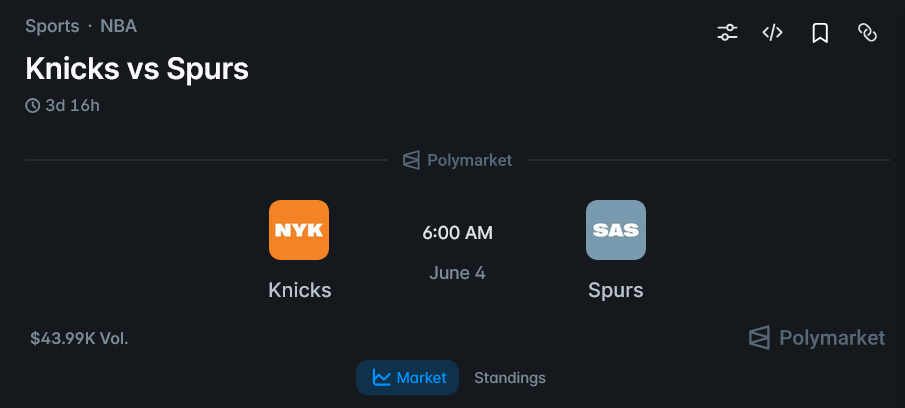
This is a multi-outcome market where buying one team means your stake is lost entirely if the other team wins. Buying San Antonio at 61 cents returns $1 per share if the Spurs win the 2026 NBA Championship and loses the full stake if New York wins. The contract resolves July 1, 2026, and total volume across all contracts has exceeded $404 million.
For a full breakdown of contract mechanics, implied probability, and how multi-outcome Polymarket markets work, see the NBA Champion market analysis on this site. This article focuses on the matchup-specific factors driving the current 61-to-38 split and what they mean for a trader approaching either side of the series.
Recent news and data
The Finals field was confirmed Saturday when San Antonio defeated Oklahoma City 111-103 in Game 7 at OKC Arena. New York had been waiting after completing a 4-0 sweep of Cleveland in the ECF. Key matchup data:
- Victor Wembanyama averaged 28.2 points, 11.5 rebounds, and 3.0 blocks per game against Oklahoma City and was named the WCF MVP. He is the first player in NBA history to record more than 15 three-pointers and 15 blocks in a single playoff series.
- Stephon Castle averaged 19.4 points per game in the WCF and posted 16 points, six rebounds, and six assists in Game 7, confirming his health after a mid-series injury concern.
- San Antonio finished 62-20 in the regular season. The two teams split their regular-season series 1-1.
- New York has been resting since their May 26 ECF clincher. Jalen Brunson led a 44-point fourth-quarter run in the ECF opener to erase a 22-point fourth-quarter deficit against Cleveland in overtime.
- Kalshi opened the same matchup at 63 cents for San Antonio and 37 cents for New York, per a cross-platform tracker aggregating both exchanges.
- Games 1 and 2 are at San Antonio. Games 3 and 4 move to Madison Square Garden in New York.
What the current price implies?
The 61-to-38 split reflects a market making two simultaneous judgments: that Wembanyama is the best player in this series, and that the rest advantage is real but not large enough to make New York the outright favorite. Both judgments are defensible against the available evidence, and neither has been clearly resolved by on-court data yet.
Wembanyama’s WCF output was historically unusual. Averaging 28 points, 11.5 rebounds, and three blocks across seven games against the defending champion, including a road Game 7, establishes him as the dominant individual talent in this matchup. The 61-cent price is largely a proxy for the market’s view that he continues at that level against New York’s defense. A trader entering the Spurs is almost entirely making a call on one player’s ability to sustain an outlier performance.
The rest gap complicates that framing in the early games. San Antonio has played continuously since May 18. New York has had eight days off. Accumulated fatigue from a seven-game series typically shows most clearly in the first two games of a new round before both teams’ conditioning levels equalize. Games 1 and 2 in San Antonio are therefore more contested than the home-court framing alone suggests, and a poor Game 1 for the Spurs would shift the market quickly against the current 61-cent level.
Heading into Game 7, San Antonio was still the underdog at sportsbooks, with OKC at roughly +120 and New York at +200 as they waited for their Finals opponent, per pre-Game 7 data. The Spurs closing out on the road in Game 7 shifted the market decisively. The current 61-cent level is a fully updated post-series price that already reflects the Wembanyama premium and the series win over OKC.
The series structure also matters for how prices will move. San Antonio hosts Games 1 and 2. New York gets Madison Square Garden for Games 3 and 4. A 1-1 split after the San Antonio games would shift the market meaningfully toward New York, and the current 38-cent price for the Knicks accounts for that scenario being plausible. The market is not treating San Antonio’s home-court advantage as decisive, which the rest factor and the MSG games explain.
How traders might think about this market?
Reasons a trader might back the Spurs
The core argument for 61 cents is Wembanyama against any opponent. His WCF performance was not a function of matchup or circumstance. He produced it across seven games against a 50-plus-win team holding the defending title, with his best output in the two elimination games. A trader buying the Spurs is backing one player’s ability to determine a Finals outcome, and the three-week evidence base for that position is strong.
San Antonio also enters the series healthy. Castle’s Game 7 performance removed the injury uncertainty that was baked into earlier Spurs pricing. The Spurs won Game 7 on the road as the underdog, which is a concrete data point about their composure in high-leverage situations. A trader who treats individual ceiling and mental composure as the primary championship predictors might view 61 cents as appropriate or even slightly underpriced given the Wembanyama factor.
For a dedicated breakdown of the Spurs’ individual contract and what the market is specifically pricing, see the Spurs analysis on this site.
Reasons a trader might back the Knicks
The rest advantage at 38 cents is the structural case for New York. Eight full days off against an opponent finishing a seven-game series is a measurable physiological gap that shows up most visibly in the early games of a new round. A $100 position on the Knicks at 38 cents returns roughly $163 if New York wins the championship, which is slightly better than even money for the team entering fresher at every position.
Brunson’s clutch production is the individual counterweight to Wembanyama. The 44-point fourth-quarter run he led against Cleveland in overtime, erasing a 22-point deficit, is the kind of late-game output that determines Finals outcomes when series tighten. A trader backing the Knicks at 38 cents is also backing Games 3 and 4 at Madison Square Garden, where the crowd advantage and home familiarity are real factors if the series is competitive by that point.
New York has been underpriced at every stage of this postseason. They opened the season at +900 to win the title and drifted as far out as +3700 during the regular season before this playoff run, per opening Finals odds. A trader who believes the market has systematically undervalued New York’s execution might view 38 cents as the latest iteration of that pattern rather than a fair reflection of the matchup.
For a dedicated breakdown of the Knicks’ individual contract and path to the title, see the Knicks analysis on this site.
Reasons a trader might stay out
The 72-hour pre-game window before June 3 carries injury and lineup risk for both teams. Any significant health update for Wembanyama, Castle, or Brunson could move prices 10 to 15 cents before tip-off, making a current entry worse than one taken after that news clears. Waiting for pre-game clarity costs relatively little if you have no directional conviction on the series before the news window closes.
Game 1 will also establish whether the rest advantage is visible in San Antonio’s early-game execution or whether their depth absorbs the fatigue. A single game produces meaningful signal in a seven-game series, and the entry price after Game 1 will be grounded in observable evidence rather than inference about fatigue and matchup. A trader without strong conviction might find the post-Game-1 entry cleaner than the current pre-series price.
Practical advice for beginners
- This is a two-outcome market in practice. Buying either team means your full stake is lost if the other team wins. There is no offsetting contract that benefits from your team losing.
- Only trade with money you can afford to lose entirely. In an active Finals, prices move 10 to 20 cents after individual game results, and positions can deteriorate quickly after a single loss.
- The contract resolves July 1, 2026. Capital is locked until that date regardless of when the series ends.
- Check order book depth before entering a large position. Total market volume is over $404 million but per-contract depth may produce wider spreads than a standard binary market.
- For a step-by-step guide on depositing funds into Polymarket before you trade, see the funding guide on this site.
Bottom line
San Antonio at 61 cents and New York at 38 cents prices a series where Wembanyama’s individual dominance and home-court advantage in Games 1 and 2 form the primary Spurs case, and New York’s eight-day rest edge, Brunson’s clutch track record, and MSG in Games 3 and 4 form the primary Knicks case.
Neither price looks dramatically off against the available matchup evidence. The most consequential variable, whether accumulated fatigue is visible in San Antonio’s performance in the early games, will be observable within hours of Game 1 tipping off June 3.
