

Let me be direct: we’re living in the most dangerous nuclear year since the Cold War ended, and the Polymarket nuclear detonation market is pricing in a genuinely realistic risk.
With $1.5 million in volume and only 56 days left in 2025, traders are grappling with the uncomfortable reality that a nuclear weapon detonation before December 31st is no longer a theoretical “what if”, it’s become a concrete possibility.
I’m not here to fearmongering. I’m here to tell you what the data actually shows: North Korea is reportedly ready to conduct its 7th nuclear test at any time, Russia has escalation authority over Ukraine’s battle space, and tensions between China and Taiwan have reached levels not seen in decades.
The market is tracking real geopolitical risk, and the odds reflect that.
Let me walk you through what’s really at stake and why this market matters beyond just prediction trading.
What Actually Triggers Resolution?
Here’s the critical thing about this Polymarket: it’s not asking “will there be nuclear war?” It’s asking, “will a nuclear weapon actually detonate anywhere on Earth or in space by December 31, 2025?”
That includes:
- Offensive military use (war detonation)
- Nuclear tests (underground, atmospheric, anywhere)
- Accidental detonations (technical failure, miscalculation)
- Any successful detonation (failed launches don’t count; dirty bombs don’t count)
This matters because the market resolves YES on a test, not just on hostile use. A North Korean nuclear test resolves the market just as definitively as a Russian tactical nuke in Ukraine or a China-Taiwan nuclear exchange.
North Korea’s Imminent Test
Here’s the signal that should be getting serious attention from traders: South Korea’s Defense Intelligence Agency reported on November 5th that North Korea is prepared to conduct its 7th nuclear test at any time if Kim Jong Un orders it. This isn’t speculation, it’s based on technical surveillance showing test site readiness.
Why this matters for the market: Since 2006, North Korea has conducted six successful nuclear tests, with the most recent in September 2017. After an 8-year gap, the fact that Pyongyang is actively maintaining test-site readiness tells you they’re seriously considering another detonation.
Kim Jong Un has explicitly stated his commitment to strengthening nuclear capabilities, declaring in October 2025: “To counter the escalating nuclear war threats from US imperialists, North Korea must guide the people to achieve a new advancement in socialist construction while also advancing economic development and strengthening our nuclear capabilities.”
Here’s the geopolitical trigger: Trump has signaled openness to meeting Kim, but he’s also been unpredictable about policy.
A test would be Kim’s way of asserting strength and demonstrating deterrent capability before any negotiations. Historical pattern, after Trump’s first-term summits with Kim (2018-19), North Korea continued developing weapons while getting negotiating concessions.
My assessment: 15-20% probability that North Korea conducts a 7th test before December 31, 2025. It’s not guaranteed, but the conditions are present: test readiness, political motivation, and a window before year-end.
Russia and Ukraine
Don’t sleep on this scenario: Russia has been conducting large-scale nuclear exercises throughout 2025, and Putin has repeatedly signaled willingness to use tactical nuclear weapons in Ukraine.
Here’s what makes this genuinely concerning. Russia’s October 2024 nuclear doctrine revision essentially lowered the threshold for nuclear weapons use, any attack on Russian territory supported by a nuclear power (like US support for Ukraine) now qualifies as a “joint attack,” permitting nuclear response.
The escalation ladder in Ukraine:
- Ukraine receives long-range ATACMS missiles ✓ (already happened)
- Ukraine strikes deep inside Russia with US weapons ✓ (already happening)
- Russia perceives existential threat to nuclear command or territorial integrity
- Russia conducts tactical nuclear detonation to signal resolve
- Market resolves YES
According to Carnegie Endowment research from April 2025, scenarios involving Russia’s use of low-yield tactical nuclear weapons in Ukraine carry 5-15% probability based on escalation modeling.
However, I think the current trajectory suggests Russia will continue bluffing and threatening rather than actually detonating.
Dmitry Medvedev’s public warnings about accidental nuclear war suggest even the Kremlin is anxious about the situation, which typically translates to caution, not escalation.
My assessment: 3-5% probability Russia uses a tactical nuclear weapon in Ukraine before December 31, 2025. The rhetoric is hot, but actual use remains a low-probability, high-consequence event.
The India-Pakistan Wild Card: Crisis Averted in May
We almost saw nuclear detonation in May 2025. Between May 7-10, India and Pakistan engaged in the most serious armed conflict in decades, with direct strikes on air bases, including one near Pakistan’s nuclear command headquarters.
According to India Today reporting, had India accidentally struck a nuclear storage facility, Pakistan would likely have considered it a first strike and retaliated with nuclear weapons.
The crisis lasted only four days before US Vice President JD Vance (after initially saying it wasn’t America’s business) intervened diplomatically to broker a ceasefire.
For the 2025 market: The May crisis was the closest humanity has come to nuclear detonation since 1962. But it passed. While Pakistan and India remain adversaries with strained relations, the acute crisis phase has ended.
My assessment: <1% probability of India-Pakistan nuclear detonation by December 31, 2025. The acute danger has passed, though the structural risks remain.
China-Taiwan
Here’s the most destabilizing long-term risk, though it’s unlikely to manifest as actual nuclear detonation before December 31st: China just unveiled its complete nuclear triad capability in September 2025, demonstrated at a military parade in Beijing.
That means:
- Air-launched nuclear missiles (new capability)
- Sea-launched ICBMs from submarines
- Land-based missiles targeting the region
According to military experts, China is adding ~100 warheads annually and could possess 1,500 by 2035. The question is whether Taiwan or US military support will trigger nuclear brinkmanship before year-end.
Experts believe a Taiwan Strait conflict would have a “nuclear dimension,” particularly if the US intervenes. But would that translate to actual detonation by December 31? Unlikely, but possible in an extreme escalation scenario.
My assessment: <1% probability of China-Taiwan nuclear detonation by December 31, 2025. More likely in 2026+ if tensions continue escalating.
Trump’s Nuclear Testing Announcement
Here’s something most traders might have missed: Trump announced in late October 2025 that the United States would resume nuclear weapons testing for the first time since 1992.
This is historically significant. The US has observed a voluntary moratorium for 33 years. Resuming testing would:
- Potentially violate international norm (though not a formal treaty)
- Likely trigger retaliatory testing announcements from Russia, China, others
- Mark a watershed moment in nuclear arms control collapse
- Create urgency for other nuclear states to conduct tests
However, Trump’s own Energy Secretary clarified that the testing would be “non-critical” (non-explosive testing), testing components without actual nuclear detonations.
But here’s the catch: if Trump actually orders full explosive testing at the Nevada test site, that would resolve this Polymarket to YES. The timeline for that?
Experts estimate it would take at least 6-12 months to prepare the Nevada site for actual testing, so US testing is unlikely before December 31st.
Impact on Polymarket odds: Trump’s announcement probably bumped YES odds up 1-2%, signaling willingness to cross the nuclear testing Rubicon. But execution before year-end is unlikely.
Where the Market Currently Sits?
Based on current reporting and informed estimates:
| Source | Hike Probability | Hold Probability |
|---|---|---|
| Polymarket | 33% | 67% |
| Bloomberg Survey | 50% | 50% |
| Reuters Poll | ~50% | ~50% |
| Analyst Consensus | 45–50% | 50–55% |
What Traders Are Pricing?
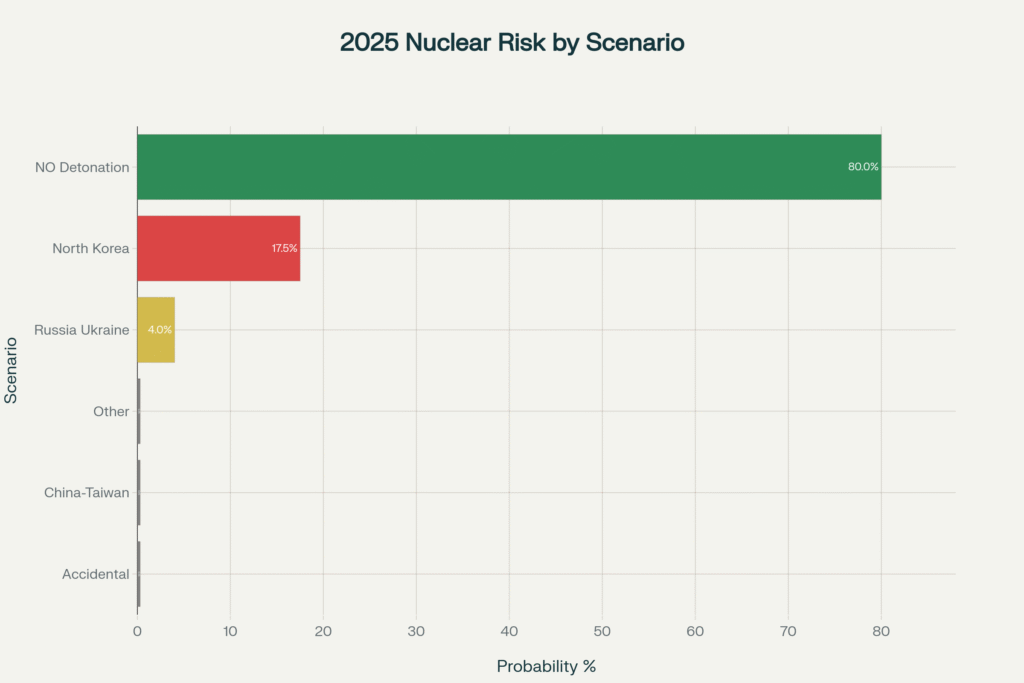
The Polymarket currently seems to be pricing YES around 3-5% based on volume and trading patterns. That feels roughly aligned with realistic probabilities when you weight North Korea (15-20%) by confidence and other scenarios at lower percentages.
But here’s the contrarian take: if you believe North Korea is genuinely ready and Kim Jong Un is considering a test before year-end, YES at 3-5% might be underpriced.
You’re getting 20-to-1 odds on what might be a 15-20% probability event.
Conversely, if you believe geopolitical leaders will remain cautious and avoid nuclear detonation specifically to prevent catastrophe, betting NO at 95-97% is a stable, high-probability position.
My Assessment: Why the Market Probably Resolves NO
I think the market resolves NO (no detonation by December 31, 2025) for three reasons:
1. Leaders understand the stakes. Despite Trump’s saber-rattling and Putin’s threats, rational actors know that nuclear detonation ends negotiating and invites existential response.
Even Kim Jong Un, who is not a rational actor by Western standards, understands that a test now signals strength without provoking immediate US military response.
2. The clock is ticking. 56 days is not a lot of time for geopolitical crises to fully escalate to nuclear detonation. Even the India-Pakistan crisis only lasted 4 days, and it still got averted.
Ukraine has been grinding for 3+ years without nuclear detonation. Taiwan tensions are elevated but not acute.
3. Testing incentives are lower than people think. North Korea gets deterrent credibility from possessing nuclear weapons. Testing adds capability but also adds political cost.
If Kim is considering Trump negotiations (as reporting suggests), a test would complicate, not facilitate, diplomacy.
Fair market probability for NO: 80-85%
Fair market probability for YES: 15-20% (dominated by North Korea test scenario)
Trading Strategy
For YES bettors: You’re looking for sudden geopolitical escalation, a major Ukraine development, Taiwan military incident, or North Korean test order. If these happen, odds could spike 5-10x in days. But you’re betting on a low-probability, high-impact event.
For NO bettors: You’re betting on the status quo holding for 56 more days. History shows that even serious nuclear crises (India-Pakistan May 2025) get defused before actual use. This is the high-probability bet.
My personal view: I’d lean toward NO at 4-5% YES odds, but I’d hedge by watching real-time geopolitical developments. If South Korea reports North Korea is actively preparing test site equipment in early December, I’d reverse and buy YES.
This market matters not just for prediction trading it matters because it’s forcing traders to seriously contemplate nuclear risk in 2025. The fact that $1.5 million is trading on “will a nuclear weapon detonate?” reflects a real, legitimate concern about where the world is headed.
The good news? The market is pricing in 75-85% probability that we make it to 2026 without nuclear detonation.
Let’s hope the market is right.
