


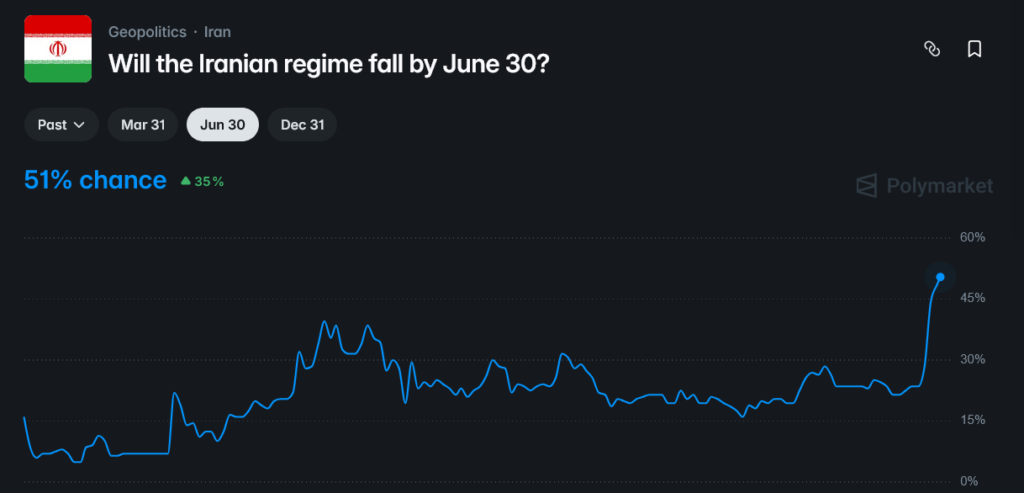
Prediction markets are currently treating the collapse of the Iranian regime as a literal coin flip. As of today, the probability of the Iranian government falling by June 30, 2026, is hovering at a tense 51% on Polymarket.
This elevated pricing reveals a massive divergence between official state narratives and where geopolitical traders are actually putting their money.
While mainstream reports highlight that Tehran’s streets remained relatively subdued last week, the financial markets are aggressively pricing in compounding, under-the-radar structural risks.
BREAKING UPDATE: US-Israeli strikes killed Supreme Leader Ayatollah Ali Khamenei on February 28, per President Trump and Iranian state TV, triggering a “transitional phase” amid IRGC vows of revenge. Polymarket “Yes” odds have likely exploded past 90% (check live), validating traders’ 51% baseline as prescient while chaos unfolds: unclear successor, protests reigniting, and Trump urging uprising.
Iran Regime Collapse Odds Hit 51% on Polymarket
Traders on Polymarket have pushed the odds of the Iranian regime collapsing near or before 2027 to a notable level. This reflects heightened concern around ongoing nationwide protests, economic stress, and political succession uncertainty as reflected in market pricing and volume. :contentReference[oaicite:1]{index=1}
Disclosure: This link may be an affiliate link. I may earn a commission at no extra cost to you.
The “Information Gap”: Calm Streets vs. Market Bets
On the surface, the regime appears to be maintaining its grip. Tehran successfully downplayed the limited Israeli military strikes on Isfahan late last year, vowing a measured response without triggering a wider regional war.
Furthermore, the Islamic Revolutionary Guard Corps (IRGC) has rapidly quashed recent sporadic protests over fuel prices.
However, prediction market traders are looking past the immediate crowd control. They are betting that the absence of daily upheaval does not equal long-term stability.
The Iranian rial has plummeted to record lows, creating an unsustainable domestic economic environment that traders believe could serve as a sudden catalyst for regime failure.
Key Market Drivers: Why 51%?
The 51% threshold is a critical psychological marker in prediction markets. It indicates that the crowd views a historic collapse not as a fringe “tail risk,” but as the slightly favored outcome.
| Metric | Value |
|---|---|
| Yes Odds (pre-strike) | 51% |
| Volume | $2.9M |
| Related: Coup Attempt | 52% ($97K) |
Traders are actively pricing in three converging pressures:
- Economic Tipping Point: The rial’s unprecedented devaluation has severely strained the Iranian working class, making localized fuel protests highly combustible.
- Succession Uncertainty: Speculation surrounding the health and succession of 85-year-old Supreme Leader Ali Khamenei has intensified, raising the risk of internal factional fracturing.
- Proxy Network Degradation: Recent, sustained setbacks for Iranian proxy forces in Syria and Lebanon have diverted crucial resources and eroded the regime’s regional leverage.
What This Means for Traders?
A 51% probability implies extreme volatility in the coming months. If the regime maintains its core control, these “Yes” shares will inevitably crash toward zero as the June 30 deadline approaches.
For geopolitical traders, the real opportunity lies in the volatility.
Any sudden news of Khamenei’s health or a localized protest breaking through the IRGC’s containment lines could send this contract spiking toward 70% or 80% in a matter of hours.
The market is quiet for now, but the 51% baseline suggests the foundation is fragile.
