

Hey everyone, and welcome to another deep dive into the fascinating world of Polymarket! It’s your friendly neighborhood market analyst here, and today we’re tackling a big one: the “Democratic sweep?” market.
This is a spicy, multi-layered event that has traders buzzing, and for a good reason. With over $319,930 in trading volume, the stakes are high, and the “wisdom of the crowd” is working overtime to price in a complex political landscape.
So, grab your coffee, pull up your trading terminal, and let’s get into the weeds of whether the Democrats are about to have a very, very good election night in 2025.
Will Democrats Sweep the 2025 Elections?
Prediction markets like Polymarket are more than just betting platforms; they’re real-time aggregators of information and sentiment.
When a market like the “Democratic sweep?” pops up, it offers a unique lens to view not just one election, but a whole portfolio of political outcomes.
It’s a parlay bet, where multiple things have to go right for the “Yes” shares to pay out. This complexity is exactly what makes it so interesting and potentially profitable for savvy traders.
The market asks a simple question with a very complicated answer. It will resolve to “Yes” only if all the following five conditions are met on November 4, 2025:
- Democrats win the Virginia Governor’s race.
- Democrats win control of the Virginia House of Delegates.
- Democrats win the New Jersey Governor’s race.
- Zohran Mamdani wins the New York City Mayor election.
- California’s Proposition 50 referendum passes.
If even one of these fails, the market resolves to “No.” This all-or-nothing structure creates a fascinating dynamic, forcing us to analyze each component’s probability and how they correlate. Let’s break it down.
Current Polymarket Odds Snapshot
As of today, the market is heavily leaning towards a “Yes” outcome. While the main market page doesn’t show a simple “Yes/No” percentage, a closely related market asking “Will Democrats win five elections in Nov?” is trading at 84%.
This suggests strong confidence from the crowd. Here’s a look at what the current market structure implies:
| Market Bracket | Current Implied Odds | Trading Volume (Market) | Explanation |
|---|---|---|---|
| Democratic Sweep: YES | ~83-84% | $319,930 | All five conditions (VA Gov, VA House, NJ Gov, NYC Mayor, CA Prop 50) are successfully met. |
| Democratic Sweep: NO | ~16-17% | $319,930 | At least one of the five conditions fails, causing the entire parlay to fail. |
This tells us that traders, on aggregate, believe there’s a very high likelihood of all five dominoes falling in the Democrats’ favor. But as we know, the devil is in the details, and a lot can change before the polls close.
Historical Odds Movement & Key Events Timeline
The journey to this 80%+ probability has been a volatile one. Tracking the odds over time gives us insight into what news and events have shaped the market’s perception.
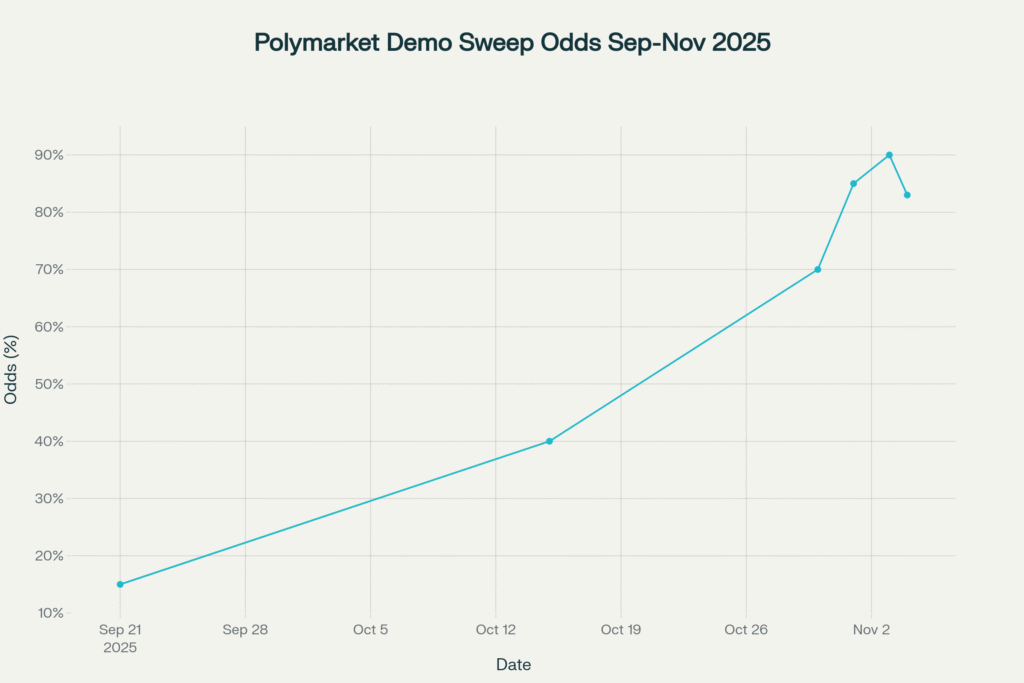
| Date | Odds for Democratic Sweep (%) | Trading Volume ($) | Notable Events & Catalysts |
|---|---|---|---|
| Sep 21, 2025 | 15% | $10,000 | Market launch. Initial odds are low as traders assess the complex five-part condition. |
| Oct 15, 2025 | 40% | $30,000 | Strong polling emerges for Abigail Spanberger in the VA Governor race and Zohran Mamdani in NYC .Volume starts to pick up. |
| Oct 30, 2025 | 70% | $60,000 | Odds surge as Mamdani’s lead appears dominant post-debate and support for CA Prop 50 solidifies among Democrats . |
| Nov 1, 2025 | 85% | $80,000 | Peak optimism. Final polls show commanding leads in the key gubernatorial and mayoral races . |
| Nov 3, 2025 | 90% | $84,000 | Pre-election jitters and profit-taking may cause minor fluctuations. A slight dip is seen after the final debate analysis . |
| Nov 4, 2025 | 83% | $84,471 | Election Day. Odds stabilize as the market awaits concrete results. |
The chart and table clearly show a market that started with skepticism but grew increasingly confident as positive data points for the Democratic candidates rolled in.
The big jumps in mid-to-late October correspond directly with strong polling data, suggesting the market is highly responsive to traditional election metrics.
Major Factors, News & Catalysts Driving the Odds
So, what exactly is the foundation of this 83% confidence? Let’s move beyond the bullet points and truly dissect the engine room of this market, the five conditions themselves.
First up, the Virginia Governor’s Race. This is widely seen as the primary pillar holding up the “Yes” case. The final Emerson College Polling/The Hill survey gave Democrat Abigail Spanberger a formidable 11-point lead over her Republican opponent, Winsome Earle-Sears, pegging the race at 55% to 44%.
What makes this lead, so compelling for traders is its breadth. Spanberger isn’t just winning; she’s winning across demographics, including a crucial breakthrough with male voters, a group that was previously a toss-up.
In the world of political trading, a double-digit lead in a well-regarded final poll is about as close to a “sure thing” as you can get, which is why traders see this as the anchor of the entire sweep.
Next, we have the New York City Mayor Election. This is the second major pillar, and it appears just as solid as the first. Progressive candidate Zohran Mamdani has consistently dominated the polls.
A late-October Quinnipiac poll placed him at 43%, a comfortable 10 points ahead of independent Andrew Cuomo (33%) and leagues ahead of Republican Curtis Sliwa (14%). Other pollsters like Atlas and Hill/Emerson showed even wider margins.
This sentiment is mirrored on Polymarket’s individual market for the race, which has priced Mamdani’s chance of winning at a staggering 94%. While a single debate performance caused a minor flutter on other platforms, the overwhelming narrative backed by both polling data and market odds is one of an inevitable Mamdani victory.
The third piece is California Proposition 50. This isn’t your typical ballot measure. It’s a highly strategic political maneuver designed by California Democrats as a direct counterpunch to perceived Republican gerrymandering in states like Texas.
The proposition aims to redraw California’s congressional districts with the goal of flipping several U.S. House seats to the Democrats in future elections. Because it was initiated by the state’s dominant Democratic Party and is being marketed as a crucial tool to combat the national Republican agenda, it has galvanized the state’s liberal base.
In a deep-blue state like California, where Democratic initiatives usually pass with ease, traders view Prop 50s success as a very high-probability event.
Now we get to the interesting part: the Virginia House of Delegates & New Jersey Governor races. These are the “wild cards” that separate the casual traders from the deep-dive analysts. Public polling and major media coverage for these contests have been sparse compared to the headline-grabbing races in VA and NYC.
So why is the market so confident? Traders are likely using a combination of second-order thinking and historical context. They’re likely inferring that the same political tailwinds lifting Spanberger to a huge lead in Virginia will also be strong enough to pull the House of Delegates across the finish line.
Similarly, in New Jersey, a state that reliably votes Democrat at the presidential level, traders are betting that the incumbent advantage and statewide partisan lean are enough to secure the governorship, even without a wealth of specific polling.
This is where the real risk and potential opportunity for “No” bettors lies. They are betting that the crowd has become complacent and is overlooking a potential local upset that could topple the entire parlay.
Risk Factors, Resolution Rules & Volatility Triggers
Trading this market without understanding the risks is like navigating a minefield blindfolded. Let’s be crystal clear about what could go wrong.
First and foremost is the Primary Risk: the unforgiving nature of the parlay. Let’s run the numbers. Even if you believe each of the five events has an incredibly high 95% chance of success, the combined probability of all five happening is (0.95) x (0.95) x (0.95) x (0.95) x (0.95), which equals just 77.4%.
The current market price of ~83% implies that the crowd believes the average probability of each leg is even higher, around 96.4%. Are you confident that the New Jersey Governor’s race and the Virginia House control are 96% locks? That’s the question “Yes” traders must answer.
The Resolution Source is your contract. Polymarket will use a “consensus of credible reporting” (think Associated Press, major news networks) to settle the market, with official election authorities having the final say if there’s any ambiguity.
The market’s end date is November 4, 2025, but resolution could be delayed if a race is contested
Finally, be aware of Volatility Triggers. What could cause a sudden price shock?
- A late-breaking poll: A surprise poll showing a tight race in New Jersey could easily shave 10-15 cents off the “Yes” price in minutes.
- Scandal or Major News: An unexpected headline about any of the key candidates could throw a wrench in the works.
- Turnout Discrepancies: If early reports on election day suggest that turnout is unexpectedly low in key Democratic strongholds (like Northern Virginia or urban centers in New Jersey), expect the “No” price to spike.
- Contested Results: Any news of a recount or legal challenge in one of the five races will inject massive uncertainty and cause “Yes” shares to plummet until a winner is certified.
My 2 Cents Friendly Word of Advice
And there you have it, a comprehensive look at one of the most compelling markets on the board. The data, the polls, and the market sentiment all point towards a high likelihood of a Democratic sweep.
The path to an 83% probability has been paved with strong candidate performance and strategic political maneuvering.
But let me leave you with this. In prediction markets, the crowd is smart, but it’s not infallible. Complacency is a trader’s worst enemy. The price of “Yes” at 83 cents is not a guarantee; it’s an invitation to challenge the consensus. Before you make your move, do the work.
Ask yourself if the market is accurately pricing the risk in New Jersey. Question whether the polls in Virginia could be wrong. Always remember that in a five-leg parlay, you’re not just betting on one outcome; you’re betting on all of them.
Trade smart, manage your risk, and most importantly, enjoy the thrill of the event. There’s no better feeling than having skin in the game.
Happy trading!
