
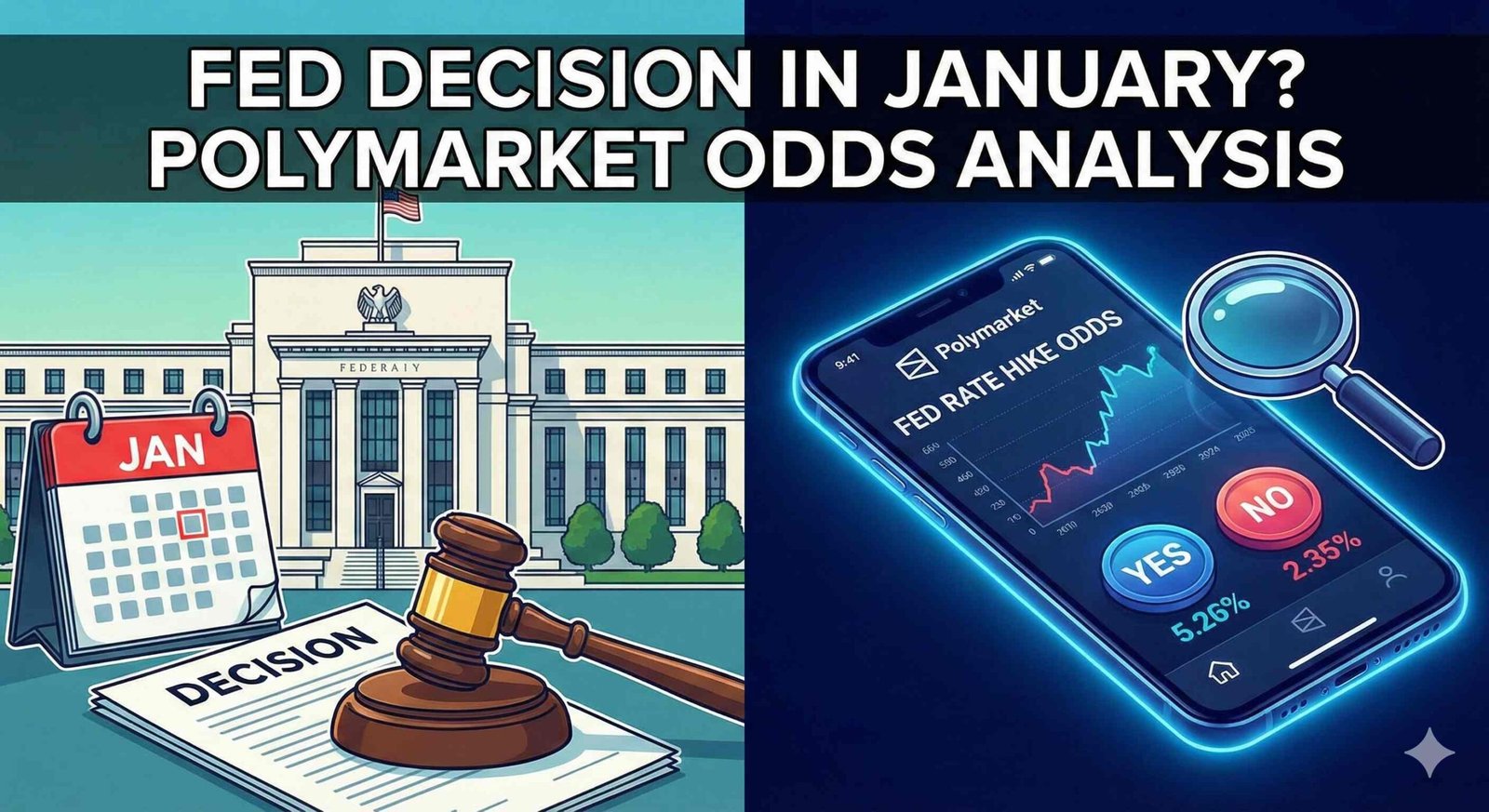
Will the Federal Reserve change interest rates at its upcoming meeting on January 27-28, 2026? Polymarket traders have delivered a resounding answer: NO.
“No Change” shares are currently trading at 98.8¢ (99% probability) versus just 1.2¢ for any rate change, with over $465 million in volume traded.
The market has converged to near-certainty that the Fed will hold rates steady at 3.50%-3.75%, marking a dramatic shift from the three consecutive cuts delivered in late 2025.
Fed Decision in January?
This Polymarket event tracks what traders believe the Federal Reserve will decide at the January meeting. Odds reflect expectations around rate cuts, holds, or surprises based on inflation data, economic momentum, and policy signals.
Disclosure: This link may be an affiliate link. I may earn a commission at no extra cost to you.
Market Overview: The 99% Consensus
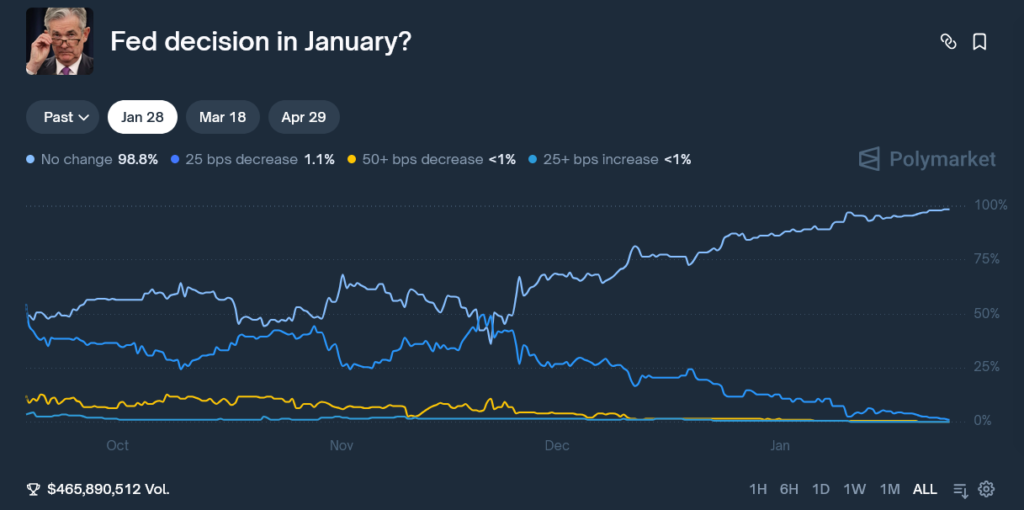
The current market pricing reflects overwhelming confidence in a Fed pause. “No change” dominates at 99% probability, while all other outcomes combined represent barely 1%.
- 25 bps decrease: Trades at 1% (1.2¢ YES shares).
- 50+ bps decrease: Priced under 1% (0.1¢ YES shares).
- 25+ bps increase: Priced under 1% (0.1¢ YES shares).
The market has shown remarkable stability, with the “No change” probability climbing from approximately 81% in early January to the current 99% level.
With a total volume of $465.4 million, this is one of the most heavily traded Fed decision markets in prediction market history.
What This Market Is Asking
This market resolves based on the upper bound of the target federal funds rate after the January 2026 FOMC meeting.
- Current Target: 3.50%-3.75%.
- Resolution Source: The FOMC’s official statement (Expected Jan 28, 2:00 PM ET).
- The Nuance: If the upper bound remains at 3.75%, the market resolves to “No Change.” If the Fed were to implement a non-standard cut (e.g., 12.5 bps), it would round to the nearest bracket, but historical precedence makes this highly unlikely.
Why “No Change” Is the Overwhelming Favorite
1. Economic Data Supports a Pause
Inflation remains stubbornly above the Fed’s 2% target. December CPI held at 2.7% annually, well above the central bank’s comfort zone.
Furthermore, GDP growth exceeded 4% annualized through the end of 2025.
The economy is running hot, not cold. With unemployment falling and real wages rising (1.1% annual increase), there is zero economic justification for additional monetary easing right now.
2. Fed Guidance Signals Caution
Fed Chair Jerome Powell has explicitly signaled a pause. The December Dot Plot, which tracks individual FOMC members’ rate projections, showed a hawkish shift, with most participants wanting to stand pat in January to assess the impact of previous cuts.
3. Fiscal Stimulus Complications
Massive fiscal stimulus from 2025 tax cuts is now hitting the economy. Record-high tax refunds are expected to bolster discretionary spending in Q1 2026.
This injection of cash competes with the Fed’s inflation goals. Goldman Sachs has revised their forecast down, now anticipating only 50 bps of total cuts in 2026 to counteract this stimulus.
Why Rate Change Scenarios Are Under 1%
The Case Against a Cut
Housing costs (up 3.2% YoY) and food prices are surging. Cutting rates into rising inflation would violate the Fed’s price stability mandate. RSM analysts noted that December’s strong data “substantially raises the bar for any prospective rate cut.”
The Case Against a Hike
While economically defensible given the 4% GDP growth, hiking is politically impossible. After three months of cuts, a sudden reversal would destroy Fed credibility and escalate tensions with the Trump administration to crisis levels.
The market views this as an institutional suicide move that the Fed will avoid.
Key Catalysts to Watch
Even with the decision priced in, volatility may occur around these events:
- FOMC Statement (Jan 28, 2:00 PM ET): Watch for language changes regarding “persistent” vs. “elevated” inflation. A shift here signals the direction for March.
- Powell Press Conference (Jan 28, 2:30 PM ET): Powell’s comments on the balance between employment risks and inflation risks will be the primary market mover.
- Fiscal Implementation: Any early data showing tax cuts overheating the economy will reinforce the “higher for longer” narrative.
How to Trade This Market?
Strategy 1: The “Parking Capital” Play (Ultra-Safe)
- Action: Buy “NO” at 98.7¢ or better.
- Thesis: Consensus is unanimous (economists, Fed futures, prediction markets). There are no scheduled data releases capable of shifting the Fed’s stance in the next 3 days.
- Return: ~1.3% in 4 days (118% annualized).
- Risk: Ultra-low, barring a massive geopolitical black swan event.
Strategy 2: The Black Swan Speculation
- Action: Buy “YES” on 25 bps decrease at 1.2¢.
- Thesis: Betting on a hidden economic shock or Powell caving to political pressure.
- Return: 83x potential.
- Risk: Extreme. 99% probability of total loss.
The Verdict
Current “No change” odds at 99% are justified by the data. The alignment of sticky inflation, robust GDP growth, and clear Fed guidance makes a January rate move virtually impossible.
For most traders, this market is now a vehicle for capital preservation rather than speculation. The real action will likely shift to the March meeting contracts immediately following Powell’s press conference.
