


The world of prediction markets is currently pricing in a geopolitical earthquake. As of this morning, January 22, 2026, traders on Polymarket have poured over $4.6 million into a contract asking a simple yet explosive question: “Will the US acquire any part of Greenland in 2026?”
This isn’t just about President Trump revisiting his 2019 ambitions. It is about the immediate collision between US economic force and European sovereignty.
With the “Yes” side trading at 34 cents, the market is signaling a roughly 1-in-3 chance that the map of the Arctic will be redrawn this year.
For traders, the catalyst is immediate, the EU Emergency Summit convening today in Brussels. The crowd is split between those betting on the resilience of the Danish Realm (“Europe won’t be blackmailed”) and those betting that the looming February 1st tariff deadline will force a concession.
Will the US Acquire Greenland in 2026?
This Polymarket event tracks whether the United States will acquire Greenland during 2026. Follow live odds, probability movements, and market sentiment as traders price geopolitical risk and diplomatic outcomes.
Disclosure: This link may be an affiliate link. I may earn a commission at no extra cost to you.
The Catalyst: The “Feb 1” Tariff Cliff
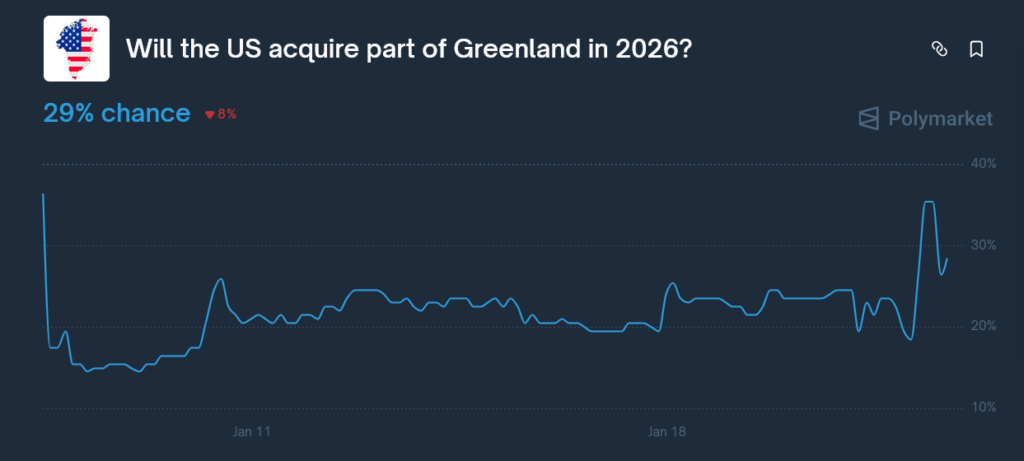
To understand the price action, you must understand the leverage. On Saturday, the White House announced a 10% to 25% tariff on eight specific NATO allies, including Denmark, the UK, Germany, and France, set to take effect on February 1, 2026, unless a “security arrangement” regarding Greenland is reached.
This shifts the dynamic from a “transaction” to “negotiation under duress.” The US argument frames Greenland not as a real estate deal, but as a national security necessity to counter adversaries in the Arctic.
When Danish Prime Minister Mette Frederiksen stated, “Europe won’t be blackmailed,” odds initially dipped.
However, reports that UK Prime Minister Sir Keir Starmer and NATO Secretary-General Mark Rutte have opened back-channel dialogues have kept the “Yes” hopes alive.
The Fine Print: What “Acquire” Actually Means
To trade this market successfully, ignore the “Purchase” headlines and focus on the Resolution Criteria. The contract does not require Denmark to sell the entire island. It resolves to “Yes” if:
Transfer of Sovereignty: A piece of land (e.g., a peninsula or island) is formally incorporated as US territory.
Exclusive Jurisdiction: A “Guantánamo-style” arrangement where the US gains primary control over a defined zone, and Danish/Greenlandic laws no longer apply without US permission.
Critical Note: Standard leases (like the existing Thule Air Base agreement) do not count unless they include the specific “exclusive jurisdiction” clause that supersedes Danish law.
Geopolitical Roadblocks: The “No” Case
Despite the economic pressure of the “Trade Bazooka,” the barriers to a “Yes” are immense:
- The EU Shield: Today’s summit in Brussels is expected to produce a unified “counter-coercion” package, potentially threatening retaliatory tariffs on US tech and agriculture. If the EU holds the line, the US leverage evaporates.
- Local Autonomy: The Greenlandic government (Naalakkersuisut) continues to state, “Greenland is not for sale.” Polls from Nuuk show over 85% opposition to US annexation.
- Time Constraint: The deal must be signed and binding by December 31, 2026. Diplomatic treaties of this magnitude usually take years. The “Yes” side is effectively betting on a “fast-track” security treaty rather than a traditional land sale.
Strategic Trade Analysis
There is a fascinating arbitrage between the “Part of Greenland” market (34%) and the general “US acquires new territory” market (trading lower). Smart money understands the “Guantánamo Clause.”
It is unlikely the US buys the whole of Greenland. It is plausible, however, that to avoid a trade war, Denmark agrees to a “Special Security Zone” (expanding Thule) that technically meets the market’s “Exclusive Jurisdiction” criteria.
- Bullish Case (Bet Yes): You believe the EU will fracture under the tariff threat before February 1, leading Denmark to cut a side deal for a “Security Zone.”
- Bearish Case (Bet No): You believe the EU’s “Trade Bazooka” response today will force the US to pause the February 1 tariffs, pushing negotiations into a long, non-binding diplomatic freeze.
Final Thoughts
The current price of 34 cents reflects the high uncertainty of today’s EU Summit. If the Summit ends with a vague statement, volatility will crush the “Yes” holders as the Feb 1 deadline approaches.
However, if news breaks of a “bilateral framework” between Washington and Copenhagen that bypasses Brussels, expect the odds to flip to 60%+ overnight.
Watch the wires for the phrase “Joint Arctic Jurisdiction”, that is your signal.
