
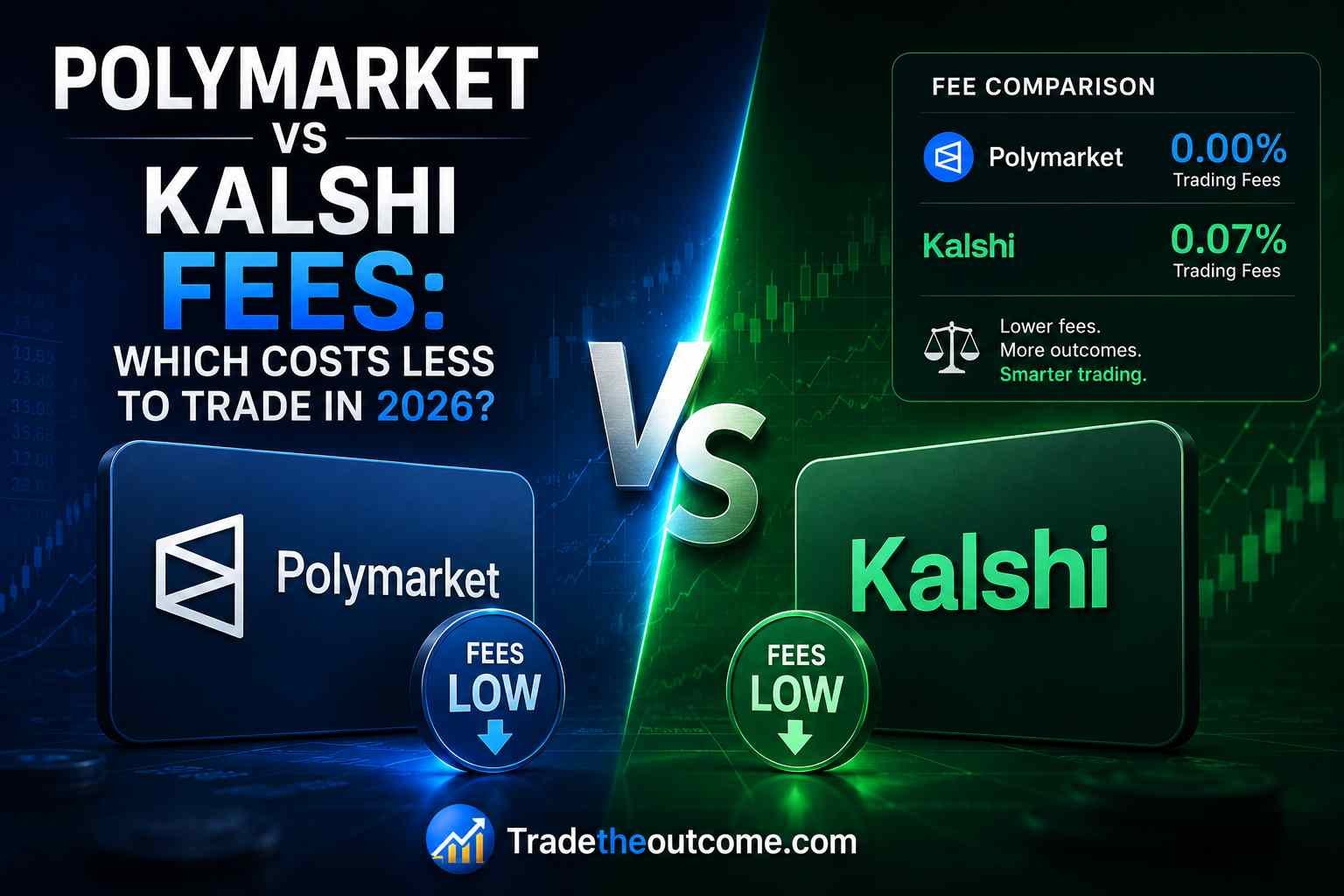
Polymarket is the cheaper platform for most takers on most categories, but Kalshi’s flat-coefficient fee formula is simpler to predict and comes with automatic tax reporting that Polymarket cannot match for US residents.
The honest answer to “which has lower fees” depends less on a single headline number and more on which platform you can legally access, what category you trade, and whether you take or make.
The two platforms charge for trading in fundamentally different ways. Polymarket runs a dynamic taker-fee curve that varies by category and by how close the contract price sits to 50 cents, while Kalshi runs a single transparent formula that scales fees with contract uncertainty.
This article compares the current trading fees on both platforms as of mid 2026, walks through how the formulas actually work with worked examples, and ends with a clear answer for the most common trader profiles.
Key Takeaways
The headline differences in one glance:
- Polymarket international taker fees follow a curve that peaks at 50 cent contracts. Peak rates run from 0% on geopolitics markets up to 1.80% on crypto markets, with most political and tech categories at 1.00%.
- Polymarket US is a separate CFTC-licensed exchange with a flat 0.30% taker fee and a 0.20% maker rebate, regardless of category or price.
- Kalshi taker fees follow a fixed formula of 7 cents times the contract price times one minus the contract price, capped at 1.75 cents per contract at the 50 cent midpoint. Maker fees are 25% of the taker fee.
- Non-trading costs are minor on both. Polymarket has near-zero Polygon gas; Kalshi charges $2 on debit card withdrawals but nothing on ACH transfers.
At a glance: the fee comparison
The cleanest way to see the difference is to look at what each platform actually charges at the three reference price points traders care about most. The table below uses Polymarket’s politics category (peak rate 1.00%) for the international comparison, since politics is the most directly competitive category between the two platforms.
| Cost dimension | Polymarket (international) | Polymarket US | Kalshi |
|---|---|---|---|
| Taker fee at 50 cent contract (politics) | 0.25% of trade value | 0.30% of trade value | 1.75 cents per contract |
| Taker fee at 80 cent contract | 0.16% of trade value | 0.30% of trade value | 1.12 cents per contract |
| Taker fee at 95 cent contract | 0.0475% of trade value | 0.30% of trade value | 0.33 cents per contract |
| Maker fee | Free | 0.20% rebate (paid to maker) | 25% of taker fee |
| Deposit fee | Free (USDC on Polygon) | Free (ACH) | Free (ACH); 2% for debit card |
| Withdrawal fee | Free on platform; gas under one cent | Free (ACH) | Free (ACH); $2 for debit card |
| Settlement fee on winnings | None | None | None |
| Tax reporting | Self-reported; no 1099 | 1099-MISC at year-end | 1099 at year-end (Section 1256 treatment) |
The single biggest takeaway from the table is that Kalshi’s fee at the 50 cent midpoint is materially higher than Polymarket’s politics rate at the same price. The relative position changes at the extremes, where Polymarket’s curve tapers more aggressively toward zero.
How Polymarket charges trading fees
Polymarket operates two distinct platforms with different fee structures depending on where the trader is located. The international platform runs the dynamic taker-fee model that has been in place since the 2024 fee overhaul.
The US platform, launched after Polymarket acquired the CFTC-licensed QCEX exchange in late 2025, runs a separate flat-rate model. Both are described in detail in our standalone guide to the full Polymarket fee structure.
On the international platform, taker fees follow the formula: fee equals number of shares times category rate times price times one minus price. The curve peaks at 50 cents and tapers to near zero at the extremes.
Category rates as of 2026 run from 0% on geopolitics markets up to 1.80% on crypto markets, with politics, tech, and finance at 1.00% and sports at 0.75%. Maker orders never pay fees on the international platform, as confirmed in Polymarket’s official trading-fees explainer.
The Polymarket US structure
The US platform charges a flat 0.30% taker fee on every trade and pays makers a 0.20% rebate, regardless of category or contract price. The trade-off is regulatory clarity rather than fee level. US traders get a CFTC-registered exchange, 1099 tax reporting, and standard brokerage-style funding, but they pay the flat fee even at extreme probabilities where the international curve would round to almost nothing.
The intermediated model that makes this possible is covered in our breakdown of how Polymarket re-entered the US market.
How Kalshi charges trading fees
Kalshi uses a single formula that has been stable since the exchange launched in 2021. The taker fee for any contract is calculated as 7 cents times the contract price (in dollars) times one minus the contract price, then multiplied by the number of contracts.
This produces a parabolic curve that peaks at exactly 1.75 cents per contract when the price sits at 50 cents and falls to fractions of a penny near 1 cent or 99 cents. The full mathematical detail, including the special rates for S&P 500 and Nasdaq-100 markets, sits in Kalshi’s official fee schedule.
Maker fees on Kalshi are exactly 25% of the taker fee at the same price. A trader who places a limit order at 50 cents that fills later pays 0.44 cents per contract instead of the 1.75 cents a taker would pay.
Kalshi’s non-trading costs
ACH deposits and withdrawals are free, and there is no membership fee, no account maintenance fee, and no settlement fee on winning contracts. Debit card deposits carry a 2% processing fee, and debit card withdrawals add a flat $2 charge on top.
The S&P 500 and Nasdaq-100 markets run a discounted formula (3.5 cents instead of 7 cents in the coefficient), which makes them roughly half-price compared to the general fee schedule.
Where the two platforms diverge on cost
The numerical comparison hides three structural differences that matter more than the headline rate for most traders. The first is category coverage.
Polymarket’s 0% geopolitics rate means trades on Iran, Russia, and election-adjacent foreign-policy markets cost nothing on the platform side, which is a meaningful advantage if those are the markets you care about. Kalshi applies its standard formula to all markets, with no zero-fee category.
The second difference is how each platform treats high-probability contracts. Both formulas reduce fees as the contract price approaches the extremes.
Polymarket’s curve tapers more aggressively in absolute terms because the category rate stacks multiplicatively with the price curve. A 95 cent political contract on Polymarket international costs roughly a tenth of what the same trade would cost at the 50 cent midpoint, while Kalshi’s shift cuts the fee to about a fifth of the midpoint cost.
The third difference is tax treatment, which is technically not a platform fee but functions like one for US residents. Kalshi automatically issues a 1099 at year-end, and event contracts settle under Section 1256 treatment with a 60/40 blended capital-gains rate regardless of holding period.
Polymarket’s international platform issues no 1099 and requires the trader to reconstruct trading history from on-chain transactions for tax filing. Polymarket US issues a 1099-MISC, which is simpler than the international platform but less favorable than Kalshi’s Section 1256 treatment.
When to choose which for lower costs
The verdict shifts depending on the trader’s profile and jurisdiction. The simplest decision framework looks at three questions: where you trade, what categories you trade, and whether you take or make.
- Outside the US, trading geopolitics or sports: Polymarket international wins decisively. Geopolitics is free; sports peaks at 0.75% at 50 cents and tapers from there.
- Outside the US, trading politics at high frequency as a market maker: Polymarket international wins because maker orders are free, while Kalshi makers pay 25% of the taker fee.
- Inside the US, trading occasionally with simple tax filing: Kalshi is the lower-friction choice. The 1.75 cent peak fee is dollar-cheap on small trades, and the Section 1256 tax treatment is the most favorable of the three options.
- Inside the US, trading frequently at high volumes: The choice flips to Polymarket US, where the 0.30% taker fee and 0.20% maker rebate become structurally cheaper than Kalshi’s per-contract formula on most positions above a few hundred contracts.
- Trading near the extremes (above 95 cents or below 5 cents): Polymarket international’s curve gives the largest fee discount, which makes it the natural choice for high-conviction positions.
For a deeper breakdown of how these fee structures affect actual trading returns over time, including the liquidity differences that interact with fees, see our full Polymarket and Kalshi liquidity comparison.
Conclusion
The “which has lower fees” question has a useful but unsatisfying answer: it depends on what you trade, where you trade, and how you trade. Polymarket is structurally cheaper for international takers on most categories and unbeatable on geopolitics, while Kalshi’s simpler formula and favorable US tax treatment make it the right fit for casual US traders who value clarity over absolute cost.
The right next move depends on jurisdiction. US readers comparing the two regulated options should factor in the 1099 and tax differences alongside the headline trading fees, because tax treatment is often the larger long-run cost.
Frequently Asked Questions
The most common follow-up questions readers have about Polymarket and Kalshi fees:
Is Polymarket really free on geopolitics markets in 2026?
Yes. Geopolitics markets on the Polymarket international platform have a 0% peak taker fee as of mid 2026, which means trades on these markets cost nothing on the platform side beyond the negligible Polygon network gas fee. The 0% rate is set by category and can change at Polymarket’s discretion.
Why is Kalshi’s fee at 50 cents higher than Polymarket’s?
Kalshi applies a single fee coefficient (7 cents in the formula) across nearly all categories, while Polymarket runs separate category rates that for most politics and tech markets sit at 1.00% peak. At the 50 cent midpoint this puts Kalshi’s per-contract fee structurally higher than Polymarket’s effective taker fee on equivalent markets. The gap narrows at extreme prices, where both formulas reduce fees as contracts approach 1 cent or 99 cents.
Do maker rebates make Polymarket US cheaper than Kalshi for limit-order traders?
For most active traders, yes. The 0.20% maker rebate on Polymarket US is direct cash back into the account on every filled limit order, while Kalshi’s maker fee is a charge. Over hundreds of round-trip trades the rebate compounds into a meaningful difference.
Are there hidden fees on either platform?
Neither platform charges account fees, settlement fees, or position-holding fees. The non-trading costs to watch for are payment-processor fees on debit card deposits and withdrawals on Kalshi, and third-party fiat-ramp fees on Polymarket international if a trader uses MoonPay or similar to convert fiat to USDC.
