

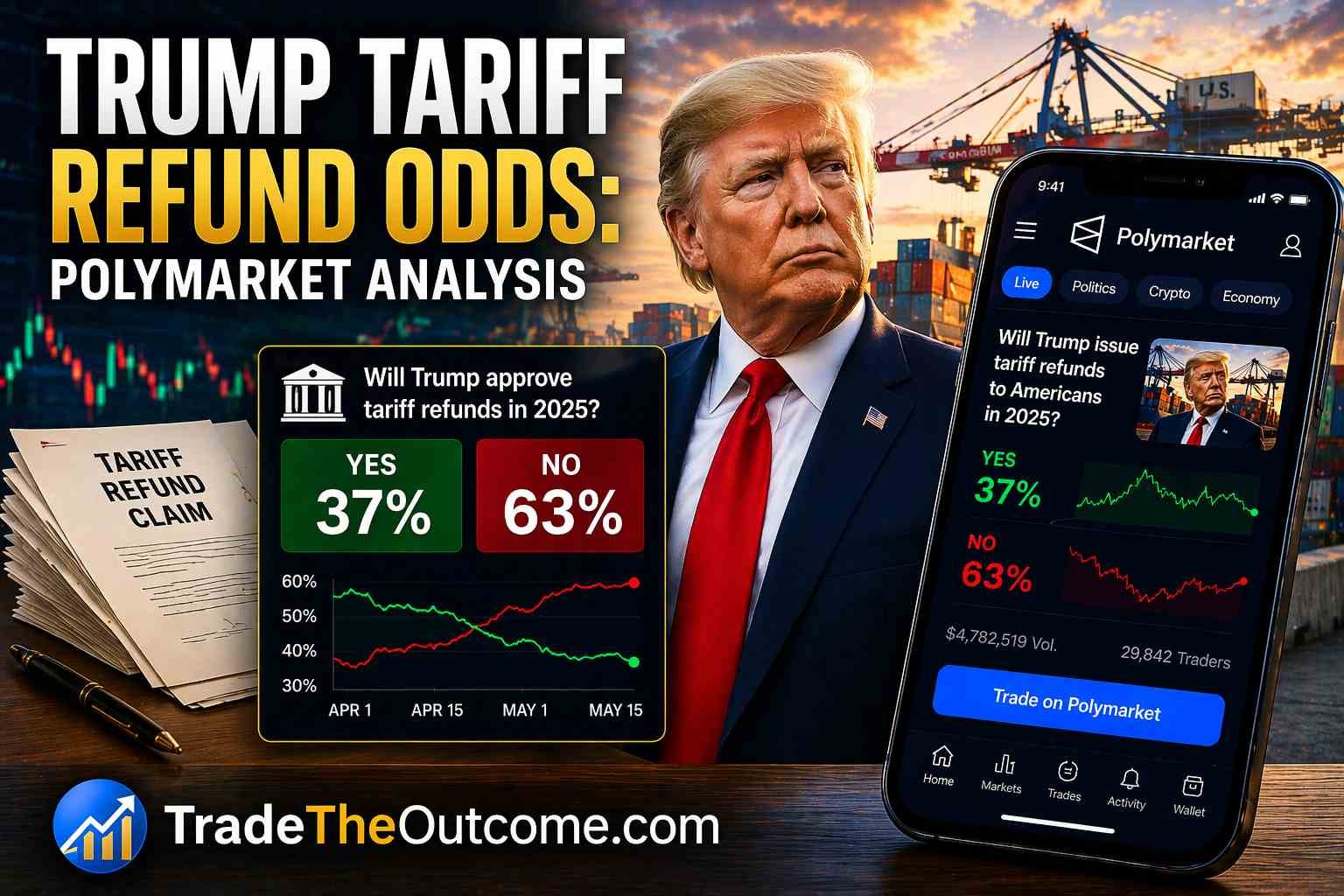
A prediction market contract tracking whether U.S. courts will force the Trump administration to refund over $130 billion in tariffs is now pricing a 64% chance of Yes by June 30, 2026. The road to that number has been anything but straight, and if you hold a position in this market, understanding the legal chain of events is critical before the deadline hits.
Will the Court Force Trump to Refund Tariffs?
This Polymarket event tracks whether U.S. courts will require tariff refunds. Traders are pricing legal uncertainty, precedent risk, and political dynamics, reflecting how likely a court ruling could overturn or modify existing tariff policies.
Disclosure: This link may be an affiliate link. I may earn a commission at no extra cost to you.
What This Polymarket Market Is Actually Asking
The contract on Polymarket asks one specific question: Will the courts force the Trump administration to actually pay refunds to importers for tariffs that were already ruled illegal, and will those refunds be issued before June 30, 2026?
This is not simply a question about whether the tariffs were illegal. That question was already answered. The Supreme Court ruled 6 to 3 on February 20, 2026 that Trump’s use of the International Emergency Economic Powers Act (IEEPA) to impose tariffs exceeded his authority. IEEPA is a 1977 law that allows a president to act during a declared national emergency. The Court found that tariffs are a Congressional power, not a presidential one.
How the Market Resolves
For this contract to resolve Yes, two things must happen before June 30, 2026:
- The Trump administration’s appeal in V.O.S. Selections, Inc. v. United States must be denied, in whole or in part.
- U.S. importers must actually receive refunds of at least some of the tariffs invalidated by the May 28, 2025 ruling.
If the appeal succeeds, or if refunds are blocked or delayed past the deadline, the market resolves No. The current price of 64% Yes means the market crowd sees roughly a 2 in 3 chance that both events happen within the deadline.
The Full Legal Timeline: How Odds Have Swung
This market has gone through several violent repricing events since it opened. Here is the key timeline based on verified court actions.
Early 2026: Oral Arguments Create Uncertainty
During Supreme Court oral arguments in early 2026, Justice Jackson warned that the constitutional complexity of the case could prolong any resolution significantly. Odds on this specific refund contract dropped sharply to 28% from a high of 39%, as traders priced in the risk of procedural delays eating up the June 30 deadline.
February 20, 2026: The Ruling That Changed Everything
The Supreme Court issued its decision in Learning Resources, Inc. v. Trump, striking down all IEEPA-based tariffs in a 6 to 3 ruling. Chief Justice Roberts, writing for the majority, held that Trump’s interpretation of IEEPA would improperly expand presidential control over tariff policy and violate the “major questions” doctrine, which requires explicit Congressional authorization for sweeping economic actions.
The ruling invalidated all IEEPA tariff programs including the February 2025 “fentanyl” tariffs and the April 2025 “Liberation Day” global and reciprocal tariffs. According to the Penn Wharton Budget Model, potential refunds from reversing these tariffs could reach up to $175 billion. Despite this legal win for importers, market odds on the refund contract briefly crashed again to 19% to 28%, because the Supreme Court ruling was silent on the mechanics of repayment and the June 30 clock was still ticking.
March 2026: The Refund Battle Begins
On March 2, 2026, the U.S. Court of Appeals for the Federal Circuit denied the government’s attempt to delay proceedings and remanded the case to the Court of International Trade (CIT). On March 4, Judge Richard Eaton of the CIT ruled that “all importers of record” are entitled to refunds for the unconstitutional tariffs, effectively covering thousands of businesses without requiring each one to file a separate lawsuit. This single ruling sent market odds climbing back toward the 60s.
On March 27, 2026, the CIT issued an additional amendment to its order, further broadening and clarifying the refund eligibility for all importers who paid IEEPA duties while the tariffs were in effect.
April 2026: The CAPE System Goes Live
On April 10, 2026, U.S. Customs and Border Protection (CBP) confirmed that Phase 1 of the CAPE refund portal would launch on April 20, 2026. CAPE (Consolidated Administration and Processing of Entries) is an automated self-service system inside CBP’s ACE platform where importers can file declarations to receive their refunds electronically. CBP estimates refunds will generally be issued within 60 to 90 days of accepting a CAPE Declaration. A trade court judge also confirmed in mid-April that tariff refunds could start processing as soon as the following week, though attorneys noted the Trump administration could still file an appeal.
What 64% Yes Actually Implies
A 64% implied probability means the market crowd currently sees this as a more likely than not outcome, but not a near-certainty. The 36% No side is not negligible. It prices in the following real risks:
- Appeal risk: According to Skadden attorneys, the government’s deadline to appeal the CIT’s order runs through early May 2026. If the Trump administration files an appeal, it could trigger a stay of Judge Eaton’s order and freeze the CAPE refund process entirely.
- Processing speed risk: CBP estimates refunds will take 60 to 90 days after a CAPE Declaration is accepted. Phase 1 launches April 20. That gives a very tight window to process any refunds before June 30.
- Scope risk: Phase 1 of CAPE is estimated to cover approximately 63% of eligible entries. Entries outside that scope may not receive refunds in time for the market deadline.
- Definition risk: The market requires that refunds actually reach importers, not just that the process opens. A technical or administrative delay could result in a No resolution even if the legal pathway is clear.
At the same time, the 64% Yes side reflects a powerful legal foundation. Courts at every level have ruled in favour of refunds. The CAPE system has a confirmed launch date. The Federal Circuit already rejected a government attempt at delay. These are not minor signals.
How Traders Might Think About This Market
The Case for Buying Yes
The legal pathway to refunds is now operational. The Supreme Court ruled, the CIT ordered refunds, the Federal Circuit denied a stay, and CBP confirmed the CAPE portal launches April 20. If refunds begin flowing before June 30, this market resolves Yes with 100 payout. A trader might consider that the infrastructure is now largely in place and the main risk is administrative rather than legal.
The Case for Buying No
The Trump administration has not yet formally accepted the refund obligation without resistance. President Trump himself has warned that the process could involve years of litigation. If an appeal is filed before early May and a stay is granted, refunds could be frozen past the June 30 deadline. A trader might consider that the 60 to 90 day processing window, combined with an April 20 launch and a June 30 deadline, leaves very little margin for any delay.
The Case for Staying Out
This market is highly binary with a hard deadline. The outcome depends on administrative speed and potential legal manoeuvres that are difficult to predict with confidence. A trader who is uncertain about the appeal timeline or the actual processing speed of the CAPE system might consider staying on the sidelines rather than taking a position based on incomplete information.
Practical Advice for Beginner Traders
If you are new to prediction markets, here are the key principles to apply before entering this contract:
- Read the resolution rules carefully. This market requires actual refunds to be issued, not just ordered. Check the full rules on the Polymarket market page.
- Size your position accordingly. A 64% market is not a sure thing. A 36% No probability means more than 1 in 3 outcomes go against Yes. Never put in money you cannot afford to lose entirely.
- Watch for the appeal deadline. If the Trump administration files an appeal in early May 2026, expect a sharp move in No direction. Track the CIT docket on cit.uscourts.gov for updates.
- Understand deadline risk. Markets that expire on a specific date carry extra risk near expiry. The closer to June 30 without confirmed refunds, the more No shares may rise in price.
- Do not rely on market odds alone. The 64% figure reflects collective trader opinion, not legal certainty. Combine it with the news and legal timeline described above to form your own view.
Where the Market Stands Now?
The “Will the Court Force Trump to Refund Tariffs?” contract on Polymarket currently sits at 64% Yes, with $354,000 in total volume and $29,500 in liquidity. The legal foundation for refunds is strong.
The CAPE portal launched on April 20, 2026. But the June 30 deadline is real, the appeal window is open through early May, and the processing timeline is tight. The market is pricing in genuine execution risk, and that 36% No side deserves serious attention from any trader considering a position here.
