

Here’s the uncomfortable truth about the current federal government shutdown: nearly 1.4 million civilian employees are either furloughed or working without pay, but the Trump administration has quietly signaled it may not honor the legal guarantee of back pay that’s been routine for over 50 years.
This creates a fascinating prediction market on Polymarket that asks a seemingly simple question with surprisingly complex legal and political implications: Will federal workers actually get paid for this shutdown?
Let me walk you through why this market matters, what the law actually says, and why traders should be paying close attention to a $0 volume market that could explode once the shutdown finally ends.
The Market Setup: What Actually Triggers a YES
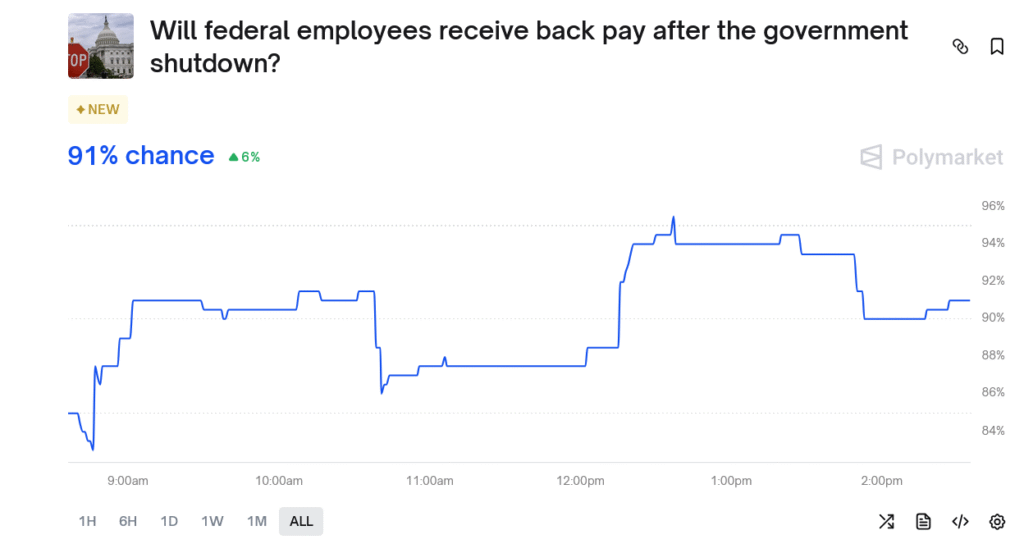
The Polymarket rules are precise: within 45 days of the shutdown ending, the federal government must begin implementing a policy where both furloughed AND excepted employees receive full back pay for the entire shutdown period.
This is stricter than it sounds. If only furloughed workers get paid (and not those who worked without pay), the market resolves NO. If Congress passes a bill, but implementation drags past 45 days, the market resolves NO. If partial pay happens but not full retroactive compensation, the market resolves NO.
The clock starts the day after the Office of Personnel Management (OPM) officially announces the shutdown has ended.
Current Shutdown Status
As of November 8, 2025, the federal government shutdown has lasted 39 days, making it the longest shutdown in US history. The previous record was 35 days during the 2018-2019 shutdown.
Here’s what that means in human terms:
| Impact Metric | Numbers |
|---|---|
| Furloughed federal employees | 670,000 to 900,000 |
| Excepted employees (working without pay) | 700,000 to 730,000 |
| Total affected civilian workforce | ~1.4 million |
| Military personnel potentially unpaid | ~1.3 million active duty |
| Estimated withheld wages (if through Dec 1) | $21 billion |
| Missed paychecks (if through Dec 1) | 4.5 million |
Source: Bipartisan Policy Center
The Senate rejected a pay restoration bill on November 7 by a vote of 53-43, falling short of the 60 votes needed to overcome a filibuster. Democrats opposed the bill because it gave Trump authority to selectively pay certain workers while denying pay to others.
The Legal Framework: What Does the Law Actually Say?
This is where things get interesting. In January 2019, President Trump himself signed into law the Government Employee Fair Treatment Act of 2019, codified at 31 U.S.C. 1341(c)(2). The law states explicitly:
“Each employee of the United States Government… furloughed as a result of a covered lapse in appropriations shall be paid for the period of the lapse in appropriations, and each excepted employee who is required to perform work during a covered lapse in appropriations shall be paid for such work, at the employee’s standard rate of pay, at the earliest date possible after the lapse in appropriations ends.”
The language is clear: all federal employees affected by any future shutdown must receive back pay. This isn’t discretionary. It’s not subject to presidential waiver. It’s the law.
Historical Precedent: Always Paid, Until Now?
Every single government shutdown since 1976 has resulted in federal employees receiving back pay, typically within 2-3 weeks of the government reopening:
| Shutdown | Duration | Back Pay? | Time to Payment |
|---|---|---|---|
| 2018–2019 | 35 days | YES (all employees) | Within 2 weeks |
| 2013 | 16 days | YES (all employees) | Within 2–3 weeks |
| 1995–1996 | 21 days | YES (all employees) | Within 2–3 weeks |
| 1995 | 5 days | YES (all employees) | Within 2 weeks |
Before 2019, Congress had to pass specific legislation for each shutdown to authorize back pay. The 2019 law was intended to make this automatic, removing political uncertainty for federal workers.
The Trump Administration’s Position
Here’s where prediction market traders need to pay attention. Despite signing the 2019 law himself, the Trump administration has taken an unprecedented stance: the law doesn’t apply, and new Congressional legislation is required.
The timeline of this reversal is striking:
October 1, 2025: Government shutdown begins
October 8, 2025: IRS sends contradictory messages about whether back pay is guaranteed, then deletes emails promising payment
October 24-30, 2025: Federal agencies send renewed furlough notices that delete all language about guaranteed back pay
October 27, 2025: Office of Management and Budget removes references to the 2019 law from official guidance
November 4, 2025: In federal court, a Justice Department lawyer confirms the government will owe back pay, contradicting White House messaging
This creates genuine legal uncertainty. On one hand, the law is explicit. On the other hand, the executive branch is signaling non-compliance.
Congressional and Union Response
Both Democrats and Republicans in Congress have rejected the administration’s legal theory. The National Treasury Employees Union (NTEU) issued a statement on November 2:
“The law is clear that federal employees receive all back pay that was missed over the course of a shutdown, and NTEU intends to make sure that law is enforced.”
Legal experts have uniformly agreed that the plain language of the 2019 law applies to all future shutdowns without requiring new legislation. The Trump administration’s own guidance when the law was signed in 2019 stated it applied “in perpetuity.”
Yet political gridlock remains. The Senate can’t pass a bill ensuring payment because Democrats oppose giving Trump selective authority over who gets paid, while Republicans won’t pass a clean back pay guarantee without broader shutdown resolution.
Market Resolution Scenarios
Let me break down the realistic pathways to YES or NO:
Scenario 1: Congress Passes Specific Back Pay Bill (60-70% probability)
The most likely path is that when the shutdown eventually ends, Congress passes emergency legislation specifically authorizing back pay for all affected workers. This has happened in every prior shutdown and would satisfy the market requirements if implementation begins within 45 days.
Risk: Senate filibuster could block or delay the bill.
Scenario 2: Administration Honors 2019 Law Voluntarily (10-15% probability)
Despite current rhetoric, the administration could reverse course and implement back pay under the existing 2019 law. This seems unlikely given the consistent messaging, but political pressure or legal advice could force compliance.
Risk: Administration has shown no willingness to comply voluntarily.
Scenario 3: Federal Courts Force Compliance (5-10% probability)
Unions could sue to enforce the 2019 law, and federal courts could order the government to pay. However, litigation takes time, potentially exceeding the 45-day window.
Risk: Court orders may come too late for the market’s 45-day deadline.
Scenario 4: Administration Refuses and Gets Away With It (5-10% probability)
The nightmare scenario: the shutdown ends, no Congressional bill passes, courts don’t intervene in time, and federal workers simply don’t get paid. This would be unprecedented and legally dubious, but not impossible given current political dynamics.
Scenario 5: Partial Payment Only (market resolves NO)
If only furloughed workers OR only excepted workers receive back pay (but not both), the market resolves NO per the strict requirements.
What Traders Should Watch?
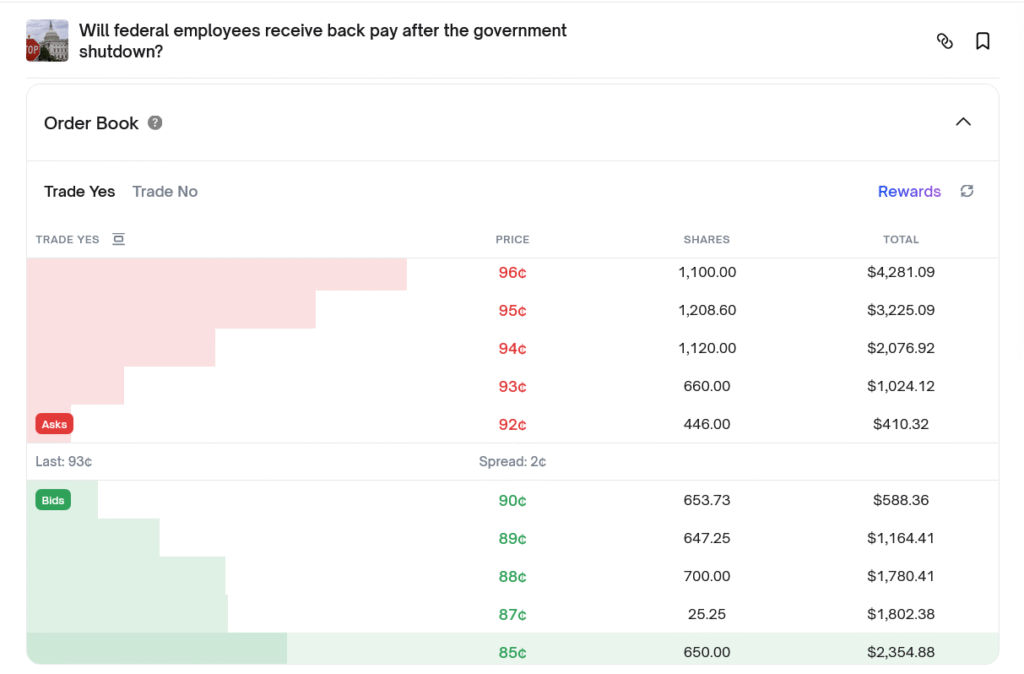
If you’re considering trading this market once volume picks up, here are the key signals:
Immediate signals:
- Any movement toward shutdown resolution in the Senate
- New legal guidance from OPM or OMB
- Federal court rulings on union lawsuits
- Congressional leadership statements about back pay legislation
Timeline considerations:
- The 45-day clock doesn’t start until the shutdown officially ends
- “Begin implementing” doesn’t require actual payment within 45 days, just the policy announcement
- Historical payment has taken 2-3 weeks after reopening
Political dynamics:
- Watch for cracks in Senate Republican unity
- Monitor whether Trump faces pressure from federal worker constituencies
- Track whether military pay becomes a wedge issue
My Assessment: 65-75% Probability of YES
Despite the unprecedented uncertainty, I believe the market should resolve YES for several reasons:
Strong factors supporting YES:
- Legal obligation is explicit: The 2019 law is clear and unambiguous
- Historical precedent is perfect: 100% of shutdowns have resulted in back pay
- Bipartisan Congressional support: Both parties publicly favor payment
- Political pressure: 1.4 million affected workers and their families create enormous constituency pressure
- Court enforcement: If it comes to litigation, the government will almost certainly lose
Factors supporting NO:
- Administration defiance: Unprecedented signals of non-compliance
- Political gridlock: Senate can’t pass bills requiring 60 votes
- Timeline risk: 45-day window could expire if courts or Congress move slowly
The key variable is political will. If the shutdown ends through a bipartisan deal, back pay will almost certainly be included. If it ends through partisan maneuvering or executive action, the situation becomes murkier.
Why This Market Has Zero Volume?
The obvious question: why is a market with such clear stakes and massive real-world impact sitting at $0 volume?
Several reasons:
- The shutdown hasn’t ended yet: traders can’t assess the 45-day window until there’s a resolution date
- Legal uncertainty: the unprecedented nature of the administration’s position creates ambiguity
- Timeline ambiguity: not knowing when the shutdown ends makes it hard to price probabilities
- Low awareness: most Polymarket traders focus on headline political events, not administrative policy
Once the shutdown ends, I expect this market to see explosive volume as traders rush to position based on Congressional and administrative signals.
The Bottom Line
The federal employee back pay market is asking whether the US government will honor a legal obligation it has never before refused. History, law, and political pressure all point toward YES. But the current administration’s unprecedented stance creates real uncertainty.
My probability estimate: 65-75% YES, 25-35% NO.
For traders, the play is to wait until the shutdown resolution is imminent, then assess whether Congressional back pay legislation is part of the deal. If yes, buy heavily. If the shutdown ends without clear payment authorization, the market becomes a genuine coin flip between legal enforcement and administrative defiance.
This isn’t just about prediction markets. It’s about whether 1.4 million federal workers and their families will be made whole after serving their country during a record-breaking shutdown. The answer should be obvious, but in 2025, nothing is certain.
